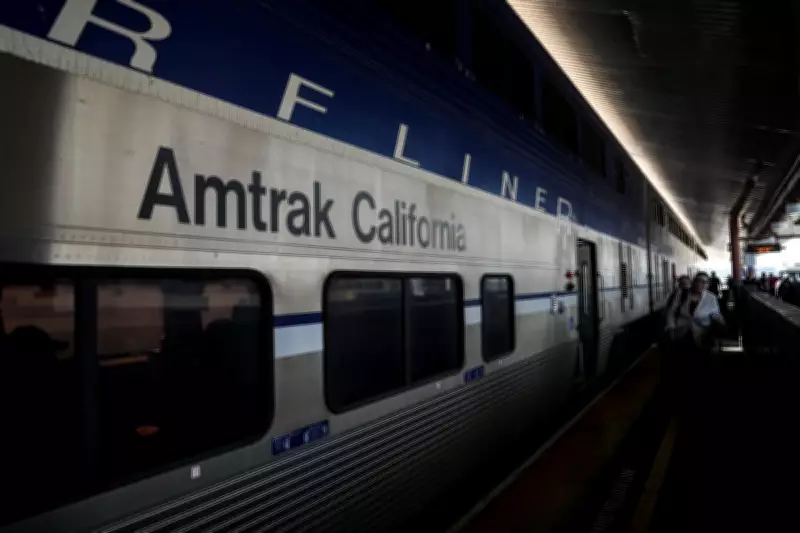
Amtrak is considering allowing passengers to store guns in lockboxes on most of its trains, a move critics argue would weaken security measures that should be strengthened following the shooting at last weekend's White House Correspondents' Association dinner.
Background of the Policy Change
The company has been exploring this policy change since early this year, under pressure from Trump administration officials to ease restrictions on transporting weapons, according to two people familiar with the plan who spoke to The Associated Press on condition of anonymity. They said the railroad has not abandoned the proposal despite Saturday's arrest of a man who allegedly traveled by Amtrak from California to Washington, D.C., with firearms intent on killing President Donald Trump and other officials at the event.
Cole Tomas Allen was arrested after attempting to race past security barricades near the hotel ballroom hosting the dinner, leading to an exchange of gunfire with Secret Service agents. A Secret Service officer wearing a bullet-resistant vest was shot but survived. Authorities said Allen carried a shotgun and semiautomatic pistol on the train from his home in Torrance, California. Amtrak declined to say if he followed existing rules, which require declaring firearms and allowing the railroad to lock them with checked bags. Allen's lawyer stated he has no criminal record and is presumed innocent.

Proposed Changes and Criticisms
Under the proposed rule, Amtrak would add lockboxes to its trains, allowing passengers nationwide to bring guns aboard, rather than only on trains with locked baggage cars. This would open up over 1,500 trains daily, including routes in the Northeast Corridor used by roughly 750,000 passengers each day, compared to the current rule limiting guns to a couple dozen long-distance trains.
John Feinblatt, president of Everytown for Gun Safety, criticized the move, stating: "Just days after a man took an Amtrak train to Washington with a shotgun and pistol and tried to assassinate the president, the Trump Administration is trying to open the floodgates for firearms on every Amtrak route. This will only make Americans less safe, and Congress must step in before the next tragedy."
Amtrak and the Transportation Department did not immediately respond to questions about the policy.
Details of the Proposed Rule
Currently, Amtrak requires passengers to declare firearms and secure them unloaded in a hard case, meeting size and weight requirements, only in checked baggage—similar to airline policies. The proposed change would still require guns to be locked aboard trains, with only the conductor holding the key. However, it is unclear how Amtrak would verify legal gun ownership or comply with local laws, which vary widely, from strict restrictions in New York City to looser regulations elsewhere.
Despite current policies, some passengers may already carry guns onboard. Unlike airports, train stations do not screen passengers or luggage, and Amtrak does not run passenger names through criminal databases. This is true at busy terminals like Washington's Union Station and unstaffed rural stations where passengers board without immediate conductor contact.
Expert Opinions
Security expert Sheldon Jacobson, whose research contributed to the TSA PreCheck system, said railroads should collect more passenger information and check backgrounds when selling tickets. However, he noted it is impossible to eliminate guns on trains without enforcement. "The initial condition is that there are almost 400 million guns in this country," he said. "Work from there rather than trying to create a utopian environment."
Jacobson argued that rail travel poses fewer risks than air travel, making it not worth the investment for strict screening systems like those at airports. But he acknowledged that calculation could change if a major tragedy occurred on a passenger train. "You have to weigh risks and rewards and decide where to put money for the greatest risk reduction with the least inconvenience," he added.

Union Concerns and Legislative Efforts
Unions have fought for stronger protections for rail workers for nearly a decade, following incidents like the 2017 shooting of a conductor by an enraged passenger in Naperville, Illinois. Two bills in Congress would give rail workers protections similar to airline crews, making it a federal crime to interfere with or assault a rail worker. Unions have also had success with state-level laws.
After 9/11, Amtrak and other ground transportation companies barred weapons on trains and buses, but none implemented measures to detect or screen every passenger for firearms. In 2010, Congress passed a law requiring Amtrak and other companies to allow firearms transport as long as they are checked.