

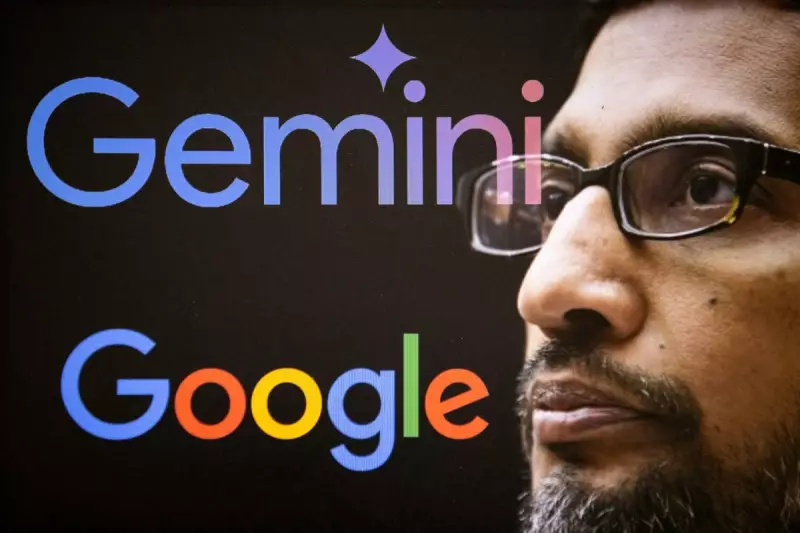
The race for artificial intelligence supremacy may already be decided, with Google leveraging its decades-long dominance of internet search to gain an insurmountable lead, a leading tech executive has warned.
The 'Insane' Leap of Gemini 3
When Google launched its Gemini 3 AI model in November 2025, the response from industry leaders was immediate and stunned. Marc Benioff, CEO of Salesforce, declared after just two hours of use that he was abandoning his three-year daily habit with ChatGPT, calling Gemini's leap in "reasoning, speed, images, video… everything" as "insane".
The model achieved a record score on the challenging 'Humanity’s Last Exam' benchmark and outperformed rivals in 19 out of 20 industry standard tests. This prompted AI pioneer Geoffrey Hinton to state Google was "beginning to overtake" ChatGPT and would likely win the broader competition.

The 'Radically Unfair' Data Advantage
According to Matthew Prince, CEO of the cybersecurity firm Cloudflare, Google's sudden leap is not down to superior chips or smarter researchers. Instead, it stems from a "massive structural advantage" in data access.
Cloudflare, which protects over 20% of the world's websites, provided exclusive figures showing the scale of Google's edge. Its AI training bots, which use the same privileged access as its search crawlers, see 322% more of the web than OpenAI's crawlers. The advantage is even greater against other rivals: 478% more than Meta, 484% more than Anthropic, and 437% more than Microsoft.
"If you believe that whoever has access to the most data will win, then Google will always have an advantage in the market, which no one will be able to overcome," Prince told The Independent. "That seems pathologically unfair."
He argues that as the internet shifts from traditional search to AI-powered answers, Google is exploiting its position as the "middle-man of the internet" to train its models on a dataset no competitor can match.
Call for Regulatory Intervention in the UK
Prince is now urging the UK's Competition and Markets Authority (CMA) to impose new rules to level the playing field. In October 2025, the CMA designated Google Search with Strategic Market Status under the UK's new digital markets regime, giving it powers to enforce stricter conduct.
The Cloudflare CEO's primary proposal is to force Google to split its AI crawlers from its search crawlers. This would mean its AI division, like all its competitors, would have to start gathering training data from scratch without leveraging its search monopoly.
"Google is refusing to play by fair rules," Prince said. "And that's the sort of place where it's right for competition authorities to step in and say, 'this is a failure in the market. You can't leverage your monopoly from search in order to gain a monopoly in AI'."
Google has defended its practices, stating that "unduly onerous regulations" would stifle innovation. It also points to tools like Google-Extended, which allows website owners to opt-out of AI training data collection—though this remains an opt-out system rather than opt-in.
Despite Gemini 3's current user base of roughly 650 million—still behind ChatGPT's 800 million—its integration into products like Search, Gmail, and Android gives it a potential reach of billions. Prince warns that without regulatory action, the AI race may effectively be over, allowing Google to establish a monopoly in AI as it did in search.






