

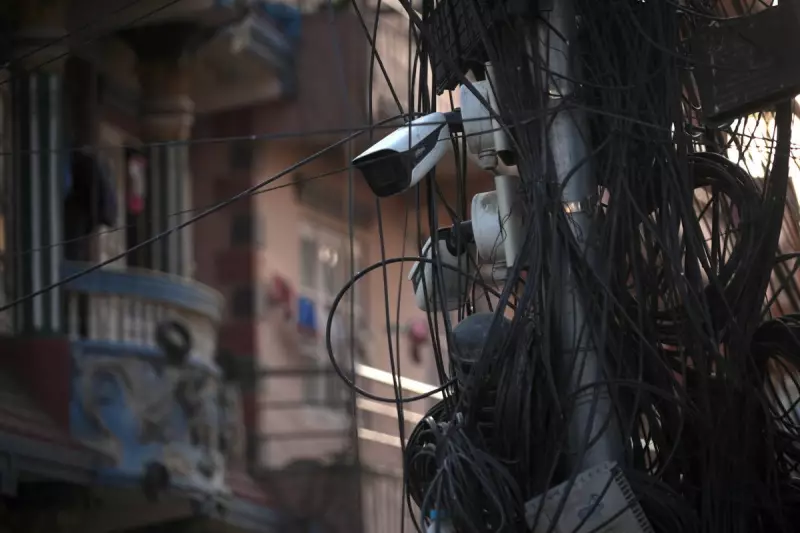
Beneath the serene, all-seeing eyes of the Buddha painted on the great Boudhanath stupa in Kathmandu, a more intrusive form of observation now dominates. Tibetan refugees, who for decades found sanctuary in Nepal, are living under the constant gaze of a sprawling network of Chinese-made surveillance cameras.
The American Blueprint for Digital Authoritarianism
An investigation by The Associated Press has uncovered a profound irony: the sophisticated surveillance tools China exports to over 150 countries, including Nepal, are fundamentally built on technology originating from its chief rival, the United States. For years, Silicon Valley firms, eager to access China's vast market, often acquiesced to demands to share their know-how, despite warnings about intellectual property theft.
This technology transfer has enabled Chinese companies to evolve from clients to fierce global competitors. Today, firms like Hikvision and Dahua—both on a U.S. Commerce Department watchlist—supply much of the surveillance infrastructure worldwide. They continue to utilise services like Amazon Web Services (AWS) for their overseas cloud operations, a practice that remains legal under current U.S. regulations.

AWS states it adheres to ethical conduct and U.S. law, while Hikvision and Dahua assert they conduct due diligence to prevent misuse of their products. However, the result is a potent export: cost-effective, AI-powered policing tools that amplify state control.
Nepal's Transformation into a Panopticon
Nepal presents a stark case study. Once a vital escape route, the country has dramatically tightened under Chinese influence and technological infusion. Tibetan officials report that the number of new refugees arriving annually has plummeted from thousands to single digits, citing "unprecedented surveillance" and warming Nepal-China ties.
The monitoring is pervasive and advanced. In a central Kathmandu command centre near the Chinese embassy, Nepali officers watch a wall of live feeds. The cameras, predominantly from Hikvision, Dahua, and Uniview, are equipped with night vision, facial recognition, and AI tracking software. They can lock onto a single individual in a crowd and store patterns of movement, building a digital memory of life under its watch.
"Now you can only be Tibetan in private," said a 34-year-old Tibetan café owner, speaking anonymously for fear of reprisal. The surveillance intensifies around sensitive dates like March 10, the anniversary of the 1959 Tibetan uprising.
China's support extends beyond hardware. It has donated tens of millions in police aid, built a school for Nepal's Armed Police Force, and trained hundreds of Nepali officers in China. A 2021 internal Nepali government report, seen by AP, indicated China even constructed surveillance systems within Nepal and in border buffer zones where such activity is banned by bilateral agreement.
The Chinese Ministry of Foreign Affairs has denied coercing Western firms or collaborating with Nepal to surveil Tibetans, calling such claims "a sheer fabrication driven by ulterior motives."
Sealing the Border with a 'Great Wall of Steel'
The digital dragnet extends to Nepal's remote northern border with Tibet, historically a porous frontier for refugees. Today, it is fortified by what China terms a "Great Wall of Steel"—a 1,389-kilometer network of fences, sensors, AI-powered drones, and glaring white observation domes.
In the ancient Mustang district, a massive Chinese observation dome looms over Lo Manthang, a city that was once a Tibetan guerrilla base. The dome is a constant, visible reminder of the reach of Chinese authority.
The consequences are severe and personal. Rapke Lama, a Nepali resident, was arrested in Tibet in April 2024 after a WeChat conversation, believing his communications were monitored. He endured months in a Lhasa prison before returning to Nepal gaunt and traumatised in May 2025. "Even now, I'm scared," he said, admitting he wears masks in public due to lingering fear.

For those like former protester Sonam Tashi, now 49, the goal is simply to get his undocumented son out of Nepal. "There are cameras everywhere," Tashi said. "There is no future." The Tibetan population in Nepal has halved, with many fleeing the suffocating atmosphere.
As former Hong Kong lawmaker Charles Mok, now at Stanford, reflected, few initially foresaw that U.S. technology sold to China could be copied and repurposed for global surveillance. That oversight has helped transform China from a tech backwater into the world's leading exporter of surveillance technologies, with Tibetan refugees in Nepal paying a heavy price for a system built, in part, with American components.





