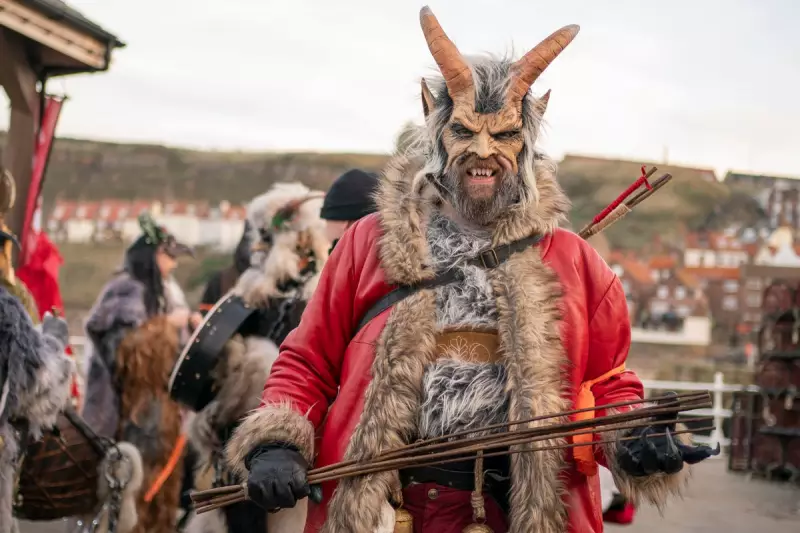
While Britain's Christmas is defined by trees, turkey, and tinsel, a glance around the globe reveals a festive season of astonishing diversity. From devilish parades to poultry-themed fast-food feasts, communities worldwide celebrate with rituals that might seem utterly bizarre to outsiders, yet are deeply cherished locally.
Festive Frights and Faecal Figures
In Germany and Austria, the kindly figure of Father Christmas is shadowed by his terrifying companion, the Krampus. This horned, hairy beast from Alpine folklore punishes naughty children. His night, Krampusnacht on 5 December, is marked by chaotic parades where hundreds don demonic costumes and rampage through streets like Bad Tolz.
Meanwhile, Catalonia offers a uniquely scatological twist. Families adopt a "caga tio" or "defecating log", feeding it nuts and sweets for a fortnight before beating it with sticks on Christmas Eve so it "excretes" its gifts. Nativity scenes here are also incomplete without a "caganer" – a figurine depicted in the act of defecation, now often modelled on celebrities from Donald Trump to footballers.
Roller Skates, Shoe Tossing, and Hidden Brooms
In Caracas, Venezuela, the journey to early-morning church services between 16 and 24 December is conducted on roller skates, with roads specially closed for the purpose. Over in the Czech Republic, unmarried women perform a festive love divination by throwing a shoe over their shoulder. If it lands with the toe pointing towards the door, marriage within the year is predicted.
Norwegians take a more defensive approach. Believing Christmas Eve welcomes witches and evil spirits, families hide all their brooms and mops before bed to prevent them from being stolen and ridden.
Unconventional Feasts and Floral Festivities
Japan's most popular Christmas dinner requires no home cooking. As Christmas is not a national holiday there, many instead queue for KFC fried chicken, with orders often placed a month in advance, making it the chain's most profitable week in Japan.
Greenland's festive table features "mattak" – raw whale skin with blubber. An even more acquired taste is "kiviak," where a small auk bird is wrapped in seal skin, buried for months, and eaten once decomposed.
In India, where Christians make up 2.3% of the population (around 25 million people), the lack of traditional fir trees leads to the decoration of banana and mango trees instead.
Symbolic Spiders, Straw Goats, and Sticky Puddings
Ukrainian trees are adorned with fake spiders and webs for good luck, a tradition stemming from a folktale about a poor woman whose undecorated tree was magically covered in a glittering spiderweb by Christmas morning.
Scandinavia celebrates the Yule goat, once a festive spirit, now a common straw decoration. The town of Gavle erects a giant version, famously often targeted by arsonists. In Slovakia, a unique pudding made from milk, bread, and poppy seeds is thrown at the ceiling by the family elder; the amount that sticks foretells the luck for the coming year.
Finally, in Portugal, the religious celebration includes "consoda" – setting extra places at the table for deceased relatives on Christmas Eve, a practice believed to bring the family good fortune.
These 12 traditions, from the macabre to the humorous, demonstrate that the Christmas spirit is a truly global phenomenon, capable of adapting to and reflecting every culture it touches in the most wonderfully unexpected ways.