Cuban Tourism Industry Faces Catastrophic Collapse Amid Geopolitical Pressures
Tourism in Cuba is experiencing a devastating decline at precisely the moment when the Caribbean nation desperately requires this vital revenue stream. The number of visitors to the island has plummeted by more than half since 2018, creating severe economic hardship for countless Cubans whose livelihoods depend entirely on the sector.
Empty Streets and Desperate Workers in Havana
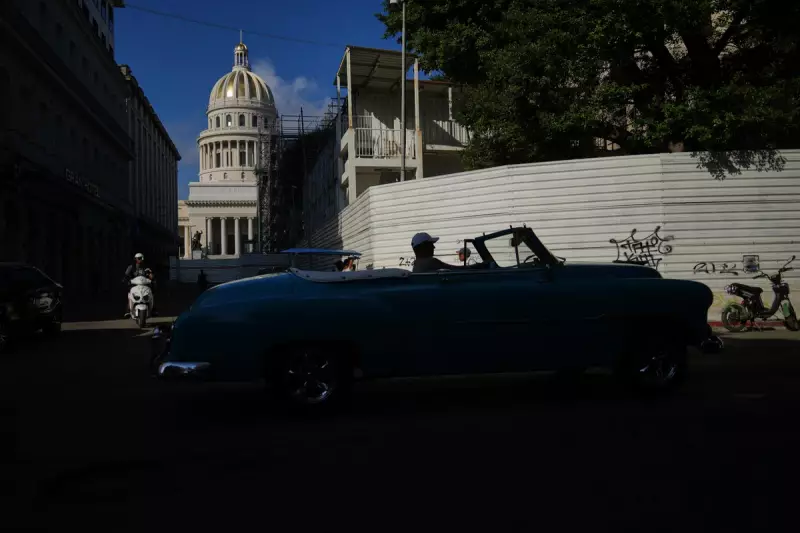
In Havana, the midday scene reveals a troubling reality. A handful of tourists emerge from a small yellow bus, quickly snapping selfies in front of colourful classic cars ranging from 1950s Pontiacs to 1960 Buicks before walking away without engaging the waiting drivers. Under the shade of a beach almond tree, drivers like Reymundo Aldama, who operates a bubblegum pink 1957 convertible Ford Fairlane, stand idle, hoping for their first customer of the day.
"This is grim," Aldama lamented. "We're waiting for them to come, we're waiting for work."

For nearly two decades, a steady stream of international visitors fuelled a tourism boom across Cuba, only for the COVID-19 pandemic and severe blackouts to strike, compounded by increasingly stringent US sanctions. Now, the island braces for what experts warn could become a catastrophic economic crisis following disruptions to crucial oil shipments from Venezuela after US military action against the South American nation.
Personal Struggles Amid Economic Desperation
The situation has become acutely personal for Rosbel Figueredo Ricardo, a thirty-year-old street vendor who sells "chivirico," a popular Cuban snack of fried flour chips sprinkled with sugar. Previously, he would load 150 bags each morning onto a plastic tray balanced on his shoulder, consistently selling out by late afternoon. Today, he prepares only 50 bags daily, working from dawn until nighttime, sometimes failing to sell a single portion.
"I'm a mid-level industrial mechanical technician, and look at me here," Figueredo said with visible frustration. With a partner, three children, and a fourth on the way, he constantly worries about providing for his family. "This is our day-to-day, so we can eat."
On a recent afternoon, unable to locate tourists near Havana's famous seawall, Figueredo walked toward the Spanish embassy, hoping that Cubans queuing for visas to leave the island might purchase his snacks.
A Brutal Decline in Visitor Numbers
For decades, tourism generated up to $3 billion annually for Cuba's economy. Visitors packed restaurants, crowded along Havana's seawall, and gathered at imposing monuments and state buildings. This constant flow of passengers boosted employment significantly and led to the establishment of hundreds of small businesses including hostels and private restaurants.
Today, the seawall is dotted mostly with Cuban couples or fishermen hoping to catch their next meal. Nearby, tablecloths at empty seaside restaurants flutter in the wind while employees clutch menus, scanning the horizon for customers who never arrive.
Official statistics reveal that approximately 2.3 million tourists visited Cuba from January to November 2025, significantly lower than the 4.8 million recorded in 2018 and the 4.2 million in 2019, before the pandemic struck. Many Cubans worry that growing tensions between the US and Cuba, combined with cuts in water and power supply and accumulating garbage in popular tourist areas, have deterred potential visitors.
Sanctions and Economic Consequences
The dramatic tourism decline hits especially hard because US sanctions stripped Cuba of nearly $8 billion in revenue from March 2024 to February 2025, representing a loss nearly 50% higher than the previous period according to government statistics.
Gaspar Biart, who has driven double-decker tourism buses for sixteen years, recently experienced an afternoon where only three people boarded his vehicle. "There's been a huge change," he observed, noting that sanctions imposed during Donald Trump's presidency have effectively closed Cuba's doors to many visitors. "We can't even breathe."

When tourism was booming and petroleum flowed freely, eight double-decker sightseeing buses would make three daily trips across Havana. Now, only four operate, and most depart largely empty. "What we're missing are customers," Biart stated plainly. "That's what all Cubans want... Tourism is a driving force for a country's economy."
Classic Car Drivers Face Bleak Prospects
Long queues once formed near rows of classic cars awaiting passengers in Havana. Demand was so high that tourists sometimes had to accept whatever vehicle was available rather than their preferred make and model. Aldama, the classic car driver, recalled working until 9 p.m. during peak periods. Nowadays, he considers himself fortunate to transport one or two tourists for a spin in an entire day.
He attributes much of the decline to Trump's June 2019 ban on cruise ships visiting Cuba, previously one of the most popular travel methods to the island. This policy led to what Aldama describes as "a brutal drop" in tourist numbers that has worsened considerably over the past six months.
Aldama previously charged $50 for drives around the capital but has reduced his price to $25, sometimes accepting just $20 when tourists insist on bartering. "The day that we run out of fuel, we'll stop driving and look for another job," he said resignedly. "There's no other choice."
International Perspectives on Cuba's Crisis
On a recent sunny afternoon, Russian visitor Vincent Seigi relaxed on a wooden bench facing the deep blue sea and Cuba's imposing Morro Castle, built during the colonial era. He had been in Cuba for just two days, accompanied by two friends as they scraped white fleshy meat from several coconuts.
"I expected it to be a little bit chaotic, not so maybe tourist friendly because of the complicated economic situation," Seigi remarked. "It's kind of like time is a bit stopped here."
While not particularly concerned about chronic blackouts or accumulating garbage, Seigi found the lack of mobile connectivity unusual. He expressed worry that similar circumstances might soon develop in Russia. "Politics is not great, to say it lightly," he commented. "We have many sanctions already because of political craziness."
With Venezuela, Cuba's strongest political and economic ally currently unavailable, questions arise about whether China or Russia might intervene. "I think our country now is only able to provide rhetorical help," Seigi suggested, such as issuing statements criticising US policy toward Cuba. He added that he doubts Russia possesses sufficient resources to offer substantial assistance while simultaneously struggling in its conflict with Ukraine.
Seigi observed that some Cubans appeared desperate to earn money from tourists, with individuals selling expensive cigars while claiming they originated from a festival sponsored by former President Raúl Castro. "So many poor people, sadly," he noted.
Resilience Amid Adversity
Meanwhile, Brazilian tourist Gloraci Passos de Carvalho, a teacher, expressed long-standing curiosity about Cuba's political and educational systems, remaining undeterred by the island's deepening crisis or ongoing tensions with the United States.
She described being struck by Cuba's welcoming atmosphere, distinctive architecture, and above all, its remarkable resilience. "It's a lesson for people, to survive with less," Carvalho reflected. "In Brazil we call it making lemonade out of lemons... So I see it in that sense, I see it in a positive light."
As Cuba's tourism industry continues its precipitous decline, the human impact becomes increasingly visible across Havana and beyond, with workers and business owners adapting to dramatically reduced circumstances while hoping for geopolitical changes that might revive their economic prospects.