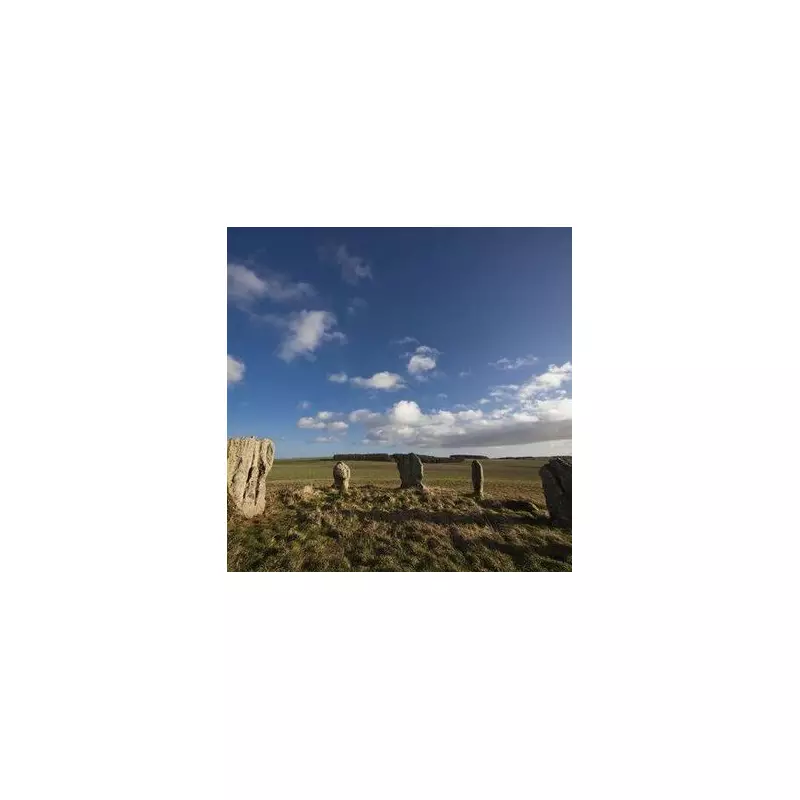
While Stonehenge draws global crowds, a lesser-known but equally captivating ancient stone circle offers a more secluded historical experience in the UK. The Duddo Stone Circle, nestled in Northumberland, presents a mysterious and breathtaking window into Britain's Bronze Age past, rivalling its more famous counterpart.
The Enigmatic Duddo Five Stones
The Duddo Stone Circle is a 4,000-year-old Bronze Age monument located near the village of Duddo in Northumberland, roughly six kilometres south of the Scottish border. Often called the Duddo Five Stones, the site is managed by English Heritage and is sometimes poetically referred to as 'The Singing Stones' or 'The Women'.
To reach the circle, visitors embark on a scenic half-hour walk or a short four-minute drive from Duddo village, crossing the picturesque Duddo Farm. Although on private land, the farm's owner generously permits free public access via a marked path. The stones stand proudly atop a hill, encircled by crops, offering a truly immersive rural setting.

A Site Shaped by Time and Weather
The circle itself is relatively compact, measuring approximately ten metres in diameter. Its standing stones, crafted from soft sandstone, bear the deep scars of millennia of Northumbrian weather. The tallest stone reaches an impressive 2.3 metres in height, and all feature striking water-etched channels running down their faces.
Adding to the site's intrigue are numerous indentations known as 'cup marks' – large, bowl-shaped hollows on the stone surfaces. Experts remain divided on whether these features are natural or man-made, deepening the circle's aura of mystery. The current arrangement of five stones is itself a recent chapter in a long history; until 1903, it was known as the Four Stones, after which a fifth was re-erected to improve the skyline profile.
Archaeological Discoveries and Public Access
Archaeological excavations, including a significant dig in 2008, have sought to unravel the monument's timeline. Evidence suggests the circle originally comprised seven stones, a theory supported by the discovery of two empty stone sockets during an 1890s excavation on the western side.
The circle sits on a slight saddle between slopes, with the land gently falling away to the north and south. The most spectacular views look north to west towards the Scottish border. Visitors should note there is no dedicated car park at the site; access is via the B6354 road, through a gate and along the farm path.
This hidden gem proves that the UK's ancient landscape still holds secrets. For those seeking a profound connection with history away from the crowds, the Duddo Stone Circle offers an unforgettable and atmospheric journey into Britain's distant past.