Las Vegas Tourism Faces Significant Setback in 2025
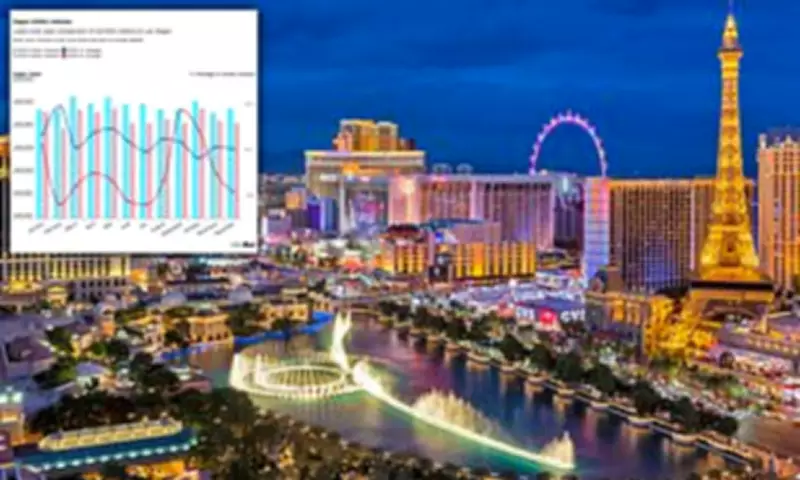
The long-anticipated downturn in Las Vegas tourism has materialised with stark clarity, as newly released figures confirm 2025 marked the year the desert entertainment capital experienced its most substantial annual visitor decline since the post-pandemic recovery phase. The Las Vegas Convention and Visitors Authority (LVCVA) has verified that the city attracted merely 38.5 million visitors throughout the year, representing a substantial 7.5 percent decrease compared to 2024's figures.
A Decisive Break from Recent Growth Patterns
This contraction signals a definitive departure from the consistent expansion Las Vegas enjoyed between 2021 and 2024, when annual visitation progressively climbed from 32.2 million to 41.7 million visitors. The 2025 total not only represents the lowest annual count since 2021 but also falls significantly short of pre-pandemic benchmarks, landing 11.4 percent below the record 42.9 million visitors achieved in 2016.
The downward trajectory persisted throughout the entire year, culminating in December marking the twelfth consecutive month of declining visitation. Approximately 3.1 million people visited during December alone, reflecting a substantial 9.2 percent year-over-year reduction and representing one of the steepest monthly declines recorded throughout 2025.

Hotel Sector Performance Mirrors Softer Demand
Hotel performance metrics moved in parallel with the diminished visitor numbers. December occupancy rates dropped to 76.1 percent, a decrease of 5.8 percentage points, while average daily room rates softened by 5.1 percent to $183.87. Across the entirety of 2025, the city maintained an average occupancy rate of 80.3 percent, representing a 3.3 percentage point reduction from 2024 levels.
The annual average daily room rate settled at $183.52, marking a five percent year-over-year decline. Consequently, revenue per available room experienced an 8.8 percent contraction to $158.62. Despite these reductions, both room-rate and revenue metrics still ranked as the third-highest in Las Vegas's historical records.
Convention Sector Provides Relative Stability
Convention attendance, which serves as a crucial driver of midweek business travel, demonstrated comparative resilience amidst the broader downturn. The city hosted six million convention attendees throughout 2025, nearly matching 2024 levels and offering one of the few stable indicators within the year's tourism landscape. December convention turnout proved particularly robust, increasing by 9.6 percent to reach 306,000 attendees.
External Factors and Regional Variations
LVCVA leadership has identified sociopolitical tensions as contributing factors to the pronounced reduction in foreign visitors, particularly affecting Canadians who constitute Las Vegas's largest international market. Specific references were made to former President Donald Trump's tariff policies and remarks regarding potential Canadian annexation.
Beyond the primary Las Vegas market, regional destinations presented mixed results. Laughlin experienced a 7.3 percent increase in visitors, reaching 1.4 million for the year, while Mesquite maintained stability with 833,000 visitors. Both markets reported year-over-year gaming revenue improvements.
Optimism for Recovery in 2026
Despite acknowledging a challenging year for the region, LVCVA leadership has expressed measured optimism regarding 2026 prospects, noting that the city will host an extensive lineup of major events. The Las Vegas Convention Center anticipates welcoming 1.2 million trade-show attendees this year, bolstered significantly by the return of the triennial ConExpo-Con/Agg show in March.
Additional substantial draws include WrestleMania 42 in April, UFC International Fight Week in June, the Formula One Las Vegas Grand Prix in November, and the National Finals Rodeo in December. Supplementary attractions encompass World Cup-themed viewing events and preparations for the National College Football Championship scheduled for early 2027 at Allegiant Stadium.
LVCVA President and CEO Steve Hill indicated the agency expects the combination of large-scale events and improving global travel conditions to contribute to visitation stabilisation following what he characterised as a difficult period for the region.