Rio's Favela Tourism Boom Sparks Intense Debate Over Poverty Glamourisation
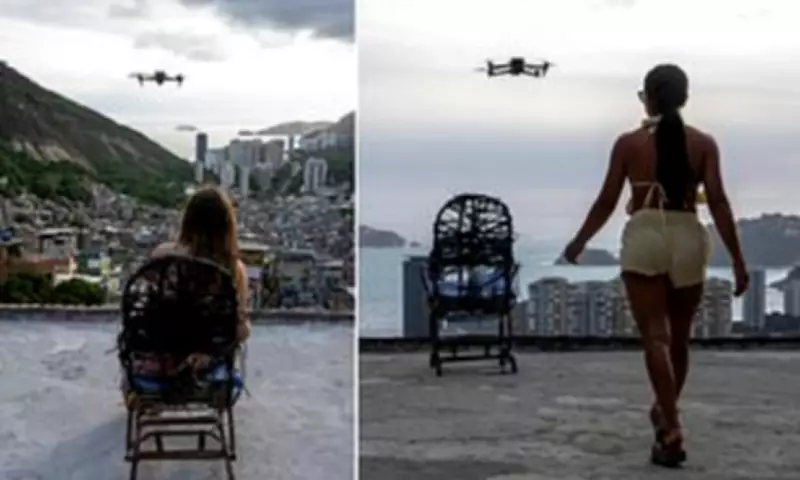
A striking scene unfolds on a rooftop in Rio de Janeiro's largest favela, where tourists meticulously apply makeup before confidently striding across the concrete expanse. They pose for a drone camera that dramatically zooms out to reveal breathtaking aerial views of the sprawling hillside community of Rocinha. Set to an infectious rhythmic beat, this viral video has captivated social media platforms, emerging precisely as the Brazilian city experiences unprecedented tourist arrivals.
The Controversy Over 'Slum Tourism'
However, the video's popularity has generated significant unease and criticism. Dozens of commentators have accused those featured in the aesthetically curated shots of engaging in what they term 'slum tourism.' Many local residents argue that visitors are inadvertently glamourising poverty and criminality within a low-income community historically dominated by drug trafficking networks. The debate highlights the complex ethical dimensions of tourism in marginalized urban areas.
Renan Monteiro, the 42-year-old founder of the tourism company Na Favela Turismo, strongly contests these accusations. He asserts that the footage originates from deliberate efforts to showcase tourists 'the positive side of the favela.' Monteiro emphatically states: 'We are not romanticising poverty. We want to change the prejudice that exists in people's minds.' He explains that access to the famous Porta do Ceu (Gate of Heaven) rooftop is strictly controlled; tourists cannot simply wander there independently.

Structured Tours and Community Integration
Visitors must join organised tours, navigating a labyrinth of narrow alleyways where residents conduct their daily routines. These tours incorporate stops to visit local artists or witness captivating capoeira performances. At the rooftop viewpoint, demand has surged so dramatically that queues for the drone-captured selfie experience have reached up to two hours, with a minimum cost of 150 reais (approximately £21.50).
Gabriel Pai, a 38-year-old delivery worker from Costa Rica who participated in a drone photoshoot, reflected on Rocinha's reputation. He noted the community 'has this image that it's kind of bad, kind of dangerous,' but added, 'I found it really lovely to see the atmosphere.' The viral video's success has attracted influencers, local officials, and even hosted a marriage proposal, amplifying its reach.
Influencers and Cultural Representation
Brazilian influencer Ingrid Ohara, commanding 12 million Instagram followers and 20 million on TikTok, featured in a rooftop sequence. She initially appears in a shower cap and towel, which she discards to reveal a skimpy dress, twirling gracefully as the drone retreats. Ohara explained her motivation: 'These videos I make always get a lot of views, and so I wanted to make one here in Rocinha because it's going viral all over the world.' She defended the content as 'showing our country, showing our Rio de Janeiro, this is part of our culture.'
Monteiro, who grew up in Rocinha, recalls earlier, problematic forms of tourism. He describes 'safari-like' excursions where outsiders guided visitors in open-air jeeps, much to the dismay of local residents. Tourism halted completely in 2017 after a tragic incident where a female Spanish tourist was fatally shot during a firefight between police and drug traffickers. When visits gradually resumed, Monteiro observed tourists once again 'wandering around on the wrong paths' without proper oversight.
Creating Safe, Structured Tourism Models
Determined to establish a safer alternative, Monteiro collaborated with community leaders to design monitored tourist routes throughout the favela, home to over 70,000 inhabitants. He developed a dedicated application to track guides' locations and manage tourist flows efficiently. This system includes safety protocols; if police operations against drug traffickers occur, guides communicate via the app to cancel ongoing tours immediately.

The initiative has trained 300 local guides and ten drone pilots, generating employment within the community. Owners of 26 rooftops and terraces in Rocinha and the neighbouring Vidigal favela now earn income by permitting tourist access. Drone pilot Pedro Lucas, aged 19, expressed how this opportunity transformed his prospects: 'I earn a good amount of money and it would be good if more people from the favela had the same opportunity.' Previously, he had few viable career options.
Record Tourism Numbers and Local Perspectives
Rio de Janeiro's tourism sector is flourishing, buoyed by world-famous beaches, the vibrant Carnival, and iconic landmarks like the Christ the Redeemer statue. Government tourism agency Embratur reported nearly 290,000 international visitors in January alone—a record high. In February, Na Favela Turismo documented 41,000 visitors to Rocinha and nearby Vidigal.
Claudiane Pereira dos Santos, a 50-year-old cleaner, welcomes this tourist 'frenzy.' She remarks: 'People immediately associate [Rocinha] with crime, the bad side. And it's not like that. There are many hardworking people, wonderful people.' She suggests critics should focus instead on the community's struggles with inadequate basic services and unreliable electricity.
Balancing Economic Benefits and Ethical Concerns
Cecilia Olliveira, Executive Director of the Fogo Cruzado Institute, which monitors armed violence in low-income communities, acknowledges the economic rationale. She states: 'I recognise that some residents see this as a legitimate source of income.' However, she cautions: 'The problem arises when the favela ceases to be a vibrant, complex neighborhood traversed by structural inequalities and becomes merely an exotic contrast or a backdrop for impactful content.'
This tension between showcasing community resilience and avoiding poverty exploitation lies at the heart of Rio's favela tourism debate. As visitor numbers climb, the conversation continues regarding how to balance economic opportunity for residents with respectful, ethical engagement that acknowledges both the challenges and strengths of these dynamic urban spaces.