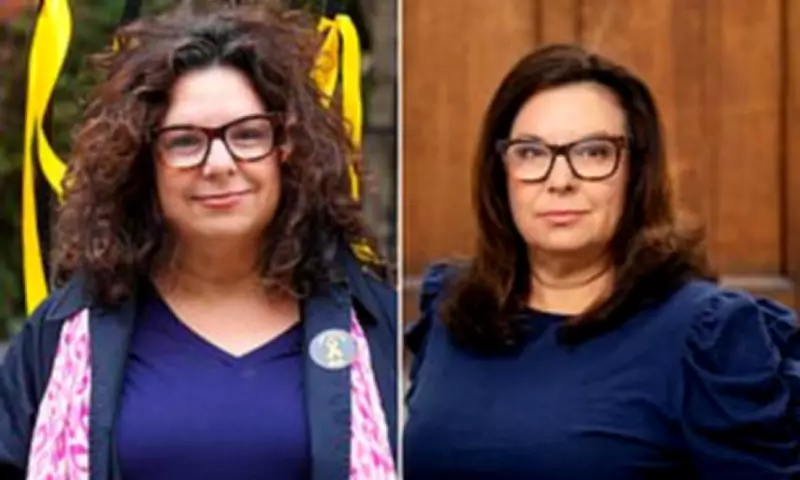
On Tuesday afternoon I went to the hairdressers for a straight, sleek blow-dry. I was speaking at a corporate event the following day and I wanted to get the kinks dragged out of my curly hair, to look more professional than what I call my untidy Jew-fro makes me appear.
Jew-fro is the affectionate name we Jewish people give to our hair, which can tend towards the big and unruly. Think of Sarah Jessica Parker in early Sex And The City, or Odessa A'Zion, the 25-year-old Jewish American actress in Marty Supreme, or, er, musician Art Garfunkel. Those billowy clouds of ringlets are often a bit of a giveaway.
As I stared in my stylist's mirror, my locks becoming progressively flatter and more, well, Gentile – a thought occurred to me. Do you know what? I wondered. I look so much less Jewish with my hair straight and sleek like this. Perhaps I could get away with being Italian or Lebanese? Maybe, maybe, I could even risk a train into Central London, in the middle of a Saturday pro-Palestine march and wander around unharassed.

A fleeting thought, yes, and a flippant one. Talking about one's hair style is arguably inappropriate the day after a double stabbing in my nearby suburb of Golders Green, just the latest in an increasing campaign of hatred and violence against the UK's British Jewish community. But perhaps the very banality of the topic is revealing in itself – and a sign of the subtle drip-drip of the growing prejudice against my community.
It is no exaggeration to say many of us are becoming increasingly aware of the physical signs of our Jewishness – and how this alone can lead to violence. What did 76-year-old Moshe Shine do exactly in Golders Green to be attacked by a knife-wielding madman while waiting at a bus stop? He was merely wearing a kippa, the traditional Jewish head covering.
Concerns about my 'visible Jewishness' have made me start to behave in ways that would have embarrassed my pre-October 7 self. Following glares and political mutterings from taxi drivers, I removed my (rather Jewish) surname from my Uber account. When Deliveroo drivers come up the stairs to my flat, I vaguely hope they don't clock the mezuzah on my doorframe, the little prayer scroll that's also a dead giveaway to one's ethnicity. And when scrolling through Jewish/Israeli newsfeeds on my phone while out in public, I look to my left and right to check who might be looking over my shoulder and whether they might be 'unfriendly'.
At the height of the anti-Israel protests, I begged my Jewish-American husband to hide his little enamel Israeli flag lapel pin as we went through East London on the Underground (I feel ashamed of that now). But all this is not without cause. The other day, a friend of my father's, a lovely grandmother in her 80s, was travelling on the Tube. 'A nice young man stood up for me and we started to chat,' she said. 'Then he noticed my Star Of David necklace and his demeanour changed immediately.' His eyes went cold and hard and he pointed at my chain like a madman. 'You people have brought this on yourselves,' he said. 'How can you be surprised about all the things that have been happening?' I was really frightened.'
What upset this lady the most is that all the other people in the carriage sat looking at their phones as if nothing was happening. 'My son has told me never to wear my Star Of David out again,' she says. 'But I'm going to.'
Most of the abuse I've received has been on social media. On X, I've been called a 'Jewish supremacist' and had a swastika and devil horns superimposed on my profile picture. Another time a man posted: 'There's the real skin-crawling depravity, the genuine visceral evils of people like Miranda Levy,' and went on to call me 'a sly, slippery monster'.
'Ah,' say all the political know-alls. 'It's not Jews we hate. It's Zionists. What about Israel? All you have to do is say you aren't a Zionist and you'll be OK.' (Zionism means you agree there should be a Jewish state and almost all Jews believe this – it's part of our upbringing and all of our prayers.) 'But, if you support baby killers and genocide, this is what you get,' they say, eyes shining with virtue-signalling vigour.

The twisted abhorrence of all these accusations was evident at Manchester's Heaton Park synagogue last October. The man who attacked that day did not ask for their views on Netanyahu and settlement building in Givat Asaf. Like me, the men who died, Adrian Daulby and Melvin Cravitz were British and Jewish and their crime was simply to visit a synagogue on Yom Kippur.
We Jews have lived peacefully and productively in the UK for generations, many hundreds of years in some cases. We love this moderate, welcoming country and are patriotic: we say a prayer for the King in shabbat services and sing the National Anthem at weddings. Many of our ancestors have fought in wars and served in governments.
The sad and interesting thing is that, until about ten years ago, I had never encountered any antisemitism. I went to a Church of England school and happily belted out Morning Has Broken in assembly. While I always had friends of all ethnicities, my first husband was not Jewish and we brought up our children without a religious education, though they were always aware of their rich culture and heritage.
I started to notice a change when Jeremy Corbyn became leader of the Labour Party in the mid-2010s, as the light sleeper of anti-Semitism woke once again. Since October 7 it has really ticked up to the point of the violence we see in our country today. I'm always astonished at the airport-like security when going to an event at a synagogue, at Jewish schools or JW3, the arts venue on Finchley Road, North London.
I know that many Jews are wondering whether they have a future in the UK. A few people I know have gone to live in Israel and more are discussing it with increasing seriousness. It's a truism that, through the ages, Jews have always (metaphorically) had their bags packed by the door in case they have to leave again. It won't be the first time.
In theory, I have a 'get out' as my husband is an American. I could 'escape' to New York (though in many circles, their attitudes to Jews under mayor Zohran Mamdani don't lag too far behind those in the UK). But for now, I'm staying put. I love the UK, the kind and friendly British people, the humour, the centuries of history of which I feel part. Terrible as things currently feel, history isn't repeating itself – this is not Germany in the 1930s.
While the Government can and should do more, the state is on our side and the King is a great supporter – and I'm heartened by the way the Jewish community around me has come together. Unless things get measurably worse, my suitcase will remain in the cupboard – and I will let my Jew-fro fly.