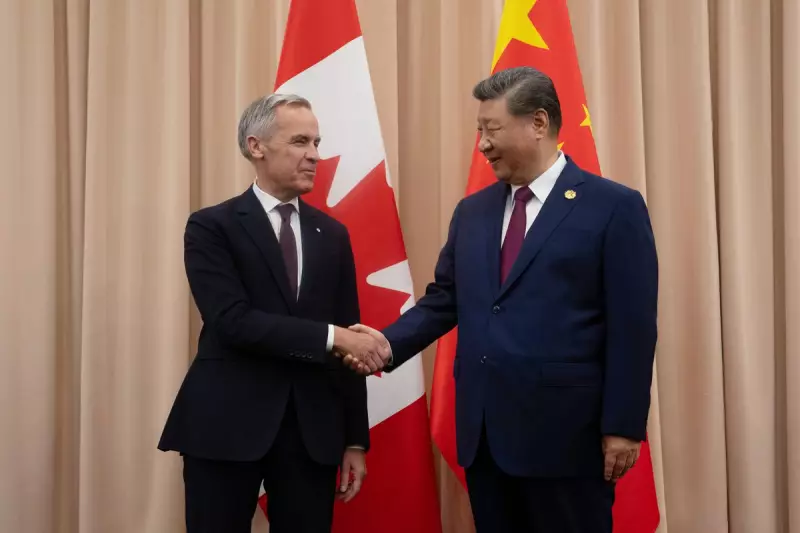
In a significant diplomatic move, Canadian Prime Minister Mark Carney touched down in Beijing on Wednesday night, commencing a pivotal four-day official visit. The trip, the first by a Canadian leader to China in nearly a decade, is squarely aimed at repairing a fractured bilateral relationship.
A Decade-Long Gap and High-Stakes Meetings
Mark Carney's arrival on 14 January 2026 marks a deliberate attempt to reset ties that have deteriorated over recent years. His itinerary includes high-level meetings with Chinese Premier Li Qiang and President Xi Jinping. The leaders last met in October 2025 at the Asia-Pacific Economic Cooperation summit in South Korea, setting the stage for this more extensive engagement.
The context for this visit is a complex web of global trade tensions and shifting alliances. Canada, a traditional stalwart ally of the United States, is actively pursuing what Chinese state media has labelled "strategic autonomy"—a foreign policy path less dependent on its southern neighbour.

Trade Wars and the Push for New Partnerships
Prime Minister Carney has framed this mission to China as a crucial step in diversifying Canada's economic partnerships and ending its over-reliance on the American market. This drive has gained urgency under the administration of US President Donald Trump.
Trump has imposed tariffs on Canadian exports and made provocative statements, including suggesting Canada could become the 51st US state. Concurrently, Beijing was antagonised by former President Joe Biden's efforts to unite allies like Canada, Europe, Australia, and India in a coordinated stance against China.
The current Chinese government perceives an opportunity to weaken these Western bonds, though it remains cautious about the potential depth of any rift. For Ottawa, the calculus is economic: forging stronger trade links elsewhere is a pragmatic response to protectionist pressures from Washington.
A Relationship in Need of Repair
The downward spiral in Canada-China relations has multiple origins. It began with the 2018 arrest of a Chinese tech executive at the behest of American authorities. The situation worsened under former PM Justin Trudeau, whose government in 2024 followed the US lead by imposing a 100% tariff on Chinese electric vehicles.
Beijing retaliated with its own tariffs on key Canadian exports such as canola, seafood, and pork, a response that also targeted separate Canadian duties on steel and aluminium. This tit-for-tat tariff war has caused significant economic pain for specific sectors in Canada, adding impetus to Carney's diplomatic mission.
This four-day visit represents a critical test of whether both nations can move beyond recent grievances. The outcome will be closely watched in global capitals, particularly London, as the UK navigates its own post-Brexit trade strategy and relationships with both North American and Asian powers. Success for Carney could signal a meaningful rebalancing in global trade dynamics, while failure may reinforce existing geopolitical blocs.