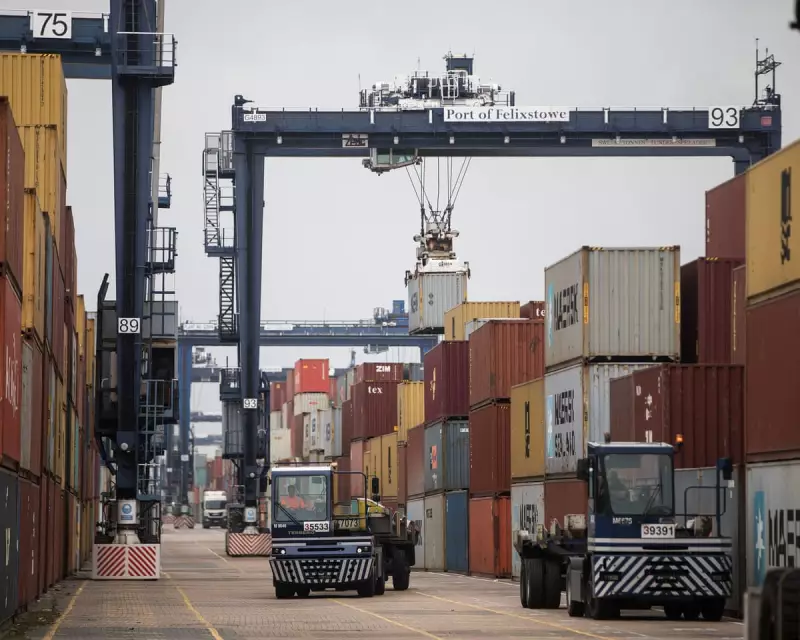
The UK's leading business group has issued a stark warning to the government, declaring that the nation's post-Brexit trade agreement with the European Union is actively hindering British companies rather than helping them grow.
Businesses Report Mounting Frustration with TCA
The British Chambers of Commerce (BCC) has revealed that more than half of UK exporters find the current Trade and Cooperation Agreement (TCA) unhelpful for increasing sales in the EU. The finding comes from a survey of nearly 1,000 businesses, predominantly small and medium-sized enterprises (SMEs).
Specifically, 54% of firms stated the deal, negotiated by Boris Johnson's government and enacted in 2021, was not assisting them. This marks a significant 13 percentage point increase in dissatisfaction compared to a similar survey conducted just one year earlier, highlighting a worsening situation.

The BCC's intervention adds considerable pressure on Sir Keir Starmer's Labour administration to accelerate its promised "reset" of relations with Brussels. The report's timing is critical, following a challenging economic period and a budget that businesses felt lacked substantial growth or trade support.
A "Strategic Necessity" for Economic Growth
Steve Lynch, the BCC's Director of International Trade, framed the issue in urgent terms. "With a budget that failed to deliver meaningful growth or trade support, getting the EU reset right is now a strategic necessity, not a political choice," he stated.
Lynch emphasised the fundamental economic challenge: "Trade is the fastest route to growth, yet firms tell us it is becoming harder, not easier, to sell into our largest market." The BCC, which represents over 50,000 firms employing 6 million people, argues that minimising trade friction must be a top government priority to boost the UK economy.
The survey uncovered profound frustration on the ground. A small manufacturing firm in Greater Manchester reported: "Since Brexit our export sales have virtually stopped. The TCA has had no impact in recovering any sales into the EU." A retailer in Hampshire linked trade difficulties to broader economic issues, noting work had dried up due to high taxes and the UK's exit from the EU.
Labour's Delicate Balancing Act on EU Relations
The BCC's call aligns with growing recognition within Labour's senior ranks about the economic damage caused by Brexit trade barriers. Recently, senior figures like Wes Streeting have publicly advocated for a deeper trading relationship, with some interpretations suggesting openness to a customs union arrangement.
However, this creates a political tightrope. Labour's manifesto explicitly rules out a return to the EU single market, customs union, or freedom of movement. Sir Keir Starmer has also previously insisted he could not foresee the UK rejoining the EU in his lifetime.
Despite this, several pro-European ministers, including David Lammy, Peter Kyle, and Bridget Phillipson, are believed to be among those pushing for the government to go further in rebuilding ties. The government has already positioned the EU reset as a top priority for 2026, following a landmark summit earlier this year, and has agreed terms to rejoin the Erasmus+ student exchange programme in 2027.
To guide the 2026 talks, the BCC has presented a five-point "business manifesto" for the EU reset. Its key proposals include:
- A deal to reduce border checks on animal and plant products (SPS agreement).
- Finalising linkages between the UK and EU Emissions Trading Schemes.
- Establishing a mutual youth mobility scheme.
- Securing full UK participation in the EU's defence research fund (SAFE).
- Enhancing cooperation on VAT and customs simplification.
In response, a government spokesperson defended its approach: "This government is removing red tape and trade barriers to support jobs, business, and growth. That’s exactly why we reset our relationship with the EU and are making strong progress in negotiations."
As the 2026 negotiations loom, British businesses are sending a clear message: the current post-Brexit trade framework is not fit for purpose, and a substantive overhaul is needed to unlock growth and competitiveness.