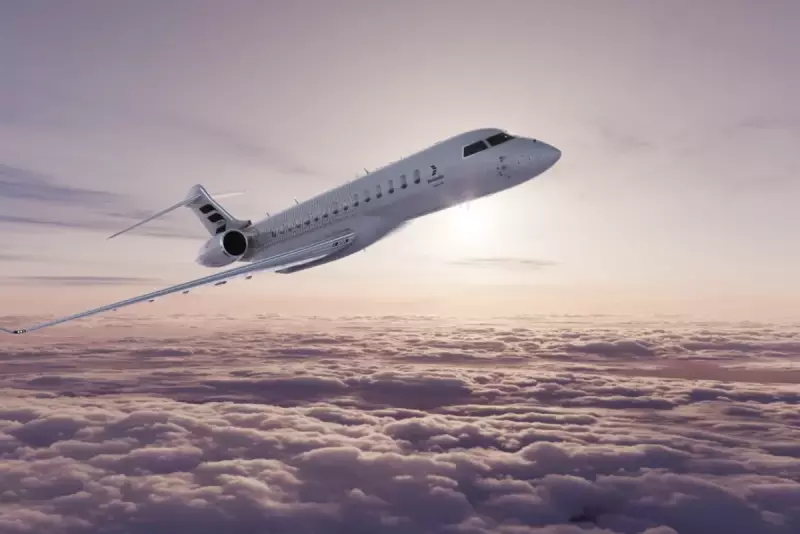
In the world of aviation, where speed and luxury often intersect, a new contender has emerged that promises to reclaim the mantle of time-saving travel. The Bombardier Global 8000, recently certified by the European Union Aviation Safety Agency, is being hailed as the fastest business jet ever conceived and the quickest civil aircraft since the iconic Concorde. But can this private jet truly become the successor to the legendary supersonic airliner that once captivated the globe?
A Legacy of Speed: Remembering Concorde
Concorde, the Anglo-French supersonic jet that first carried paying passengers fifty years ago this month, was more than just an aircraft; it was a veritable time machine. Larry Mueller, former CEO of IBM Europe and now head of the ultra-high-end travel firm Cuvée, reminisces about its unparalleled convenience. "Concorde was all first class, so you were treated in a great way," he notes. "But for me it was really about the convenience of leaving Paris and getting to New York in three-and-a-half hours – and picking up two hours of time." Indeed, the evening westbound flights outran the Earth's rotation, allowing passengers to witness the sun rising in the west, a surreal experience that underscored its time-bending capabilities.
The Current Landscape: Supersonic Dreams and Realities
While companies like Denver-based Boom Supersonic aim to reintroduce commercial supersonic travel with their Overture jet by the end of the decade, former British Airways Concorde pilot Captain Jock Lowe suggests it may be 2050 before such tickets become widely available. In this interim, the Bombardier Global 8000 steps into the spotlight, offering a pragmatic alternative for those seeking faster journeys without breaking the sound barrier.

Unpacking the Global 8000's Capabilities
Bombardier's latest creation boasts an ultra high-speed cruise mode of 605 mph, which is 10% quicker than the typical 550 mph cruising speed of long-haul passenger aircraft. This translates into tangible time savings on key routes:
- London to New York: The journey is reduced to six hours, saving 40 minutes compared to a fast commercial jet crossing.
- Manchester to Cape Town: If a direct flight existed, the Global 8000 would complete the trip in just over 10 hours, an hour faster than a commercial jet.
- London to Perth: While Qantas manages the route in under 16 hours with jet stream assistance, the Bombardier plane would shave off 90 minutes, arriving in approximately 14.5 hours.
However, these gains pale in comparison to Concorde's supersonic feats. On the London-New York route, Concorde passengers could be sipping martinis in Manhattan while those on the Global 8000 were still disembarking, highlighting the stark difference in velocity.
Historical Context: The Sonic Cruiser and Beyond
The pursuit of near-sonic speed is not novel. In the early 2000s, Boeing unveiled its Sonic Cruiser, a delta-winged design reminiscent of Concorde intended to carry over 200 passengers. Sir Richard Branson of Virgin Atlantic expressed interest, but the project never progressed beyond conceptual stages due to lukewarm airline reception. The team eventually pivoted to develop the Boeing 787, now a staple in global fleets. Today, the business jet sector has achieved what commercial aviation could not, with the Global 8000 featuring a maximum altitude of 51,000 feet and a smooth flex wing engineered to minimise turbulence, offering what Bombardier claims is the industry's smoothest ride.
The Economics and Practicalities of Private Jet Travel
Despite its advantages, the Global 8000 comes with a hefty price tag. The aircraft itself costs $78 million (£57 million), and operational expenses are astronomical. For instance, saving 90 minutes on the London-Perth route compared to a Qantas flight would incur hundreds of thousands of pounds in fuel costs for just eight passengers. This echoes past extravagances, such as when former Foreign Secretary Liz Truss accrued a £500,000 bill for a government private jet trip to Australia and back.

The true value of private jets lies in their flexibility. With the ability to bypass fixed schedules and congested hubs, they offer unparalleled route and timing options. For example, the daily Perth flight arrives in time for lunch the next day; missing it means waiting until dinner with one-stop alternatives. Having a Global 8000 on standby eliminates such delays, though it remains a far cry from Concorde's supersonic prowess.
The Future of Fast Flying: New Routes and Innovations
Looking ahead, the aviation industry is focusing on new city-pairs that eliminate time-consuming connections. The proposed non-stop London-Sydney route, set to launch next year, is predicted to be an instant success by cutting out layovers. More modestly, airlines like Wizz Air are deploying long-range Airbus A321s on routes such as Luton to Yerevan, Armenia, leveraging private jet hubs to save travellers time. These developments suggest that while supersonic travel may be on the horizon, incremental speed enhancements and strategic routing will define the near future of fast flying.
In summary, the Bombardier Global 8000 represents a significant step forward in business aviation, offering notable time savings and luxury amenities. Yet, as it cruises at subsonic speeds, it cannot fully replicate the time-warping magic of Concorde. For now, it serves as a testament to the enduring quest for efficiency in the skies, blending innovation with practicality in an era where time remains the ultimate luxury.