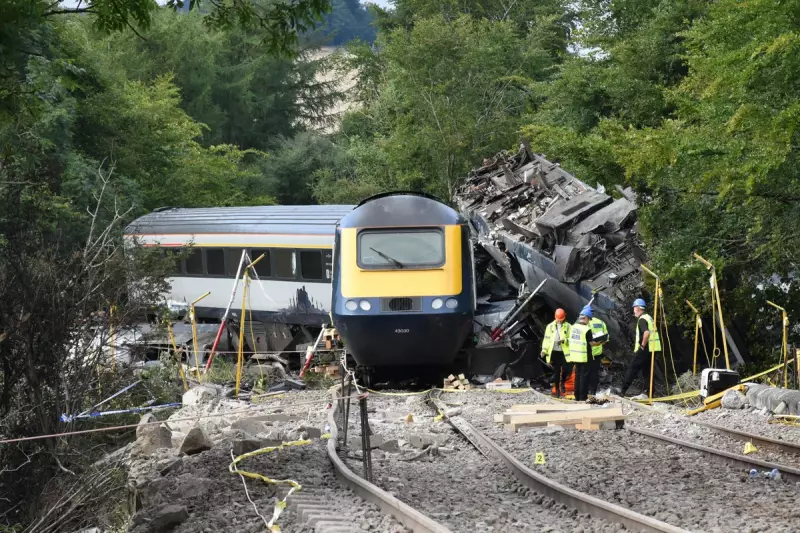
Network Rail Safety Information Transfer 'Ineffective' Before Fatal Derailment
A fatal accident inquiry has been told that the transfer of safety-related information between Network Rail and its contractors was "ineffective" prior to the catastrophic train derailment in Aberdeenshire that claimed three lives. The inquiry at Aberdeen Sheriff Court is examining the circumstances surrounding the tragic incident on August 12, 2020.
Details of the Fatal Incident
Three people lost their lives when the train crashed at Carmont near Stonehaven after striking debris that had been washed onto the track by exceptionally heavy rainfall. The victims were identified as train driver Brett McCullough, 45; conductor Donald Dinnie, 58; and passenger Christopher Stuchbury, 62. The inquiry has revealed that the debris originated from a drainage system that had not been constructed according to the original designer's specifications.
Breakdown in Communication and Safety Processes
Nick Bucknall, an inspector with the Rail Accident Investigation Branch (RAIB), provided crucial testimony to the inquiry. He stated that modifications made to the drainage system during construction between 2011 and 2012 were never properly communicated by contractor Carillion to either the designer Arup or to Network Rail itself.

"Network Rail's processes that were intended to ensure a managed transfer of safety-related information from constructor to infrastructure manager were ineffective," Mr Bucknall told the court. He further explained that had these processes functioned correctly, the discrepancies between the design intent and the actual constructed asset might have been identified, potentially allowing for remedial action to be taken.
Critical Design Changes and Their Consequences
The inquiry heard that civil engineering firm Carillion implemented several significant alterations to the drainage system. Most critically, this included the omission of a soil particle filter—a component that would have substantially reduced the risk of a washout event. These changes were not documented in the final "as-built" drawings that should have been shared with the designer and Network Rail.
Consequently, Network Rail's asset managers remained unaware of the modifications. This lack of knowledge meant that no specific inspection regime was established for the altered sections of the drain, despite the lower portion being inspected in May 2020.
Extreme Weather and Infrastructure Failure
The court was informed that the rainfall on the night of August 11-12, 2020, was "exceptionally heavy", causing considerable damage across Scotland's railway network. At the accident site, 51.5mm of rain fell between 5.50am and 9am. The incorrectly installed drainage system was completely overwhelmed by this volume of water, leading directly to the washout of debris onto the tracks.
Uncertain Documentation and Missed Opportunities
Mr Bucknall, basing his evidence on the RAIB report published in March 2022, indicated it remains uncertain whether the crucial as-built drawings were ever created. "The preparation of as-built drawings would have been an opportunity to spot the inappropriate design modifications," he emphasised. Without this formal documentation, Network Rail staff would only have been aware of the changes through verbal communication or direct site observation.
Aftermath and Corporate Responses
In a subsequent criminal prosecution, Network Rail was fined £6.7 million in 2023 after admitting to health and safety failings related to the crash. Carillion, the contractor responsible for the drainage work, had already entered compulsory liquidation in January 2018.
A Network Rail spokesperson stated the Government-owned company is committed to supporting the inquiry and implementing the recommendations from the RAIB report. "We've made significant changes to how we manage the risk of severe weather since the accident and our work to make our network more resilient will continue," the spokesperson added.