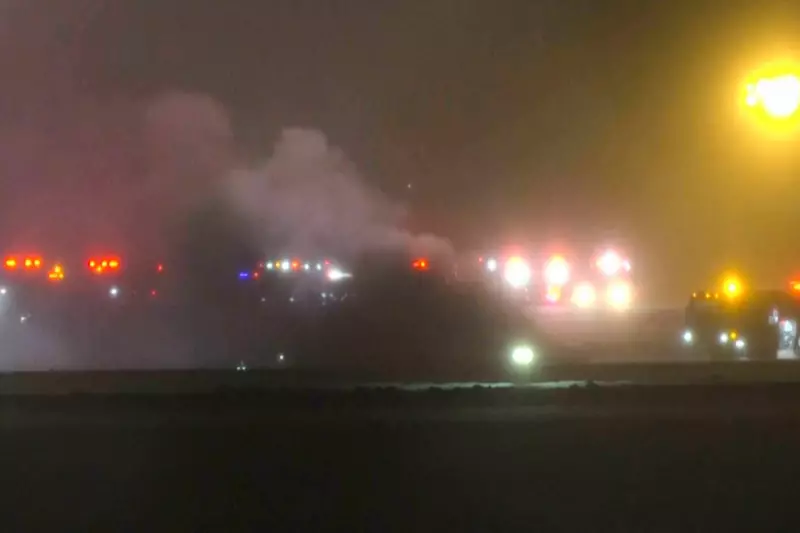
The National Transportation Safety Board has commenced its official investigation into a devastating business jet crash in Maine that claimed the lives of all six individuals on board. The federal agency's team arrived on Tuesday at Bangor International Airport, where the tragic incident occurred during takeoff on Sunday evening.
Crash Details and Immediate Aftermath
The ill-fated aircraft, a Bombardier Challenger 600, was destined for Paris when it attempted to depart around 7:45 p.m. on Sunday. Witnesses reported that the jet flipped over upon takeoff and subsequently caught fire, resulting in a catastrophic scene at the airport. The Federal Aviation Administration confirmed in an updated statement that the crash resulted in the deaths of four passengers and two crew members, though formal identification of the victims is still pending through coordination with Maine's Office of the Chief Medical Examiner and local law enforcement.
Weather Conditions and Investigative Focus
Preliminary reports indicate that the crash coincided with the onset of a significant winter storm affecting the region. This has prompted immediate questions about whether adverse weather, particularly potential icing on the aircraft's wings, contributed to the disaster. Aviation safety experts have highlighted that the Bombardier Challenger 600 model has a documented history of icing-related issues during takeoff, which have been factors in previous fatal accidents in locations such as Birmingham, England, and Montrose, Colorado, over two decades ago.

Jeff Guzzetti, a former federal crash investigator and current aviation safety consultant, emphasised the critical importance of de-icing procedures. "Even a minimal accumulation of ice on the wings can severely compromise an aircraft's performance," Guzzetti noted. "Given the prevailing weather conditions and this aircraft model's known susceptibility to wind contamination, the NTSB will undoubtedly prioritise examining whether proper de-icing protocols were followed, especially as the effectiveness of such treatments can diminish within approximately twenty minutes."
Aircraft Ownership and Airport Context
Investigators have revealed that the crashed jet was registered to a corporation sharing an address in Houston, Texas, with the personal injury law firm Arnold and Itkin Trial Lawyers. One of the firm's founding partners is listed as the registered agent for the company that owns the aircraft. Meanwhile, Bangor International Airport, situated roughly 200 miles north of Boston, is frequently utilised as a refuelling stop for private jets crossing the Atlantic due to its proximity to Europe.
Investigation Timeline and Broader Implications
The NTSB is expected to release a preliminary factual report within the next month, providing an initial overview of the crash circumstances. However, a comprehensive final report detailing probable causes and safety recommendations is not anticipated for over a year. This investigation will scrutinise all potential factors, including mechanical issues, pilot actions, and operational procedures, alongside the weather-related concerns.
This tragic event underscores ongoing challenges in aviation safety, particularly for business jets operating in harsh winter conditions. The Bombardier Challenger 600, introduced in 1980 as the first private jet with a walk-about cabin, remains a popular choice for charter services, making the findings of this probe highly relevant to the industry.