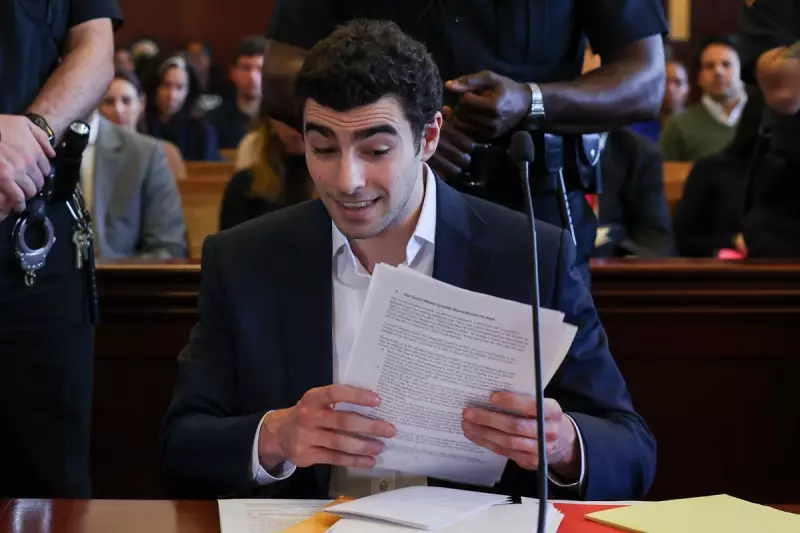
Manhattan prosecutors have formally requested a judge to establish a July trial date for the state murder case concerning Luigi Mangione, who stands accused of killing UnitedHealthcare CEO Brian Thompson. This development comes as federal proceedings, which could potentially involve the death penalty, are scheduled to commence later in the year.
Prosecutors Advocate for State Trial Priority
In a detailed letter submitted to the court, Assistant District Attorney Joel Seidemann has asked Judge Gregory Carro to begin the New York trial on July 1. Seidemann emphasised that the state's interests would be significantly compromised by any unnecessary postponement until after the federal trial concludes. The state trial currently remains unscheduled, with the next hearing not anticipated until May, when Carro is expected to rule on a defence motion to exclude specific evidence.
Federal Trial Timeline and Complexities
The Manhattan district attorney's office raised this scheduling matter shortly after U.S. District Judge Margaret Garnett announced that jury selection for the federal case would start on September 8. The subsequent phases of the federal trial are projected to occur either in October or January, contingent upon whether prosecutors are permitted to pursue the death penalty.

If capital punishment remains a possibility, the second phase of the federal trial, encompassing opening statements and testimony, is slated to begin on January 11, 2027. Should the death penalty be excluded, opening statements would proceed on October 13. Capital cases inherently involve greater complexity and require extended preparation periods, contributing to the extended timeline.
Legal Arguments for State Precedence
In his correspondence with Judge Carro, Seidemann articulated that state prosecutors were integral to the investigation from its inception, whereas federal authorities joined approximately two weeks following Thompson's death. Mangione was charged in federal court merely one day after his state indictment.
"It is entirely natural then that the state case would proceed to trial prior to the federal case," the prosecutor asserted, referencing established legal precedent. He further contended that the state possesses an overriding interest in prosecuting Mangione for what he described as "the cold-blooded execution of Brian Thompson."
Double Jeopardy Implications
The scheduling conflict extends beyond mere logistical concerns. Under New York state law, the district attorney's office would be prohibited from trying Mangione on state murder charges if the federal case proceeds to trial first. State double jeopardy protections become effective once a jury is sworn in during a prior prosecution, such as a federal case, or if that prosecution concludes with a guilty plea.
Case Background and Evidence Disputes
Brian Thompson, aged 50, was fatally shot on December 4, 2024, while walking to a midtown Manhattan hotel for UnitedHealth Group's annual investor conference. Surveillance footage captured a masked gunman shooting him from behind. Investigators noted that the ammunition was inscribed with the words "delay," "deny," and "depose," phrases commonly associated with insurance claim avoidance practices.
Mangione, a 27-year-old Ivy League graduate from an affluent Maryland family, was apprehended five days later at a McDonald's in Altoona, Pennsylvania, located approximately 230 miles west of Manhattan.
Ongoing Legal Proceedings and Evidence Challenges
Mangione is scheduled to appear in federal court on Friday, where Judge Garnett is expected to rule on several pretrial matters. These include whether the case will retain its capital status and whether prosecutors will be allowed to present certain evidence to jurors that has been contested in the state case.
The disputed evidence comprises a 9 mm handgun, which prosecutors allege matches the weapon used in the killing, and a notebook in which they claim Mangione expressed his intent to "wack" a health insurance executive. Mangione has entered not guilty pleas to both federal and state murder charges, with the state charges carrying a potential life imprisonment sentence.

Defence Motions and Prosecution Readiness
In the federal case, Mangione's legal team is seeking to prevent prosecutors from pursuing the death penalty and aims to have at least some charges dismissed. They argue that authorities prejudiced their client by sensationalising his arrest and publicly expressing their desire for his execution.
Regarding evidence, Mangione's lawyers contend that the Altoona Police Department conducted an illegal search of his backpack without a warrant. Prosecutors counter that the search was lawful, conducted in accordance with Altoona police protocols that mandate prompt searches of a suspect's property for dangerous items, and that a warrant was subsequently obtained.
In his letter, Seidemann assured Judge Carro that the Manhattan district attorney's office is fully prepared to proceed to trial and that any outstanding pretrial issues in the state case can be resolved before July. Following a three-week hearing in December regarding the defence's evidence request, Carro indicated he would not rule until May 18, but noted "that could change."
In a previous ruling from September, Judge Carro dismissed state terrorism charges against Mangione but upheld the remainder of the case, including an intentional murder charge.