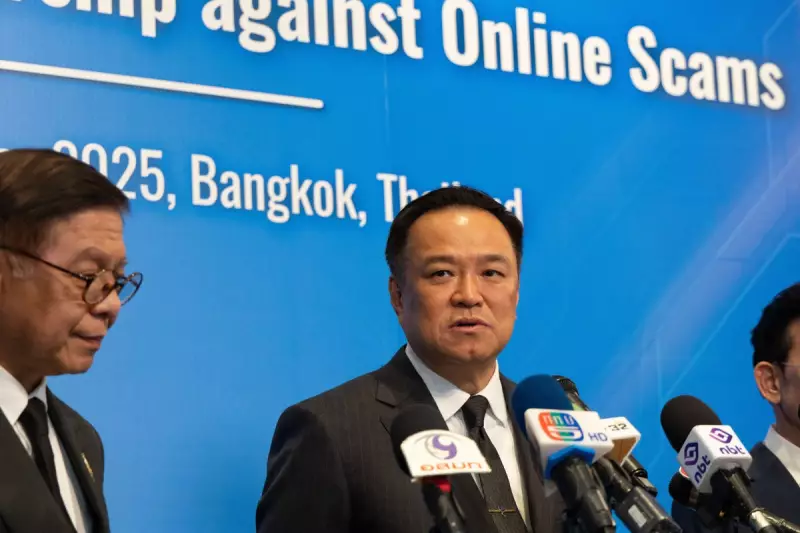
Thailand has spearheaded the launch of a major international initiative designed to combat the rampant spread of online scams, a criminal industry centred in Southeast Asia that drains billions from global victims annually.
A Unified Front Against Digital Fraud
Hosted by Thailand's Ministry of Foreign Affairs and the United Nations Office on Drugs and Crime (UNODC), a two-day conference in Bangkok culminated on Thursday, 18 December 2025, with the announcement of the Global Partnership Against Online Scams. The event drew over 300 participants from nearly 60 countries, underscoring the widespread concern over this escalating threat.
In his keynote address, Thai Prime Minister Anutin Charnvirakul emphasised the collective nature of the challenge, stating that online scams “reveal a deeper problem — a collective vulnerability that no country can address alone.”

Commitments and Private Sector Involvement
The founding partnership agreement was signed by five nations: Thailand, Bangladesh, Nepal, Peru, and the United Arab Emirates. The framework pledges cooperation across political commitment, cross-border law enforcement, victim protection, and public awareness campaigns.
Crucially, the conference highlighted the essential role of the private sector. Internet giant Meta, which owns Facebook, Instagram, and WhatsApp, presented a threat report detailing how scam networks are increasingly leveraging artificial intelligence. The company outlined protocols it is deploying to stop scams across its platforms.
Social media platform TikTok formally signed the conference's closing statement, becoming one of the first corporate members of the new alliance. This move comes as TikTok, one of the world's most popular apps, seeks to address scrutiny from various governments over issues ranging from data transparency to child protection.
The Scale of the Scam Epidemic
The urgency for action is stark. So-called scam centres, which use fake investment schemes and romance scams to extort money, have proliferated across Southeast Asia. According to UNODC estimates, victims lost between $18 billion and $37 billion to these crimes in 2023 alone.
Brian Hanley, Asia-Pacific director of the Global Anti-Scam Alliance (which TikTok joined this month), stressed the need for a united front. “Scams are exploiting, not only transnational boundaries, but also the seams across various platforms from banks, telcos, to social media platforms,” he said. “It will be harder to combat criminal networks without all the major stakeholders at the table.”
The alliance describes itself as a collective effort involving governments, law enforcement, consumer protection bodies, and companies from the tech and cybersecurity sectors.
Regional Context and Global Momentum
Recent events have fuelled demand for a coordinated regional response. These include scam centre raids in Myanmar, difficulties repatriating victims in Thailand, and the tragic death of a South Korean student forced into scam labour in Cambodia.
While Cambodia is noted as a hub for scam compounds and has been criticised by neighbour Thailand, it was not represented at the conference amid ongoing armed conflict between the two nations.
The Bangkok conference builds on prior commitments, such as the United Nations Convention against Cybercrime, signed by over 70 countries in Vietnam in October 2025. UN Secretary-General António Guterres hailed that document as “a vow that no country... will be left defenseless against cybercrime.”
As Hanley concluded, “TikTok is the one that we’re talking about today, but hopefully tomorrow everyone’s joining. We’re starting to get critical mass and momentum as everyone realizes it’s affecting their bottom lines and consumer trust.”