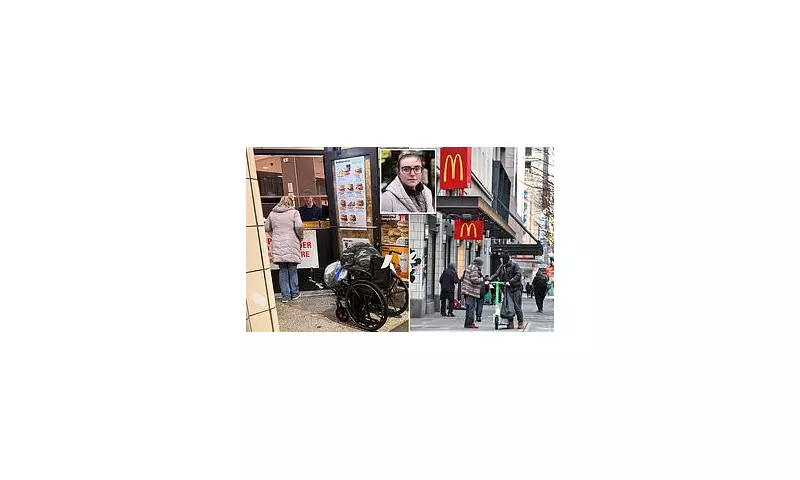
In a stark symbol of urban decay, a McDonald's restaurant in downtown Seattle has become so dangerous that it has permanently closed its dining room to the public, serving customers only through a makeshift, reinforced hatch.
The Fortified Fast-Food Outlet
The fast-food outlet, located on the notorious corner of 3rd Avenue and Pine Street, took the drastic step after enduring horrific violence, including a fatal shooting. Locals have grimly nicknamed it 'McStabby's'. The once-welcoming double doors are now propped open, their glass covered with plywood, while a service hatch has been cut into the space they once occupied.
This hatch is mostly covered with thick plexiglass, featuring only a small opening along the bottom for transactions. Patrons are explicitly banned from entering and must navigate a gauntlet of vagrants and drug users congregating outside to place an order.

A Landscape of Despair and Violence
The area, known locally as 'The Blade'—the stretch of 3rd Avenue between Pine and Pike Streets—is a world away from the nearby, upscale Pike Place Market. During a visit by the Daily Mail last Thursday, the scene was one of open-air drug use and despair, with individuals incapacitated by substances like fentanyl slumped on litter-strewn pavements.
Nick, a 45-year-old former addict who spent nearly a decade in the neighbourhood, described the peril. "They do drugs and attack each other," he said. He witnessed a girl being shot and killed near a lamppost outside the McDonald's in January 2020—an incident that left one woman dead and seven others injured, including a nine-year-old boy. "When it’s dark, it’s way worse - way more people getting assaulted and robbed," he added.
McDonald's initially closed the dining room during Covid-19 but never reopened it post-pandemic, citing ongoing safety concerns. Employees live in fear; one young worker described a homeless man launching himself over the service hatch to threaten staff and steal food. He admitted no one called the police, believing it would be futile, and confessed to being followed home multiple times by individuals attempting to rob him.
Policing and Policy Challenges
The response from authorities appears limited. The Daily Mail observed two Seattle Police Department officers urging loiterers to move so the street could be "sprayed" with a bleach solution—a clean-up that occurs three times daily. One officer, new to the job, noted he had already seen three stabbings in front of the McDonald's since the start of the year.
Critically, a shift in policy seems to be hampering enforcement. Under an order from SPD Chief Shon Barnes effective January 1, most drug cases are referred to the Law Enforcement Assisted Diversion (LEAD) programme—a voluntary scheme critics label ineffective. "Most of the time when I arrest someone for drugs, and I ask if they are enrolled in the programme already, they say yes," one officer remarked.
This approach, coupled with accusations that city officials like Mayor Katie Wilson and City Attorney Erika Evans have made it harder to charge public drug use, has created an environment where chaos persists just blocks from Seattle's most iconic tourist attractions. The story of 'McStabby's' stands as a potent testament to the profound public safety and social challenges facing one of America's major cities.