An 18-year-old man from Canberra has been taken into custody and charged with multiple offences following a series of alleged incidents involving Nazi salutes and the distribution of extremist propaganda.
Alleged Incidents of Hate-Fuelled Behaviour
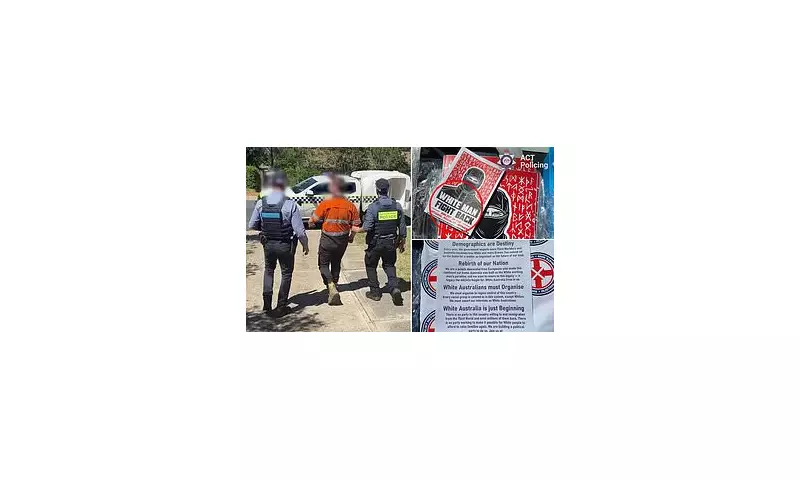
According to police allegations, the teenager performed the outlawed Nazi salute on two separate occasions, directing the gesture at people inside shopping centres in the Australian capital. The first alleged incident occurred in October, after a member of the public confronted him for placing 'propaganda-style' stickers around a shopping precinct. Police state he performed the salute before leaving.
A second salute was allegedly carried out at a different shopping centre on 12 December. Furthermore, detectives allege the youth repeatedly trespassed on the Australian National University campus during August and September, where he affixed extremist stickers to buildings and public property.

Christmas Eve Raid and Charges
On 24 December, the Australian Federal Police's (AFP) National Security Investigations team, supported by ACT Policing, executed a search warrant at a home in the suburb of Weston, approximately 12km southwest of Canberra's CBD.
Officers seized a significant haul of evidence, including mobile phones, a computer, stickers, storage devices, a video camera, and clothing. The teen was led from the property in handcuffs.
He has since been charged with two counts of publicly displaying prohibited Nazi symbols or performing a Nazi salute, an offence carrying a maximum penalty of five years in prison.
Additional charges include two counts of damaging Commonwealth property, with a maximum penalty of ten years, and two counts of offensive or disorderly behaviour on Commonwealth premises, which may attract a fine.
National Context and Official Condemnation
AFP Assistant Commissioner for Counter Terrorism and Special Investigations, Stephen Nutt, strongly condemned the alleged actions. He highlighted that the AFP established the National Security Investigations team in September specifically to target individuals and groups spreading hate and division.
Authorities outlined signs of radicalisation, which can include withdrawing from family, adopting extremist rhetoric, fixating on conspiracy theories, and spending excessive time in fringe online forums. They urged the public to report any concerns about extremist behaviour.
This arrest occurs amidst heightened concerns over extremist activity in Australia. It follows a neo-Nazi assembly outside the New South Wales parliament two months ago and an Islamic State-inspired attack at a Hanukkah event in Bondi less than a fortnight ago, which resulted in 15 deaths.
In a separate but related incident, a car bearing a Hanukkah-related symbol was set alight outside a rabbi's house in Melbourne in the early hours of Christmas Day. No one was injured, but the home was evacuated as a precaution. Prime Minister Anthony Albanese described the suspected firebombing as 'beyond comprehension'.
Jeremy Leibler, President of the Zionist Federation of Australia, stated the attack was designed to frighten Jews for being visibly Jewish. He argued that "Australia has to treat anti-Semitism as a public safety issue, not a niche community concern." He called for a federal royal commission into the Bondi attack and the wider anti-Semitism crisis.
In response to recent events, hate speech reforms and an overhaul of ministerial powers to cancel visas for sowing division are under consideration. Victoria has vowed to follow NSW in cracking down on hate crimes and expanding police powers, with NSW Police moving on Christmas Eve to ban protest rallies from key areas of Sydney following the Bondi attack.