Photographs of Lucy Letby, with her striking icy blue eyes and shoulder-length blonde hair, cover nearly every wall of her family home in a quiet cul-de-sac in Hereford. In the lounge near the front door, a portrait shows her as a toddler, sporting a blunt fringe and a navy velvet bow. Upstairs, class photographs from her school days, now over two decades old, line the walls, while a graduation picture sits proudly in a gilt-edged oval frame.
Throughout the house, walls, windowsills, and noticeboards are plastered with holiday snaps, handwritten cards, and trinkets she crafted over the years. A visitor to the property described it to the Daily Mail as 'like a shrine' to the inhabitants' only daughter, noting that 'every single surface and wall is covered in photos of Lucy or Lucy memorabilia.'
The Crimes and Conviction
Lucy Letby, the neonatal nurse convicted of murdering seven premature babies and attempting to kill seven more at the Countess of Chester Hospital between 2015 and 2016, is serving a whole-life term at HMP Bronzefield in Surrey. Now 36, she is incarcerated alongside some of the country's most dangerous female criminals. Her name is reviled worldwide for the heinous crimes against innocent newborns, leaving families torn apart by their loss.

Recently, inquests into the 'unnatural deaths' of five of Letby's victims, known as Babies C, E, I, O, and P, were opened at Cheshire coroner's court. Despite her convictions, Letby continues to protest her innocence, with her newly-appointed legal team filing documents containing new 'expert' evidence with the Criminal Cases Review Commission in hopes of a retrial. She has allegedly told fellow inmates and prison staff that she believes her convictions could be overturned later this year.
Parental Devotion and Anguish
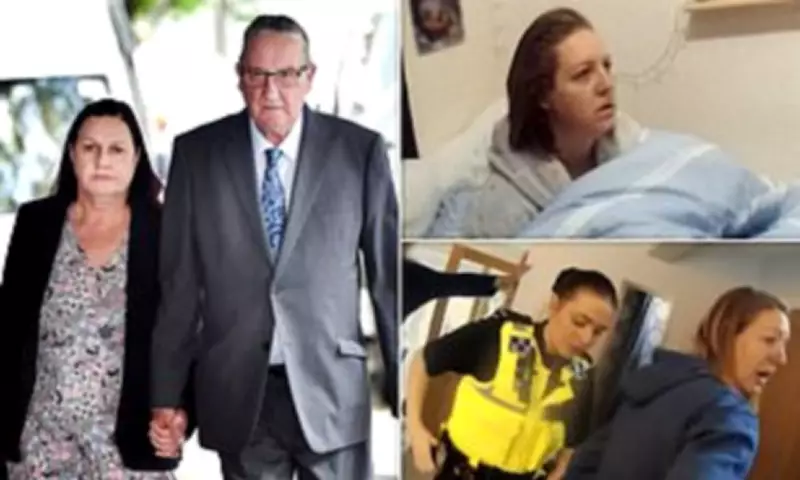
To her devoted parents, John and Susan Letby, this potential news offers a glimmer of hope. Since her first arrest in July 2018, they have maintained unwavering faith in their daughter, believing she is a victim of 'scapegoating' to cover up hospital failings. An only child in a close-knit family, Lucy has been their pride and joy since birth.
The new Netflix documentary, 'The Investigation Of Lucy Letby,' aired this week, providing a harrowing insight into the impact of her arrests on the family. Previously-unseen footage from police body cameras shows Susan Letby's haunting wails as officers arrived to arrest Lucy for a second time in June 2019. In between sobs, she cried, 'Please, no, not again, no.' As officers cuffed the sleepy nurse in her fluffy dressing gown, Lucy asked her parents, 'You know I didn't do it, don't you?' They replied in heartbreaking unison, 'We know that.'
At her third arrest in November 2020, Susan reportedly pleaded with officers, 'I did it; take me instead.' Neighbors on the quiet cul-de-sac have described the family as 'broken' since the arrests, with one stating, 'Their lives ended then and there. The way it happened each time was disgusting.'
Public and Media Scrutiny
In response to the Netflix documentary, John and Susan released statements via Maltin PR, a reputation management firm working pro bono for the family. They branded the footage 'heartbreaking' and 'a complete invasion of privacy,' adding, 'We will not watch it – it would likely kill us if we did.' Critics noted that their initial statement did not mention the babies who died or their grieving parents. A second statement opened with condolences to the families, but reiterated, 'our daughter is innocent and this is a horrendous miscarriage of justice.'
The couple has become increasingly reclusive since Lucy's conviction, with net curtains drawn across their semi-detached home and their car rarely leaving the driveway. John, 80, and Susan, 65, have abandoned hobbies like watching football and horse-racing, as well as Sunday outings to Hereford City Church. Their only regular journey is the 264-mile round trip to Surrey to visit Lucy in prison, where she is entitled to three hour-long visits per month. Recently, John has been going alone as Susan recovers from hip replacement surgery.

Background and Health Issues
John and Susan met in Hereford in the early 1980s and married in July 1986, with Susan pregnant at the time. Lucy's childhood friend, Dawn Howe, mentioned in an ITV documentary that Lucy had a 'difficult' birth, which may have influenced her decision to become a neonatal nurse. At age 11, she was diagnosed with an underactive thyroid, causing tiredness and depression, and later developed optic neuritis, leading to blurred vision and pain.
Lucy described her parents' behavior as 'a little suffocating at times,' but they saw it as protection. They were proud of her nursing degree from the University of Chester and her role as a poster girl for the Countess of Chester's neonatal unit fundraising campaign. In 2015, with their help, she bought a £179,000 house near the hospital.
Legal Battles and Family Involvement
As Lucy's world began to unravel, her parents became deeply involved in her case. They attended a meeting with hospital officials in December 2016, where minutes show they vociferously attacked consultants they believed had a 'personal grudge' against Lucy. In a letter read at the Thirlwall Inquiry in January 2017, they expressed being 'shocked to the core' and described Lucy's ordeal as having 'broken our hearts.'
John made 'agitated' calls to the hospital and even threatened the chief executive. In July 2017, he reported issues at the neonatal unit to police, a year before Lucy's first arrest. Despite this, he appeared polite and reserved during her 2023 trial, nodding to reporters as he passed.
Life in Prison and Ongoing Questions
In prison, Lucy has 'enhanced' status for her protection, living in a spartan cell with basic amenities. She spends time in the library, has an 'insatiable appetite' for books, and earns money from a cleaning job to call her parents. In a letter to a friend, she expressed missing her cats, Tigger and Smudge, whom her parents now care for.
John and Susan's desolation is summed up in their letter to the Thirlwall Inquiry: 'The overlying question that has kept us awake from the day this all started, and no one has come up with an answer, is, 'Why Lucy?'' This same question echoes for the 14 families whose babies she is accused of harming, as they continue to seek justice and closure.