Public Expresses Deep Concerns Over Labour's Proposed Police Force Mergers
New polling data has exposed significant public apprehension regarding Labour's ambitious plans to overhaul policing in England and Wales. Research conducted by Ipsos for the Daily Mail reveals that a majority of voters fear that proposed police force mergers will damage officers' crucial local knowledge and lead to slower emergency response times.
Widespread Opposition to Force Consolidation Plans
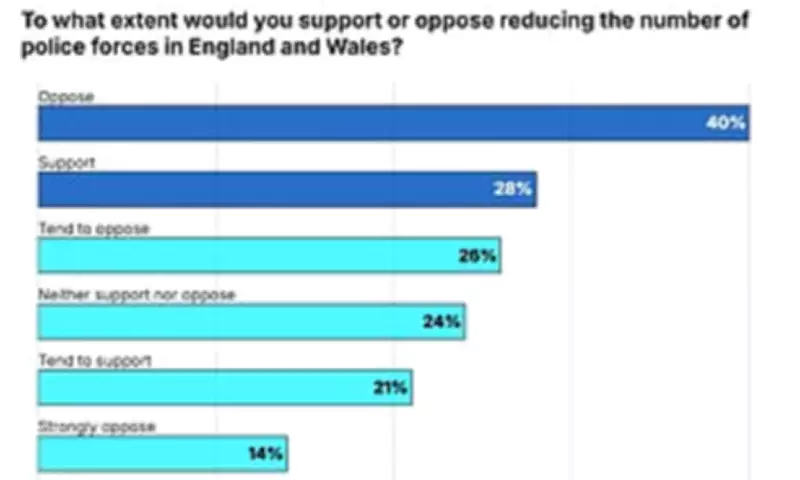
The survey found that 40 percent of respondents actively oppose Home Secretary Shabana Mahmood's proposals to consolidate the existing 43 police forces into as few as 12 larger regional entities. Only 28 percent expressed support for the mergers, with the remainder either indifferent or uncertain.
Nearly eight out of ten participants - a striking 77 percent - voiced concerns that such mergers would cause police to "lose local knowledge and community connections." Furthermore, 69 percent said they were worried the restructuring would result in slower police response times, despite Labour's commitment to implement nationwide targets of 15 minutes in urban areas and 20 minutes in rural locations.

Scepticism Over AI Chatbots and Budget Promises
The research also uncovered public wariness regarding the Home Office's plan to deploy artificial intelligence 'chat bots' to handle non-urgent police calls. A significant 46 percent of those polled believe this technological intervention will degrade the quality of police services, while only 28 percent anticipate improvements.
When asked specifically about their comfort levels with AI interactions, 57 percent of respondents stated they would feel uncomfortable if their initial police contact was with a chatbot rather than a human officer. Only 25 percent expressed comfort with such an arrangement.
Regarding financial implications, the polling revealed scepticism about Labour's claims that mergers would free up resources for frontline policing. Just 46 percent believe the restructuring would lead to increased frontline budgets, while 40 percent consider this outcome unlikely.
Support for Other Policing Reforms
Despite these concerns, the public demonstrated strong backing for several other aspects of Labour's policing agenda. Regarding the expanded use of facial recognition technology, 57 percent expressed support with only 19 percent opposed.
Specifically on the Home Office's pledge to equip forces with 40 additional vehicles featuring live facial recognition cameras, support rose to 64 percent. Furthermore, 54 percent believe the presence of such cameras on their local high streets would enhance their sense of safety, with only 13 percent saying it would make them feel less secure.
The survey also revealed substantial public approval for measures aimed at increasing police accountability. A notable 58 percent support granting the Home Secretary direct powers to dismiss underperforming chief constables, while an overwhelming 81 percent back Mahmood's proposal to introduce a new 'licence to practise' for all police officers.
Public Priorities and Current Policing Perceptions
The research provided insights into how the public currently perceives policing in their communities. A substantial 67 percent of respondents said police foot or vehicle patrols are seen too rarely in their neighbourhoods.
When asked to identify their top policing priorities, responding to 999 calls and tackling violent crime both ranked highest at 46 percent each. Other significant concerns included combating anti-social behaviour and street patrolling (both 36 percent), addressing drug dealing (35 percent), fighting shoplifting and theft (23 percent), tackling phone theft and street robbery (13 percent), and investigating fraud or scams (10 percent).
Ipsos research director Hannah Shrimpton commented on the findings: "The support for facial recognition technology suggests that security remains a priority for many, despite privacy considerations. However, the clear discomfort with AI chatbots indicates that there is work to be done in improving public trust in digital solutions."

Shrimpton added: "There's a delicate balance to strike between advancing technological capabilities and maintaining public confidence. Additionally, the strong backing for professional development through a 'licence to practise' for police officers reflects a public desire for accountability and continuous improvement in policing standards."
The Ipsos survey interviewed a representative sample of 970 adults aged 18 to 75 across England and Wales, with polling conducted online on February 5th.