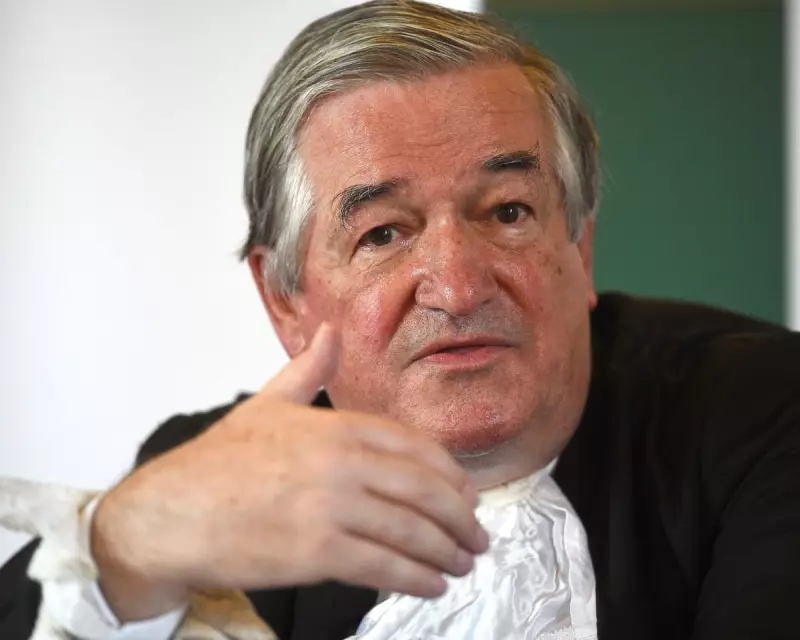
Sir James Munby: A Judicial Force for Justice and Transparency
The legal world mourns the loss of Sir James Munby, a formidable high court judge whose career was defined by moral courage and a relentless drive for reform. Sir James, who passed away at the age of 77 from a heart attack, served as president of the family division and chairman of the Law Commission, leaving an indelible mark on the British justice system.
Challenging Injustice and Government Austerity
Throughout his tenure, Sir James Munby was renowned for his outspoken stance against perceived injustices, particularly in the face of government austerity measures. He skillfully embedded pointed rebukes in his judgments, often embarrassing authorities into action. During a period when legal aid cuts left many litigants without representation and NHS services faltered, he did not hesitate to confront ministers directly.
In a bold move that tested constitutional boundaries, Sir James proposed that HM Courts and Tribunals Service should cover legal costs in defiance of Ministry of Justice restrictions. He argued passionately that denying parents legal representation in cases where children were at risk of permanent removal was a "denial of justice" and a failure of the state to uphold fair trial rights.

A Voice for the Vulnerable in Mental Health and Family Law
Sir James's compassion extended to mental health provision, where he issued stark warnings about systemic failures. In a 2017 case involving a teenage girl at risk of suicide, he lamented the "disgraceful and utterly shaming lack of proper provision" of NHS services, stating the nation would have "blood on its hands" if a hospital bed could not be found. His efforts to secure specialist care were met with frustration, leading him to remark that he might as well have been "talking to myself in the middle of the Sahara."
As a pioneer for transparency, Sir James championed more open justice in family courts and supported the introduction of "no fault" divorce. His leadership accelerated reforms that reduced waiting times in care cases, and he advocated for legal protections for unmarried cohabiting couples to prevent injustice upon separation.
Early Life and Distinguished Career
Born in Oxford in 1948, James Munby was the eldest of five children. His mother, Mary, worked as a researcher in psychiatry, while his father, Denys, was a reader in transport economics and a conscientious objector during World War II. Educated in Scotland and at Magdalen College School, Oxford, he nurtured a lifelong passion for steam trains, even working as a labourer on footplates.
After graduating with a first in law from Wadham College, Oxford, and winning the Eldon law scholarship, he was called to the bar in 1971. He joined New Square Chambers, specialising in chancery and family law, and became a silk in 1988. His expertise led to frequent instruction by the official solicitor in medical treatment and consent cases, including the landmark House of Lords case concerning Anthony Bland, a victim of the Hillsborough disaster.
Appointed a high court judge in 2000 and promoted to the court of appeal in 2009, Sir James also chaired the Law Commission, driving legislative reforms. In 2013, he became president of the family division, where he issued guidance to open up reporting in the court of protection, enhancing public understanding and confidence.
Legacy and Later Years
Known for his erudition and occasional impatience with what he deemed nonsense, Sir James was described as having "an impression of a volcano about to explode." He retired in 2018 upon reaching the judicial retirement age of 70, marking the occasion with a valedictory speech that humorously referenced family law principles, and a visit to a miniature steam railway in Kent, where an engine was renamed "The Flying Munby" in his honour.
Remaining active post-retirement, he chaired the Nuffield Family Justice Observatory until 2023, continuing to monitor family courts. In a Guardian article, he criticised shortages in secure children's homes for those with mental health needs and raised concerns about safeguards in assisted dying legislation.

Sir James Munby is survived by his wife, Jennifer, a fellow barrister, their two children, Thomas and Charlotte, and four grandchildren. His legacy is one of moral clarity and compassion, as noted by Kirsty Brimelow KC, chair of the Bar Council, who likened his judgments to the writings of Charles Dickens in their crusade against social injustice.