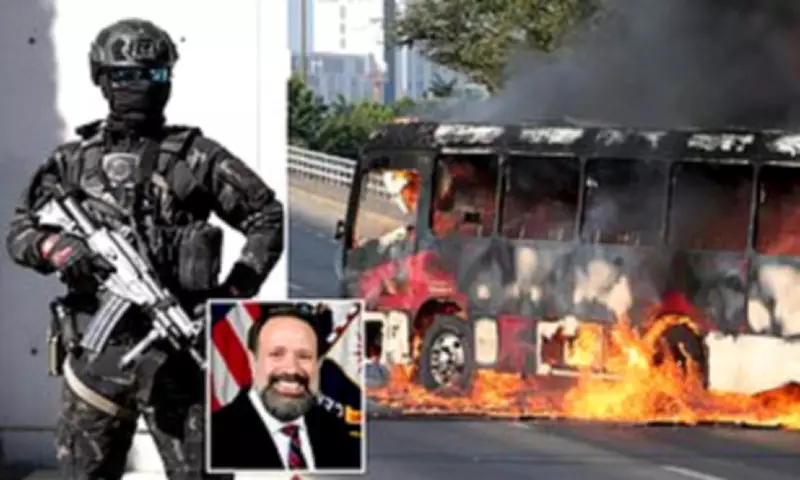
Cartel Chaos Erupts After Mexican Raid on CJNG Leader El Mencho
Smoke billowed over the tourist haven of Puerto Vallarta. Tractor-trailers burned fiercely across major highways, while gunmen brazenly erected checkpoints, operating with the confidence of a sovereign authority collecting tolls through fear. Tourists found themselves confined to resort hallways, police units were pinned down, and soldiers faced ambushes in broad daylight. Guadalajara's airport, serving Mexico's second-largest city, descended into chaos as armed convoys moved with impunity.
This is the violent aftermath that unfolds when a state strikes directly at the head of a powerful cartel machine. The fall of the Jalisco New Generation Cartel's (CJNG) longtime leader, known by his nom de guerre 'El Mencho,' born Nemesio Oseguera Cervantes, was never destined to pass quietly or without significant retaliation.
A Parallel Regime, Not a Personality Cult
CJNG is far more than a personality cult revolving around a single individual. It operates as a vertically integrated criminal enterprise that functions effectively as a parallel regime. This organization taxes territory under its control, dominates key ports, operates industrial-scale fentanyl laboratories, fields sophisticated drone units and armored vehicles, and deploys disciplined hit teams with military-grade coordination. Its influence has deeply penetrated municipal governments, state police commands, and even segments of the federal structure.

When an organization of this magnitude and complexity loses its apex figure, it does not simply retreat or collapse. Instead, it demonstrates ruthless continuity. It burns highways to signal that succession is already in motion. It ambushes soldiers to prove that the chain of command survives the man at the top.
The Polite Narrative Versus Hard Reality
The polite official narrative suggests this is merely contained fallout—a bold raid proving Mexico can act decisively under pressure from Washington, delivering a decisive blow in a new era of seriousness. This storyline conveniently protects the political class in Mexico City. However, it deliberately avoids the more challenging question: if such violent retaliation was inevitable, why was it not properly anticipated and contained?
If Mexico's defense establishment executed the raid with full awareness of CJNG's extensive reach, then that demanded meticulous preparation. This should have included:
- Vetted rapid-response units staged in likely flashpoints.
- Coordinated corridor lockdowns across known cartel strongholds.
- Immediate financial seizures to choke operational liquidity.
- Follow-on arrests targeting second- and third-tier leadership.
- Hardened perimeters around critical infrastructure like airports, ports, refineries, and major commercial arteries.
If these defensive layers were thin, delayed, or merely symbolic, that is not simply bad luck. It is the direct consequence of years of political accommodation and tolerance.
Thriving in Political Tolerance
Cartels of this immense scale do not thrive in a vacuum. They flourish inside a framework of political tolerance. Governors often accept geographically contained violence so long as it does not spill into lucrative tourist districts or vital financial centers. Municipal police may collect payments and pass intelligence in exchange for maintaining local calm. Judges can convert procedural delays into practical impunity. Federal authorities frequently manage criminal power rather than dismantle it, because open confrontation carries a high political cost. Electoral incentives consistently reward short-term quiet over the difficult work of structural reform.
This is precisely how a criminal enterprise matures into a parallel authority. Now, it is asserting that authority in brutal daylight. The consequences extend far beyond Jalisco's beaches like Puerto Vallarta. Tourism contracts as international travelers reassess risk. Commercial corridors slow as blockades and uncertainty ripple destructively through supply chains. Rival factions probe newly exposed territory, and such fragmentation often produces even bloodier competition.

Transnational Impact and Future Risks
Fentanyl production does not pause during this chaos; it recalibrates. American communities tragically absorb the resulting overdoses. CJNG and its competitors already maintain operational nodes inside the United States. They manage extensive distribution networks, enforce debts, intimidate witnesses, and launder proceeds through American financial channels. The violence in Mexico and the damage inflicted in the United States are not separate phenomena. They are interconnected extensions of the same vast criminal enterprise.
Cartel leadership will now meticulously reassess risk. If calibrated intimidation north of the border could slow or complicate sustained pressure, they will study that option. These organizations are rational actors. They generally prefer profit to chaos and avoid actions that might invite overwhelming U.S. retaliation. However, they consistently probe boundaries.
Historically, such probing has involved targeted violence, intimidation of witnesses, or settling internal disputes on American soil. It has meant threats against family members to silence cooperation. It has utilized subcontracted crews and intermediaries to create deniable distance between command and act. None of it resembles a conventional invasion, but all of it is strategically designed to protect revenue streams and test governmental resolve.
The Central Strategic Question
Deterrence functions effectively when the cost of probing is clear and immediate. The United States is not a permissive battlespace. Federal, state, and local law enforcement capacity is deep. Intelligence authorities are expansive. Financial monitoring is highly sophisticated. Cartel networks operating inside the country understand this reality and generally calibrate their activities accordingly.
This brings us back to the central, pivotal question: Was this operation merely a headline-grabbing event, or is it the opening move in a genuinely sustained campaign? Mexico must now decide whether it intends to systematically dismantle the criminal machine or merely disrupt it temporarily.
Leadership decapitation without concurrent financial strangulation offers only temporary relief. A serious, long-term effort requires:
- Coordinated asset seizures inside Mexico.
- Aggressive prosecution of political and judicial facilitators.
- Federal intervention in compromised local police forces.
- Judicial reform that ends impunity created by procedural delay.
- Permanent territorial control rather than rotating deployments that concede ground once headlines fade.
Anything less signals the enduring power of the cartel and the profound fatigue of the state. The United States can reinforce this effort through continued indictments, aggressive Treasury designations, enforcement actions against facilitators operating within U.S. jurisdiction, enhanced intelligence sharing, relentless extradition demands, and applying economic leverage to ensure cooperation does not drift once public attention moves elsewhere.
External leverage matters, but ultimate sovereignty requires domestic will. Mexico will either be governed by its constitutional authorities or by armed criminal enterprises that burn public infrastructure to set their own rules. If the state cannot impose a sustained, unbearable cost on organizations that challenge it with open warfare, it is not asserting control. It is, in effect, conceding it.