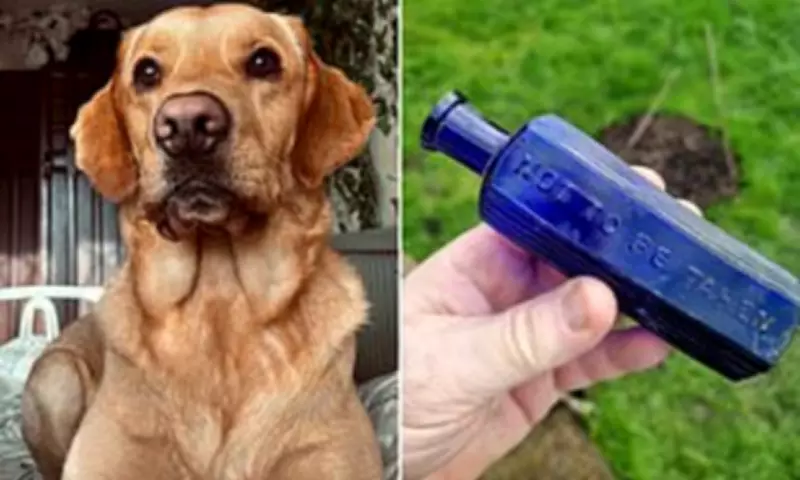
Canine Curiosity Uncovers Grisly Victorian Murder Evidence
A pet Labrador has inadvertently helped shed new light on a notorious 160-year-old murder case after persistently digging up a buried bottle of poison in his Devon garden. Stanley, the determined dog, unearthed a Victorian-era blue glass vial beneath the lawn at his home in Clyst Honiton, Devon, revealing what appears to be a tangible connection to one of Britain's most infamous poisoning cases.
The Discovery That Revealed a Dark Past
Owner Paul Phillips, 49, initially mistook the object for a pipe fragment until he noticed the chilling words 'Not To Be Taken' inscribed on the glass surface. This discovery has sparked historical investigation linking the bottle to the 1865 murder of William Ashford by his wife Mary Ann Ashford, who once lived just two doors away from the current property.
The historical context reveals a dramatic tale: Mary Ann Ashford poisoned her husband's tea to inherit his money and pursue a relationship with her younger lover, who happened to be employed by William. Following her conviction, Ashford was publicly hanged before approximately 20,000 spectators in March 1866, though the execution reportedly went badly wrong, taking several agonizing minutes to complete.

A Turning Point in British Justice
This botched execution proved instrumental in shifting public opinion against corporal punishment, ultimately contributing to the abolition of public hangings in Britain. Mr Phillips reflected on the significance, stating: 'It is fascinating that we have found a bit of history in my garden from a woman that was instrumental in the end of corporal punishment 160 years ago.'
The determined Labrador had been fixated on the same garden spot for nearly a year, despite repeated attempts to deter him. 'We kept patching up and even at one point had to put a paving slab over it but he was insistent there was something there he wanted,' Phillips explained. The breakthrough came when Stanley finally exposed enough of the object for his owner to investigate properly.
Historical Research Uncovers Chilling Details
Upon discovering the perfectly preserved bright blue bottle, Phillips conducted extensive research that revealed its Victorian origins and common usage during the mid-19th century. Recalling local stories about a historic hanging in the village, he located old newspaper accounts detailing the Ashford case.
The investigation uncovered that William Ashford, a shoemaker with an estate valued at £120, had made his wife sole beneficiary of his will. Mary Ann planned to use this inheritance to establish a new life with her lover Frank Pratt. Newspaper reports from the time document William's mysterious illness and sudden death, followed by his wife's arrest by the police officer living next door.
Forensic tests eventually revealed traces of arsenic and strychnine on Mary Ann's clothing, confirming the poisoning. Phillips noted the suspicious circumstances surrounding the bottle's burial: 'If you had bought that bottle for the right reasons - like killing rats or something - why would you bother burying it? The fact there was a murder due to poisoning in the next door down from us - you have to put two and two together!'
Modern Reactions to Historical Horror
The brutal nature of the story has left Phillips reluctant to keep the bottle inside his home. 'It is in the garage at the moment which is a shame because it's lovely but I bet it comes with some weirdness!' he admitted. Despite this unease, the discovery has captivated his family and neighbors, including a local councillor who has taken particular interest in the historical find.
Remarkably, since unearthing the poison vial, Stanley has completely ceased digging in that particular spot of the garden. Phillips hopes local historians might help uncover additional information about this unique connection to Victorian crime and punishment, noting that the property likely once served as a cider barn with more extensive grounds during the 19th century.
This accidental archaeological discovery serves as a tangible reminder of how personal dramas from Britain's past continue to resonate through time, unexpectedly surfacing through the simple digging of a curious dog in a Devon garden.