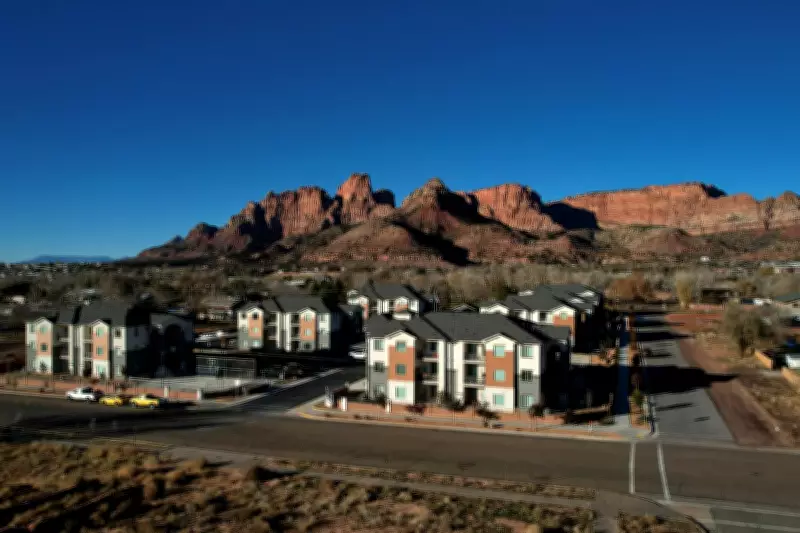
The prairie dresses, walled compounds, and deep-seated distrust of outsiders that once defined two remote towns straddling the Arizona-Utah border have largely faded into history. Today, Colorado City, Arizona, and its neighbouring town, Hildale, Utah, present a strikingly different picture, having been released from court-ordered supervision nearly two years ahead of schedule following a profound societal transformation.
A New Era Dawns for Former Sect Strongholds
Where weekend soccer matches, local bars, and even a winery now thrive, such commonplace activities were strictly forbidden under the rule of the Fundamentalist Church of Jesus Christ of Latter-Day Saints (FLDS). The sect's leader, Warren Jeffs, is currently serving a life sentence for sexually assaulting minors. Courts wrested control from the church, leading to a court-mandated overhaul that excised religious influence from local governments and the shared police department.
"What you see is the outcome of a massive amount of internal turmoil and change within people to reset themselves," said Willie Jessop, a former FLDS spokesman who later broke with the sect. "We call it 'life after Jeffs' — and, frankly, it's a great life."

The Sinister Turn Under Warren Jeffs
Some former members recall earlier, more communal times within the FLDS. However, they describe a dark shift after Jeffs assumed leadership following his father's death in 2002. Church leaders began breaking apart families, casting out men deemed unworthy and reassigning their wives and children. Jeffs' edicts pulled children from public schools, removed basketball hoops, and dictated even the most personal aspects of followers' lives.
"It started to go into a very sinister, dark, cult direction," recounted Shem Fischer, who left the towns in 2000 after the church split up his family. The FLDS originally settled in the area in the 1930s to continue practicing polygamy after the mainstream Mormon church renounced it. Authorities largely turned a blind eye until Jeffs' extreme actions forced intervention.
Learning Representative Government
For nearly 90 years, the towns functioned as a theocracy. The 2017 court order forced them to learn the fundamentals of democratic governance. "They had to learn how to operate 'a first-generation representative government,'" noted Roger Carter, the court-appointed monitor. The FLDS had controlled most land through a trust, making private property ownership a novel concept for many residents. Civic leaders now prioritise residents' needs over sect doctrine.
'Like a Normal Town'
With Jeffs imprisoned and the church stripped of official control, many FLDS members left. Other places of worship have opened, and practicing FLDS members are now believed to be a small minority. Hildale Mayor Donia Jessop speaks of huge strides, including reconnecting with family members divided by the church.
Longtime resident Isaac Wyler, once ostracised after his expulsion, notes the dramatic change. "Like a normal town," he said, pointing to new amenities like a supermarket, bank, pharmacy, and coffee shop that have replaced FLDS-run businesses. Newcomers like Gabby Olsen and her husband Dion Obermeyer are drawn by the natural beauty, with outsiders often surprised by the community's evolution. "'Oh yeah, there's a winery,'" Obermeyer remarked.
Challenges and the Path Forward
Despite progress, challenges remain. New openness has brought common societal issues like drug use. Polygamy persists in some forms, evidenced by a 2024 case where a Colorado City sect member was sentenced to 50 years for crimes involving underage girls. Recovery is a generational process.
Briell Decker, once Jeffs' 65th "wife," now works helping others leave polygamy. "I do think they can, but it's going to take a while because so many people are in denial," she said, highlighting the ongoing journey toward full accountability and healing for these uniquely transformed communities.