Earth and Other Planets Review: A Quirky Fusion of Classical and Folk
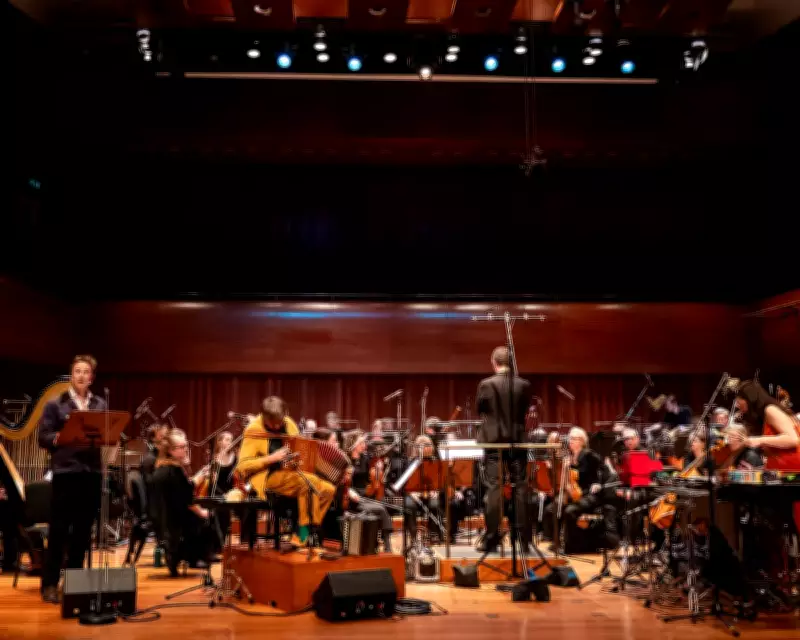
At Milton Court in London, an unconventional performance blurred the lines between concert hall and gig, leaving audiences pondering its very nature. Robert Macfarlane, the acclaimed writer, set the tone by questioning whether the event was a formal concert or an informal gig, highlighting its unique hybrid character.
The Silent Planet: A Reimagined Holst Suite
The centrepiece of the evening was The Silent Planet, a bold reinterpretation of Gustav Holst's beloved orchestral suite, The Planets. This innovative work featured poetic narrations by Macfarlane, accompanied by atmospheric improvisations from the Britten Sinfonia soloists, alongside the dynamic duo of Stevens & Pound. Conductor Clark Rundell expertly guided each movement, weaving together classical precision with folk spontaneity.
The performance delivered some truly memorable moments: terrifying blasts of conch shell evoked the warlike spirit of Mars, bright horn flares captured the mercurial energy of Mercury, and a whirlwind hoedown brought Venus to life. However, the piece occasionally sprawled noisily, with movements sliding into one another through rapid transitions from drones to jigs and reels. Ian Gardiner's orchestration, while ambitious, sometimes lacked the finesse of Holst's original compositions.

A standout was the newly composed movement, Earth, which threaded the familiar tune of All Things Bright and Beautiful into the mix. This section offered a brief respite of breathing space before launching into yet another syncopated romp, showcasing the ensemble's versatility.
Stevens & Pound: Left-Field Folk Virtuosity
The duo of Delia Stevens and Will Pound billed themselves as a "left-field folk" act, and their performance lived up to this description. Stevens, a percussionist, danced between an array of instruments laid out like a jumble sale—including mixing bowls, a toy piano, a guitar, a vibraphone, and numerous drums and shakers. She often played two or three instruments simultaneously, driving the rhythm with high-energy virtuosity.
Pound, on melodeon and harmonica, brought his folk background to the fore, complementing Stevens's classical training. Their mashup created a rhythmically driven experience that inspired toe-tapping and chin-bobbing throughout the evening. By the end, Pound humorously declared the encore—an upbeat arrangement of the Sailor's Hornpipe—to be "a rave," eliciting polite giggles from the well-behaved audience.
Folk and Classical: A Historical Meeting
The first half of the performance explored older intersections of folk and classical music. Benjamin Britten's diffident English Folksong Suite and Percy Grainger's irresistibly knowing Lincolnshire Posy bookended a medley by Stevens & Pound. In this segment, the Britten Sinfonia's wind and brass sections were joined by members of Sinfonia Smith Square, transforming traditional folk tunes into funky interpretations inspired by tango and bluegrass.
While the evening could feel fragmentary at times, it was undeniably ambitious—a hallmark of one of the UK's most tenacious classical ensembles. The blend of genres was not only innovative but also immensely enjoyable, proving that such cross-pollination can yield thrilling results.
Future performances are scheduled at the Norfolk Events Centre in Norwich on 29 January and West Road Concert Hall in Cambridge on 30 January, offering more opportunities to experience this unique fusion.