Brazilian Women in Favelas Turn to Martial Arts Amid Rising Gender Violence
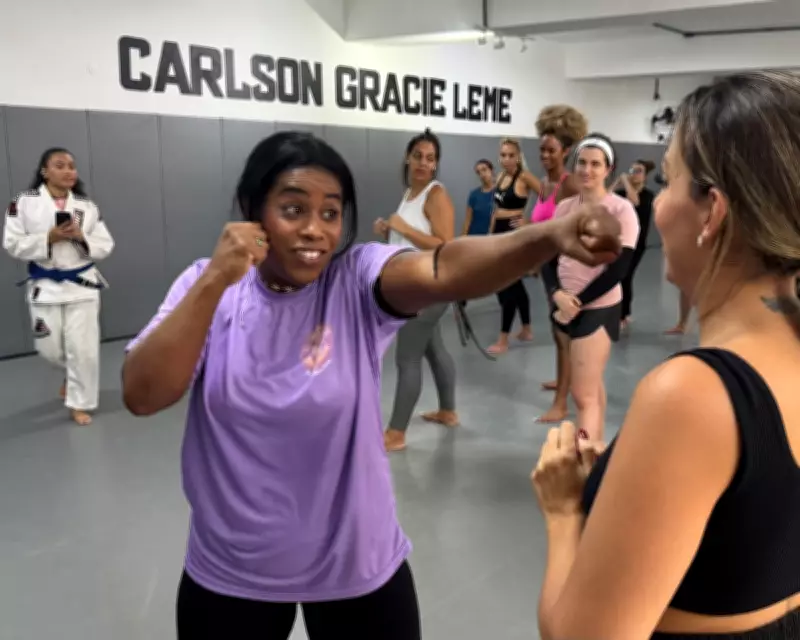
In a martial arts studio at the entrance to a beachside favela in Rio de Janeiro, muay thai instructor Ana Paula Lima teaches a group of young women essential self-defence techniques. They learn how to avoid blows, protect their heads during falls, and break free from arm grabs. "Women are vulnerable," Lima emphasises, "but we don't have to be helpless." This scene reflects a growing trend across Brazil, where women are seeking martial arts training to protect themselves against escalating gender-based violence.
Escalating Violence and Personal Empowerment
Sabrina Fortunato, a 19-year-old law student, is among the 30 women attending a free self-defence class organised by the civil rights group Instituto de Defesa da População Negra and Rio city hall. "I'm looking for a way of feeling more physically safe," Fortunato explains. "The news is shocking and makes women feel unsafe in their own country, in their own home." Gender-based violence in Brazil is not only widespread but increasing. A 2025 survey revealed that 37.5% of women experienced some form of violence in the past year, including verbal and physical abuse, sexual violence, and stalking, up from 28.6% eight years earlier.
Femicides have surged by 14.5% over five years, reaching 1,568 cases in 2025. In 16 of Brazil's 27 states, 13% of femicide victims had restraining orders against their killers. Women have held nationwide protests to condemn this violence and the state's failure to prevent it, despite strong laws like the 2006 Maria da Penha law targeting domestic violence. Privately, many are turning to self-defence sports for protection.

Growth of Self-Defence Initiatives
Érica Paes, a former MMA athlete, founded Empoderadas, a state-wide programme in Rio offering self-defence classes along with legal and psychological aid to survivors of domestic violence. "Back in 2019, there weren't many initiatives that worked on self-defence as a tool for prevention and strengthening women," Paes notes. "Now there are more women looking for this type of training and more projects are appearing." Since its inception seven years ago, 35,000 women have utilised Empoderadas' services.
According to a recent market survey, six in every 10 Brazilian women practise or want to take up a combat sport, with over half citing self-protection as a key reason. Women report that combat sports boost their confidence and physical awareness, teaching techniques to defend themselves and escape attacks. Mariana Rocha, a 38-year-old nutritionist, started jiujitsu after her local studio introduced women-only classes. "Jiujitsu teaches you to walk differently, to pay attention to things, to keep your hands free to avoid an assault or even an unwelcome embrace," she says. Rocha feels safer and reflects on high-profile cases, such as a woman beaten in a lift, wondering if basic self-defence knowledge could have reduced her suffering.
Root Causes and Legislative Responses
Samira Bueno, executive director of the Brazilian Forum on Public Safety, attributes part of the rising violence to misogynistic online communities, known as the manosphere. Recent incidents include an 18-year-old gang-rape suspect surrendering to police in a T-shirt bearing the phrase "Regret Nothing," associated with misogynistic influencer Andrew Tate, and a senior military police officer accused of shooting his wife dead, who described himself as an "alpha male" in text messages. A disturbing TikTok trend also emerged before International Women's Day, where men filmed themselves making violent gestures after simulated proposals, with captions like "Training in case she says no." Police investigated, and TikTok removed violating content.
In response to what senators called "structural" and "growing" hatred against women, Brazil's senate approved a bill to classify misogyny as a hate crime in late March. The bill awaits passage in the lower house. The government has also updated the Maria da Penha law to enhance protections for victims. However, Bueno points out that laws often fall short due to insufficient investment in public policy. "Women feel unprotected and the state has failed them ... I think it's natural that women go after solutions such as self-defence," she states.

Community Support and Ongoing Struggles
Milane Lobato, a 49-year-old muay thai teacher, turned to martial arts three decades ago after leaving an abusive relationship. "The law exists, but it's not enforced," she asserts. Lobato recently launched a project providing free self-defence classes to women and girls in Rocinha, Rio's largest favela, creating a supportive space often lacking elsewhere. One of her students, a 31-year-old who left an abusive partner after 15 years of violence, shares that police were doubtful and unsympathetic when she reported the abuse. She is still fighting for custody of her children. "It's not just about learning self-defence, it's a support network," she says. On the blue tatami mats in Rocinha, she adds, "you feel welcomed, you feel protected."
As women continue to march against violence on International Women's Day and beyond, the demand for martial arts classes underscores a grassroots movement towards empowerment and safety in the face of persistent threats.