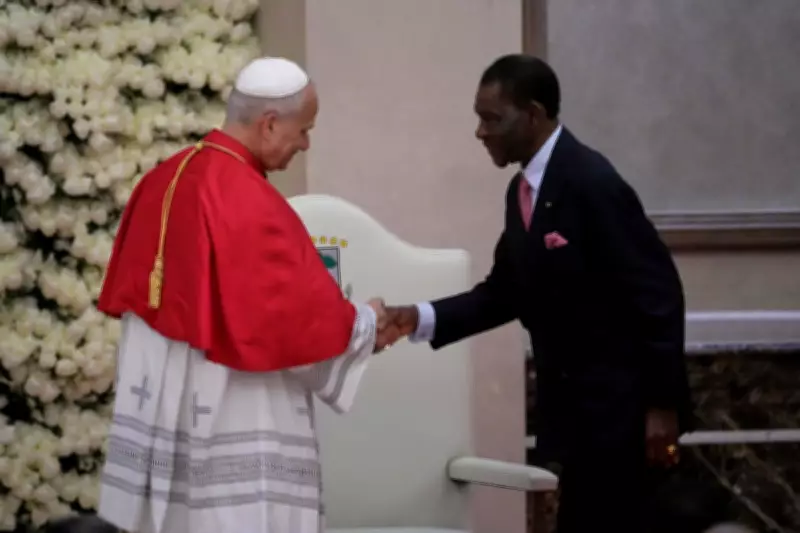
Exiles Fear Papal Visit Could Legitimize Equatorial Guinea's Longtime Ruler
Individuals who have fled reported abuses in Equatorial Guinea and sought refuge abroad are expressing deep concern that Pope Leo XIV's visit to the Central African nation could serve to legitimize and launder the image of Africa's longest-serving ruler, President Teodoro Obiang Nguema Mbasogo. The pontiff's trip represents the final stop on a four-nation African tour, following visits to Algeria, Cameroon, and Angola.
Voices from Exile Express Alarm
Gutïn Bae Tongala, a 59-year-old cook originally from the island of Annobon in Equatorial Guinea, now residing in Spain, is among those deeply troubled by the papal visit. He fled his homeland in 2002, citing government abuse of minority groups and decades of systemic oppression under the ruling family. "Obiang knows very well that the pope’s visit comes like a ring on his finger," Tongala stated from Spain. "Obiang will use the pope’s presence to clean up his image."
This sentiment is echoed by other exiles and activists who fear the president will tout the high-profile visit as an implicit blessing for his government, which has been accused by human rights organizations of maintaining a repressive regime. Tutu Alicante, a U.S.-based activist leading the EG Justice rights group, noted that President Obiang has historically sought international respect through major events, such as hosting the Africa Cup of Nations football competition twice, in 2012 and 2015.

The Catholic Church's Deeply Entrenched Role
Equatorial Guinea, while officially a secular state, has a population that is approximately 75% Catholic, one of the highest percentages on the African continent. The Catholic Church, a legacy of Spanish colonization, is deeply woven into the nation's political and social fabric. Churches frequently serve as educational centers, hospitals, and community spaces for the population of nearly 1.9 million people.
State ceremonies, including presidential inaugurations and Independence Day celebrations, traditionally feature a Catholic Mass. In a symbolic display of this connection, President Obiang was inaugurated in 2011 at the massive neo-Gothic Basilica of Immaculate Conception in his hometown of Mongomo, a structure modeled on St. Peter's Basilica in the Vatican.
"The church leaders are very much interconnected intrinsically with the government," explained activist Tutu Alicante. "Part of it is the fear the government has instilled in everyone, including the church, and part of it is the monetary gains that the church derives from this government."
A Complex Historical Relationship with Power
The relationship between the Catholic Church and political power in Equatorial Guinea has been historically complex. Former President Francisco Macias Nguema persecuted Catholics, closed churches, and banned the church in 1978 in an effort to sever ties with the former colonial power, Spain.
His nephew, Teodoro Obiang Nguema Mbasogo, deposed him in 1979 and overturned the ban. Obiang transitioned to a civilian leader in 1982, the same year he hosted Pope St. John Paul II during a visit. He has remained in power since, winning six consecutive elections under circumstances widely criticized by international observers.
Calls for Papal Advocacy Amidst Documented Abuses
Despite Pope Leo XIV's denunciations during his visit against the "colonization" of Africa's minerals and the "lust for power," and his calls for justice and closing the gap between the privileged and disadvantaged, exiles and rights groups are pleading for more direct condemnation of the regime's practices.
More than half of Equatorial Guinea's population lives in poverty, according to World Bank data. Human rights organizations have repeatedly accused the government of using the nation's substantial oil wealth to enrich primarily the president's family. One of the president's sons, who serves as vice president, has been convicted of money laundering and embezzlement in France and sanctioned by the United Kingdom.

A 2024 Amnesty International report documented "widespread use of arbitrary arrests, torture and other ill-treatment" in the country. In the same year, the Spanish high court investigated Carmelo Ovono Obiang, another of the president's sons, for the alleged kidnapping and torture of two opposition leaders holding Spanish citizenship.
Experts and citizens now living abroad argue the president is leveraging the papal visit to seek legitimacy despite widespread discontent over his family's enduring grip on power. Recent controversies include a prolonged government internet shutdown on Annobon Island following protests and the country's involvement in opaque deals with the United States to receive deported migrants.
Jorge Awal, a 27-year-old now working in Spain's private sector, voiced a common plea among the diaspora: "I would like the pope to speak out in defense of the Christians who live in Equatorial Guinea and who have to endure the abuses of human rights that occur day by day at the orders of Obiang Nguema."
When contacted by The Associated Press, Catholic officials in Equatorial Guinea and the government did not respond to requests for comment on the reported abuses. However, the Rev. Fortunatus Nwachukwu, a senior official in the Vatican's missionary evangelization office, emphasized the church's role in difficult civil spaces. "Should the church go to war against the government? Surely no," Nwachukwu stated. "Should the church swallow everything as if it were normal? No. The church has to continue preaching justice, always in defense of life, human dignity and the common good."