Four Years of Conflict: Assessing the Grim Realities of Russia's War in Ukraine
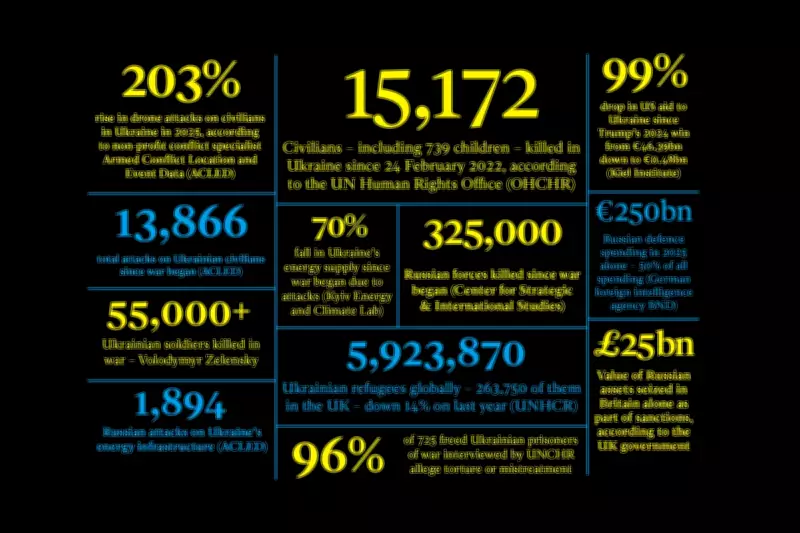
Russia's full-scale invasion of Ukraine has now persisted for four devastating years, with no clear resolution in sight despite numerous peace negotiations mediated by the United States. As this grim anniversary arrives, the brutal war of attrition continues to exact a horrific human cost, having claimed over 15,000 Ukrainian civilian lives. The conflict has not only transformed the landscape of modern warfare but also reshaped global political alliances and humanitarian crises.
Mounting Civilian Casualties and Humanitarian Crisis
The past year has witnessed Russian forces increasingly targeting civilian populations, resulting in higher casualty figures than any period except the initial invasion year of 2022. In 2025 alone, there were 14,656 civilian casualties including both injuries and fatalities, representing a 31 percent increase from the previous year. Since the conflict began, the United Nations Office of the High Commissioner for Human Rights has documented 15,172 Ukrainian civilian deaths, including 739 children.
Russian military casualties reached a staggering 1.2 million last month, according to the Centre for Strategic and International Studies, marking a death toll unprecedented for any major power since World War II. Ukrainian President Volodymyr Zelensky has confirmed that 55,000 Ukrainian soldiers have been killed since the full-scale invasion began, up from 46,000 reported last year. Independent analyses suggest Russian military fatalities may be substantially higher, with the BBC identifying 186,102 deceased Russian soldiers, though experts estimate this represents only 45 to 65 percent of actual losses.

Escalation of Drone Warfare and Infrastructure Attacks
Moscow dramatically intensified its drone production capabilities in 2025, enabling nightly launches of hundreds of unmanned aircraft against Ukrainian targets with devastating consequences. Data from monitoring group Armed Conflict Location & Event Data reveals that more than half of the 58,495 air and drone strikes conducted by both Russian and Ukrainian forces since 2022 occurred in the past year alone.
The rapid expansion of drone warfare and increasingly autonomous systems has made it easier to carry out attacks with devastating consequences for civilians, explained Uliana Poltavets, Ukraine programme coordinator for Physicians for Human Rights.
Attacks on Ukraine's civilian infrastructure reached unprecedented levels in 2025, with 662 assaults on healthcare facilities representing a 48 percent increase from 2024. Russia specifically targeted Ukraine's energy infrastructure 1,077 times between February 2024 and February 2025, a 224 percent surge from the previous year that left millions without power or heating during the coldest winter in years, with temperatures plunging to -26°C.
Elisabeth Haslund, spokesperson for the UN's refugee agency, warned that such systematic destruction will significantly complicate future reconstruction efforts. Recovery will not happen overnight, she emphasized. Even with a ceasefire in place, humanitarian needs will persist for some time.
Stalemate on the Frontlines and Strategic Implications
Russian territorial gains have remained marginal despite enormous human cost. Since 2022, Putin's forces have expanded their controlled territory in Ukraine by only about four percent, bringing their total control to approximately 20 percent of the country. The fiercest fighting has centered around Pokrovsk in Donetsk, a strategic former transport hub connecting Ukrainian frontline positions.
Military analyst Emil Kastehelmi of the Black Bird Group suggested Russia's infrastructure attacks serve multiple strategic purposes: Try to lower the fighting morale of Ukrainian civilians, try to hinder the functionality of Ukrainian society as a whole, or weaken military production capabilities as much as possible. Russia is forcing Ukraine to make difficult decisions regarding prioritization.

The Institute for the Study of War describes Russian advances as continuing at a footpace in eastern Ukraine and do not portend the collapse of Ukrainian lines. While Ukrainian forces conducted successful counterattacks in Dnipropetrovsk and Zaporizhzhia in February, these gains remained localized and haven't significantly altered the overall strategic situation.
Geopolitical Shifts and Funding Challenges
The political landscape transformed dramatically in 2025 as the United States, previously Ukraine's most generous ally, withdrew nearly all financial, humanitarian, and military support under the Trump administration. American aid plummeted by 99 percent from a record €46.39 billion in 2024 to just €0.48 billion in 2025 as the Trump administration sought to pressure both countries toward a peace agreement.
This withdrawal forced European nations to dramatically increase their support, boosting assistance from €43.54 billion in 2024 to €72.8 billion in 2025, a 67 percent increase. In December, European Union countries agreed to an additional €90 billion support loan, providing a vital lifeline for Ukraine's struggling wartime economy.
President Zelensky faces the dual challenge of maintaining support from a volatile US administration while resisting Moscow's uncompromising territorial demands during ongoing but largely fruitless peace negotiations. With peace talks showing little substantive progress, questions remain about how long European financial support can be sustained.
The Centre for Strategic and International Studies warns that combined Russian and Ukrainian casualties could reach two million by spring 2026, with Russian forces suffering the majority of these losses. As the war enters its fifth year, the human tragedy continues to unfold alongside profound transformations in warfare tactics, international alliances, and the very future of European security architecture.