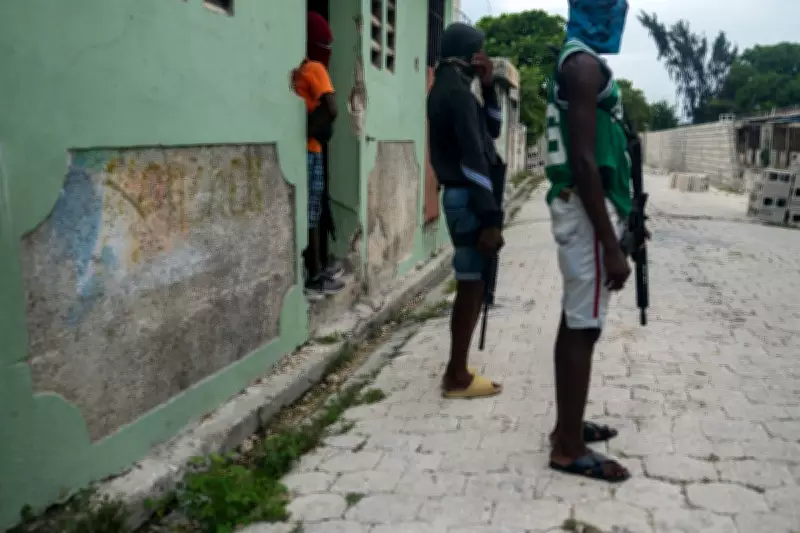
Haiti's Violent Gangs Prey on Hungry Children in Post-Assassination Chaos
Haiti continues to struggle with escalating violent crime five years after the assassination of President Jovenel Moïse, with armed gangs now exploiting a devastating hunger crisis to recruit vulnerable children. A British charity operating on the island reveals that the persistent power vacuum has left the most defenseless populations at severe risk of exploitation and violence.
A Mother's Flight from Gang Violence
Altagrace, a mother residing in Haiti's capital, Port-au-Prince, recalls the traumatic moment that irrevocably altered her life. "Gangs invaded the neighbourhood and started shooting," she states. The crossfire resulted in her brother's death, compelling her to flee the area to preserve her own safety. "If we didn't leave the area, we would become part of these groups," she explains.
Altagrace is among 1.4 million individuals internally displaced as Haiti contends with the leadership void created by the president's assassination nearly five years prior. During this period, firearms have poured into the nation without restriction, empowering armed factions and rendering people like Altagrace and her 14-year-old daughter, Anne, susceptible to manipulation and brutality.

Life in Overcrowded Displacement Camps
Anne describes existence as "very difficult" since their relocation across the city to evade violence, followed by transfer to a camp for displaced persons. Her mother reports that up to ten people are squeezed into minuscule rooms, living "like animals in a cage." These camps, intended as sanctuaries for civilians escaping terror, have become hotspots of institutional collapse, where malnutrition and disease proliferate wildly.
No Haitian authority possesses sufficient strength to reclaim control, ensure justice, or deliver fundamental life necessities. "When we were at home, my mother used to prepare food in the morning when we had to go to school, but in the camp, there are far too many people," Anne testified in accounts shared with The Independent.
Gangs Exploit Hunger to Lure Children
Women and children face exceptional danger of violence and abuse within these camp environments. According to Mary’s Meals, a British charity, murderous gangs are attempting to attract young, starving individuals with pledges of sustenance. Haiti has endured social and political turmoil for decades, with poverty fueling high crime rates and feeble law enforcement unable to counter gang proliferation.
The COVID-19 pandemic, fuel scarcities, and extreme weather events have intensified pre-existing inequalities. The country descended deeper into crisis following the July 2021 assassination of President Moïse. Police implicated a group of foreign mercenaries in the attack, arresting dozens, including his wife. The New York Times indicated he was killed due to his endeavors to combat arms and drug smuggling.
Gang Consolidation and Humanitarian Catastrophe
That murder case was still progressing through courts as recently as March, while gangs have solidified power and battled each other for influence in the intervening years. Approximately 90 percent of the capital now falls under gang dominion, forcing hundreds of thousands from their employment, educational institutions, and residences into camps throughout lawless Haiti.
UNICEF declares this has triggered the worst hunger crisis in the nation's history, reporting in October that over half the population confronts 'crisis' levels of food insecurity. Individuals have been herded into displacement camps away from violence, yet these locations also suffer from inadequate supplies.
The organization cautioned last year that child recruitment into gangs skyrocketed by 70 percent in 2024 as gangs focused on famished children trapped in deplorable conditions within overcrowded camps. UNICEF asserts that half of all armed group members are children, some as youthful as eight years old. Around 1.2 million Haitian children live in terror of armed violence and recruitment by gangs capitalizing on their hunger.

The Lethal Cycle of Child Recruitment
"Many are taken by force. Others are manipulated or driven by extreme poverty," elucidated UNICEF spokesperson James Elder. "It’s a lethal cycle: Children are recruited into the groups that fuel their own suffering." Mary’s Meals, a Scottish charity collaborating with local partners in Haiti to nourish schoolchildren, states the situation is "far more severe" today than at their inception. Killings, trafficking, murder, and sexual violence happen daily.
Emmline Toussaint, who coordinates a school feeding program in and around Port-au-Prince—where gangs control roughly 85 percent of the city—informed The Independent that providing essentials is crucial for deterring youth from gangs. "When you are a child that has been displaced, with no access to clean water, with the everyday risk of being raped, would he or she wake up in the morning and go to school? They would not be motivated. The motivation comes from the fact that they know there is that school meal waiting for them."
"The first thing that you're thinking of is your survival, if I need to survive what do I need? First is the food," Toussaint emphasized.
Food as a Beacon of Hope
Granting these children food access helps mitigate worries about gangs preying on vulnerable youngsters entangled in conflict. Discussing her own children, Altagrace remarks: "With the help of Mary’s Meals at school, I no longer have concerns. The children always come and tell me about the different types of food they are offered. Then, as a mother, even if I can't eat, if my child finds something to eat, it makes me happy."
"You see them being happy while at school, they're playing, you see their smiles when they have that meal. It's a good sign, it’s a sign of hope," she concludes, highlighting how basic nourishment can offer a fragile lifeline amidst pervasive despair.