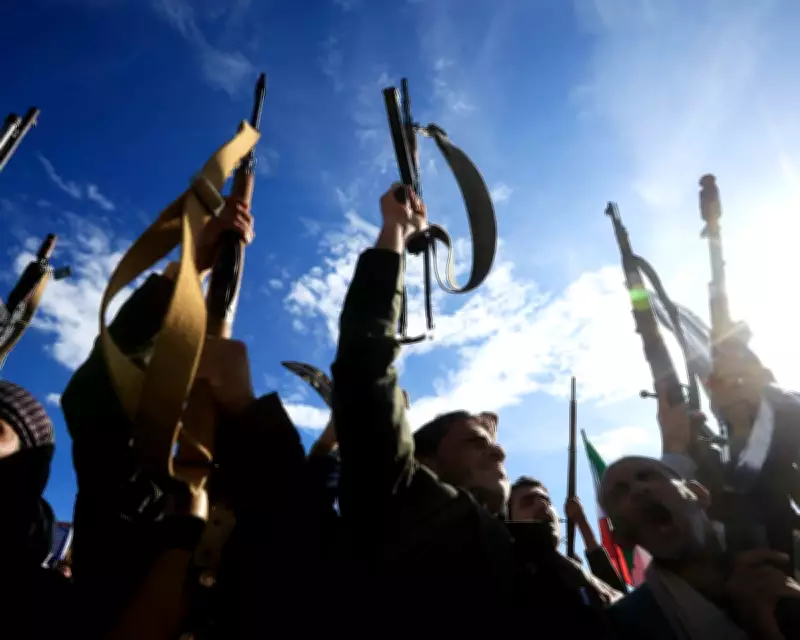
Houthi Forces Enter Iran Conflict with Missile Attacks on Israeli Military Sites
The US-Israeli war with Iran has expanded significantly with the entry of Houthi forces in Yemen, marking a dangerous escalation that threatens to spread the conflict further and inflict more damage on the global economy. Houthi supporters in the Yemeni capital of Sana’a rallied in solidarity with Iran, underscoring the group's alignment with Tehran.
Missile Strikes and Regional Tensions
Houthi forces, close allies of Iran, announced on Saturday that they had fired a salvo of ballistic missiles at sensitive Israeli military sites. The group's military spokesperson, Yahya Saree, later stated that a second wave of strikes was carried out using a barrage of cruise missiles and drones, targeting additional military locations. Saree vowed in a televised speech to continue military operations until Israel ceases its attacks and aggression on all fronts.
Israel confirmed intercepting one missile originating from Yemen, but the attacks highlight the Houthis' growing role in the conflict. Multiple outlets reported that this was the second Houthi attack on Israel in less than 24 hours, following their official entry into the war on Saturday.

Threat to Global Trade and Economy
The involvement of the Houthis, who control Yemen's most populous areas, poses a direct threat to the Bab al-Mandab strait at the southern end of the Red Sea. This strategic choke point is crucial for energy supplies and other trade in and out of the Middle East. With Iran's near-total closure of the Strait of Hormuz, a shutdown of the Bab al-Mandab could amplify the war's already severe impact on the global economy.
Farea Al-Muslimi, a research fellow at Chatham House, warned that this escalation marks a serious concern, with potential disruptions to key commercial maritime routes. He emphasized that vital economic and military infrastructure across the Gulf region may become increasingly exposed.
Diplomatic Efforts and Regional Dynamics
In response to the escalating conflict, Pakistan has announced it will host a meeting of Middle Eastern powers on Monday, aiming to develop a regional approach to ending the war. The talks will include the foreign ministers of Saudi Arabia, Turkey, and Egypt. However, the absence of any warring parties casts doubt on the effectiveness of these diplomatic efforts, challenging persistent US claims of progress.
Pakistan's foreign minister, Ishaq Dar, stated that Iran has agreed to allow an additional 20 Pakistani-flagged vessels to pass through the Strait of Hormuz, with two permitted daily. Meanwhile, Saudi Arabia has been able to divert some oil exports via pipeline to the Red Sea, but commentators warn that if this route is threatened, Riyadh could enter the war directly.
Wider Escalations and Humanitarian Concerns
The conflict's expansion is evident in multiple fronts. US media reported that a missile and drone attack on Prince Sultan airbase in Saudi Arabia wounded at least 12 US soldiers, two seriously. Drones also struck Kuwait International Airport, causing significant damage to its radar system.
In a further sign of spreading hostilities, Iran's central operational command claimed it targeted a Ukrainian anti-drone system depot in Dubai, alleging it was assisting US forces. Ukraine has been providing anti-drone technology to Gulf states, drawing on experience from attacks by Russian forces using Iranian-designed drones.
Ukrainian President Volodymyr Zelenskyy announced defence agreements with the United Arab Emirates and Qatar, following a similar pact with Saudi Arabia last week. Additionally, air defences shot down a drone near the residence of Iraqi Kurdish leader Masoud Barzani in Erbil, highlighting rising tensions in northern Iraq.
Weaponry and International Reactions
Reports indicate the use of cluster munitions in the conflict, with experts citing Gator anti-tank mines found in an Iranian village near a missile base in Shiraz. These weapons are banned by over 100 countries due to their indiscriminate nature. The US is the only party in the conflict known to possess such munitions, though Iran has used ballistic missiles with cluster warheads in strikes on Israel.

Admiral Brad Cooper, head of US Central Command, condemned cluster bombs as inherently indiscriminate. Despite US claims to have devastated Iran's military, Reuters cited intelligence sources suggesting Washington has destroyed only about a third of Iran's missile and drone arsenal.
Political Maneuvering and Future Risks
As the war enters its second month, Pakistan has sought to act as a peace broker, with Prime Minister Shehbaz Sharif holding extensive discussions with Iran's President Masoud Pezeshkian. However, the effectiveness of regional meetings without key protagonists remains uncertain.
Saudi Arabia's Crown Prince Mohammed bin Salman has privately urged former US President Donald Trump to escalate the offensive against Iran, fearing a wounded but undefeated Tehran regime. Trump suggested that Saudi Arabia should normalize relations with Israel in return for the attack on Iran, referencing the Abraham Accords.
The survival of Iran's regime after a month of bombing leaves Trump with a choice: seek an exit from the costly war or intensify the campaign, possibly with ground troops. Thousands of US marines and airborne forces have been deployed, raising speculation of a land incursion on Kharg Island or islands in the Hormuz strait.
Tehran has warned that such actions would lead to a complete shutdown of the Strait of Hormuz and escalated attacks on regional infrastructure, including desalination plants essential for water supply in Gulf countries. Al-Muslimi cautioned that any further escalation, combined with renewed Saudi-Houthi confrontation, could trigger a major regional conflagration, more intense and devastating than previous conflicts.