Iranian Beautician's Videos Capture Protest Violence and Aftermath of Fear
A 37-year-old Iranian beautician who filmed the violent crackdown on protesters in her hometown of Karaj now lives in terrified isolation, too afraid to leave her home. The woman, whose identity is being withheld for security reasons, participated in the massive demonstrations on January 8, capturing raw footage of the deadly confrontation between protesters and security forces.
A Night of Collective Boldness Turns to Bloodshed
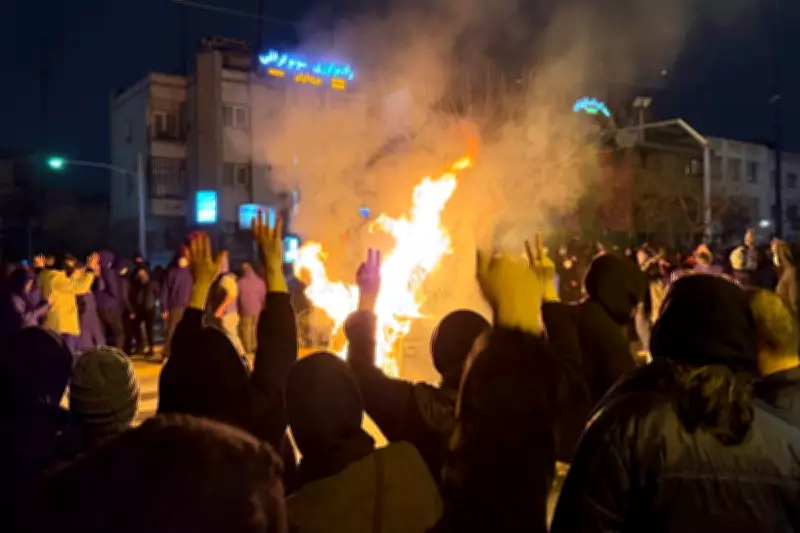
On the night of January 8, hundreds of thousands of Iranians took to the streets across the country in what were possibly the largest anti-government rallies since the 1979 Islamic Revolution. The beautician marched with friends through Karaj, recording as they chanted against the ruling theocracy. Her videos show protesters filling a main boulevard, their confidence bolstered by numbers, with women, men, and children joining cries of "Death to the dictator" and "Death to Khamenei," referring to Supreme Leader Ali Khamenei.
The atmosphere shifted dramatically when violence erupted. Tear gas canisters landed among the crowd, followed by gunfire. "Don't be afraid," the beautician screamed repeatedly in her recording, her voice breaking as the crowd echoed the chant. She cried out, "Are they using live bullets? Shameless!" The videos depict chaotic scenes: protesters running for cover among trees, small fires glowing in the darkness, and later, groups huddled over wounded individuals, frantically trying to stop bleeding with makeshift bandages.

Unprecedented Crackdown and Mounting Casualties
Monitoring groups report at least 6,854 people were killed, most on January 8 and 9, with estimates suggesting the true toll could be triple that figure. The government has acknowledged over 3,000 deaths, denouncing the protests as "a coup." An unprecedented clampdown followed, including a monthlong internet blackout that obscured the full extent of the violence. More than 50,000 people have been reported detained.
The beautician's account, verified by The Associated Press for location and authenticity, aligns with documentation from other protesters and rights groups. She wrote to a relative in Los Angeles that she witnessed nearly 20 people shot in her immediate circle. The parents of a family friend were killed while trying to assist a wounded person. Another friend's father was fatally shot, and authorities later demanded $4,500 equivalent for the release of his body.
From Hope to Despair: A Personal Journey
Struggling in Iran's crippled economy, the beautician worked as a nail technician, having given up on starting a family due to financial hardship and repression. She had participated in earlier protests, including the 2022 demonstrations ignited by Mahsa Amini's death, but grew disillusioned by the violence that left over 500 dead and 22,000 detained. Her relative said her desire shifted "from saving her country to saving herself."
The final straw came when economic pressures made basic goods like cooking oil unaffordable. In December, she earned only $40, down from an already paltry $300-$400 monthly average. This propelled her to join the January 8 protests, where the initial exuberance quickly turned to shock and paralysis.
A Nation Blanketed in Fear and Grief
Since that night, the beautician has retreated into terrified isolation, moving in with her mother and rarely venturing outside. She described a blanket of fear settling over Iran, with people resembling "walking corpses" devoid of hope. "We have seen so many horrific scenes of people being killed before our eyes that we are now afraid to leave our homes," she wrote.
She takes tranquilizers but cannot sleep, haunted by the stress that security agents might attack homes at any moment. Neighbors have agreed not to admit anyone who rings doorbells. In a late January message, she expressed despair about change, fearing Iran's leaders will become entrenched and that "all those people who died will have died in vain." She saw little hope in international diplomacy, including Iran-U.S. nuclear talks, feeling abandoned by the world.

The beautician's videos and messages provide a poignant, firsthand account of both the collective boldness that fueled the protests and the profound trauma that has followed one of the bloodiest crackdowns in the Islamic Republic's history. Her story illustrates how a nation's political unrest has become deeply personal, leaving countless individuals trapped between quiet rage and paralyzing fear.