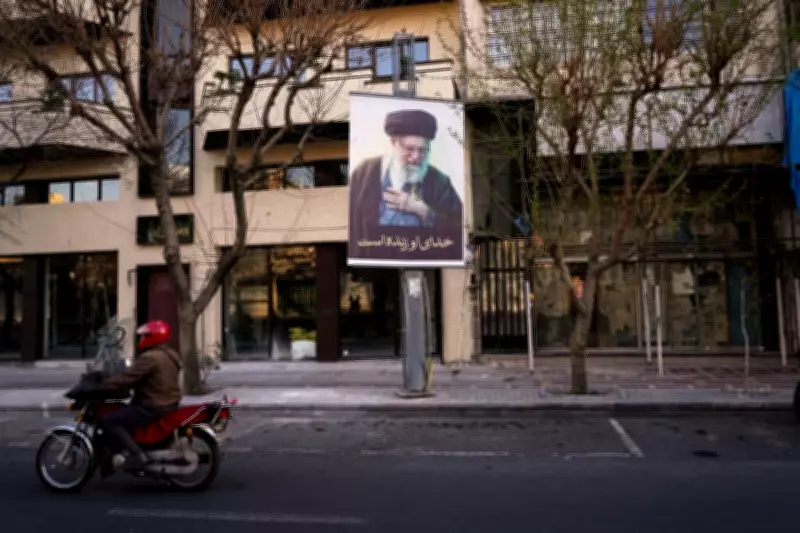
In the wake of Ayatollah Ali Khamenei's death, Iran has been thrust into a state of profound turmoil, with public reactions ranging from jubilant celebrations to deep-seated fear and uncertainty. As U.S. and Israeli bombardment persisted for a second day on Sunday, the nation grappled with the loss of its supreme leader, who had dominated the Islamic Republic for nearly four decades, alongside key military figures.
Celebrations and Cautious Optimism
Across Iran, scenes of open jubilation emerged, with people dancing in streets, honking car horns, and shouting joyfully from windows and rooftops. Videos verified by the Associated Press showed crowds in cities like Karaj, near Tehran, engaging in raucous celebrations. One man in northern Tehran expressed his inner elation, stating, "Inside, we are in party mode," but noted that public displays were muted due to fears of retaliation from authorities.
Golshan Fathi, a Tehran resident, described the atmosphere as living "between hope and fear," with some Iranians viewing Khamenei's death as a potential turning point. A doctor in Rasht shared that it was "one of the best nights, if not the best night, of our lives," highlighting the emotional release felt by many.

State Response and Public Mourning
In contrast, authorities swiftly mobilized to demonstrate control, rallying massive crowds in cities such as Isfahan and Yazd to mourn Khamenei, whom state media declared a martyr. Tens of thousands filled squares, waving Iranian flags and chanting anti-American slogans. Parliament speaker Mohammad Bagher Qalibaf emphasized on state TV that the government and military were prepared for such scenarios, asserting their resilience beyond individual leaders.
President Masoud Pezeshkian announced the formation of a new leadership council, with the foreign minister indicating a new supreme leader would be selected within days. This rapid response aimed to project stability amid the chaos.
Security Grip and Repression
Despite calls from former U.S. President Donald Trump for Iranians to seize their government, the state's security apparatus remained formidable. The Basij paramilitary, instrumental in crushing last month's protests, maintained a heavy presence in Tehran. Reports emerged of Basijis pulling a man from his car for honking in celebration, underscoring the risks of dissent.
Many Iranians, still reeling from last month's bloody crackdown that killed thousands, expressed reluctance to join new demonstrations. A doctor in Rasht noted, "I don't think that the people have their determination in their own hands yet," reflecting widespread fear of further violence.
Bombardment and Humanitarian Crisis
As celebrations unfolded, Iranians faced the harsh reality of ongoing bombardment. Blasts in Tehran sent plumes of smoke into the sky near government buildings, with authorities reporting over 200 deaths, including 165 at an all-girls school in the south. Residents rushed to supermarkets, emptying shelves of essentials like water and bread, while long lines at gas stations indicated fears of shortages or plans to flee the capital.
Iran retaliated with missile strikes on Israel and Gulf Arab states, as Israel pledged non-stop attacks. This escalation added to the uncertainty, with one 27-year-old Tehran resident describing a nearby strike as terrifying and wishing it were a bad dream.
Deep Societal Divisions
Iran's society remains deeply split. Last month's protests, which saw hundreds of thousands chanting "Death to Khamenei," highlighted significant opposition to clerical rule, yet loyalists continue to support the system for religious or patronage reasons. Experts like Esfandyar Batmanghelidj of Johns Hopkins University warned that while the strikes might embolden some, the regime's repressive capacity persists, making mass uprisings challenging.
Arang Keshavarzian of New York University noted that despite grievances, Iran lacks the organized movements seen during the 1979 revolution, suggesting that bombing alone won't spur social change. Reza Mehrabi, 67, cautioned against premature celebrations, recalling the aftermath of the 1979 revolution and urging careful consideration of Iran's path forward.

As Iran navigates this critical juncture, the interplay of foreign intervention, internal repression, and public sentiment creates a volatile landscape. The nation stands at a crossroads, with its future direction hanging in the balance amid ongoing conflict and division.