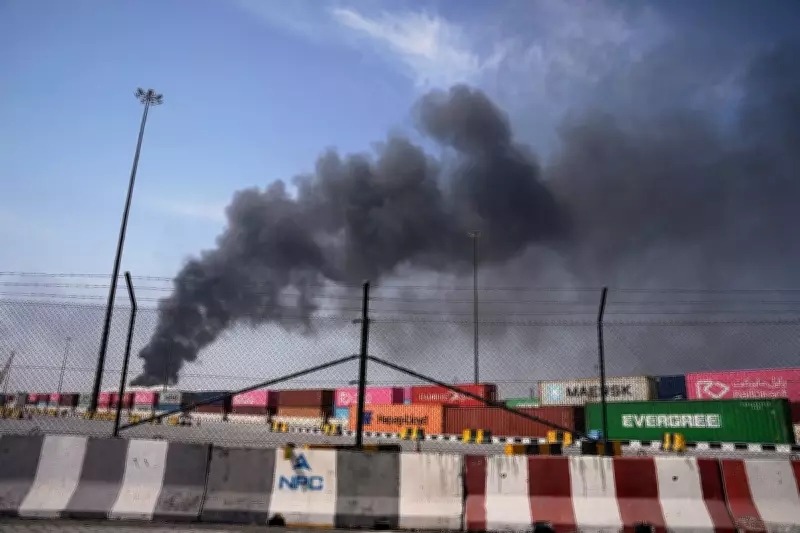
Iran's Deliberate Strategy: Bombing Dubai and Neighbours to Destabilise Region
A Middle East expert has provided a detailed analysis explaining why Iran launched ballistic missiles and drones at Dubai and its neighbouring Gulf states. This aggressive action represents a deliberate strategy by the Iranian government designed to inflict early and substantial costs on regional stability.
Retaliation Following US-Israeli Strikes
The recent conflict escalation began with joint US-Israeli military operations over the weekend that resulted in the death of Iran's supreme leader and prompted immediate retaliation. Iran responded with volleys of ballistic missiles and drones targeting not only Israel but also several Persian Gulf neighbours including the United Arab Emirates, Saudi Arabia, Oman, Bahrain, Kuwait and Qatar.
Hundreds of missiles and drones were launched across the Gulf region, forcing the grounding of commercial aircraft and creating widespread disruption. This occurred despite none of these nations having officially coordinated with the initial US-Israeli operations against Iran.

Targeting US Security Guarantees
Iran's selection of targets reveals a calculated approach. Almost all Gulf states share one crucial characteristic: they maintain security guarantees from the United States and host significant US military installations. These bases fall comfortably within range of Iran's most plentiful ballistic missile systems.
The strategic value of these facilities cannot be overstated. The base struck in Bahrain served as headquarters for the US Fifth Navy Fleet, while Al Udeid Airbase near Doha, Qatar - home to US Central Command and approximately 10,000 US troops - also faced Iranian ballistic missile attacks. Iran recognises the sophistication of US early warning systems and likely doesn't anticipate causing substantial damage to American infrastructure.
An Unpopular Regional Power
Despite Iran's relative size and military capabilities within the region, the government maintains strained relationships with neighbouring states. At best, Iran is viewed as a regional rival; at worst, as an outright adversary. Saudi Arabia and Iran have engaged in a proxy war over Yemen for more than a decade, while Iran claimed historical ownership over Bahrain as recently as December last year.
Other Gulf states including the UAE, Kuwait, Oman and Qatar have pursued more pragmatic relations with Iran, maintaining regular diplomatic channels and offering mediation through Gulf Cooperation Council mechanisms. Despite these simmering tensions, Iran had never previously engaged in direct military confrontation with any of these nations until the recent attacks.
The Strategic Objective: Regional Destabilisation
Iran's fundamental aim appears to be making the entire region less stable and ensuring all neighbours feel the consequences of continued hostilities. The regime effectively vows that if military operations persist, the relative peace and prosperity the Gulf has enjoyed will come to an abrupt end.
Iran hopes neighbouring states will perceive this as a war of choice initiated by the US and Israel, with Gulf countries being unwillingly dragged into hostilities. This forces Gulf states to either reinforce their alliance with the United States or actively work toward de-escalation. The strategy represents Iran's signature "forward defence" approach - attacking distant targets to demonstrate the depth of its military reach.
Expanding the Conflict Zone
Beyond direct missile attacks, Iran maintains a damaged but still extensive network of independent proxies across the Middle East. Groups in Yemen, Iraq and Lebanon remain loyal to the Islamic Republic and may employ long-term insurgent strategies on its behalf. Hezbollah has already resumed hostilities by firing projectiles into Israel from Lebanon, opening another conflict front.
The strategically vital Strait of Hormuz, through which twenty percent of global oil travels, represents another weapon in Iran's arsenal. Two oil tankers have already been attacked in the strait, causing Brent Crude prices to surge by thirteen percent. These attacks differ significantly from the calculated de-escalatory strikes Iran conducted in 2024 and 2025.

Existential Conflict for the Islamic Republic
This conflict represents an existential struggle for the Iranian regime. The extensive attacks across the Gulf serve as a stark reminder that Iran will employ every available means to drag the entire region into chaos, uncertainty and instability to ensure its own survival. At minimum, Iran seeks to create significant political consequences for all involved parties.
The critical question remains whether the regime will survive long enough for these consequences to take effect. While Iran possesses the region's most extensive and varied missile arsenal, sustaining this strategy indefinitely presents logistical challenges. Other nations may simply choose to wait out the bombardment. The Gulf states' increasingly strained relations with Israel over the past two years might make several reluctant to deepen their involvement, though increased military pressure on Iran remains possible if Gulf states become more engaged in operations.