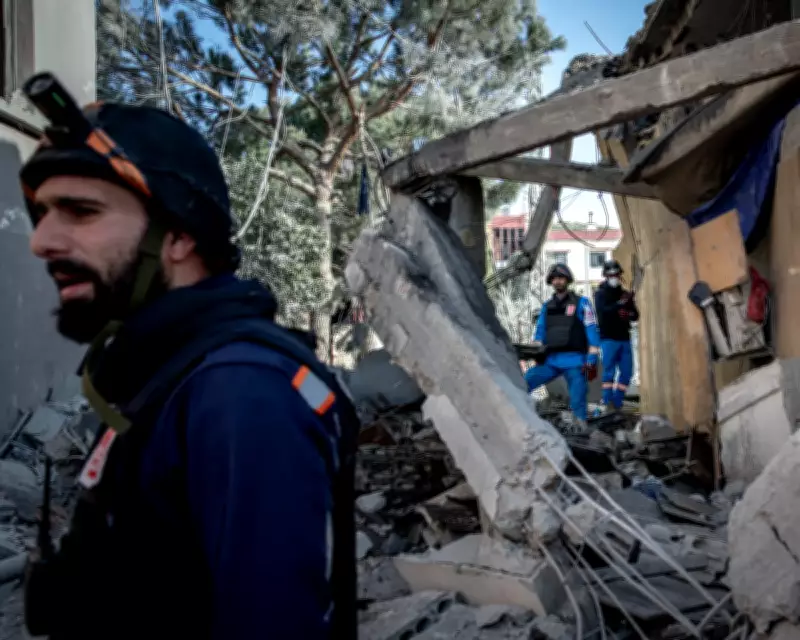
Israeli Forces Escalate Attacks on Healthcare Workers with Deadly 'Quadruple Tap' Strikes in Lebanon
Paramedics searching for survivors in Nabatieh on Monday, shortly after an Israeli airstrike, represent just one instance in a devastating pattern of attacks targeting medical personnel in Lebanon. The Lebanese health ministry has condemned these actions, stating that the killing of 91 healthcare workers demonstrates "total disregard" for international law.
Mayfadoun Rescue Mission Turns Deadly
When emergency calls came through regarding an Israeli airstrike in Mayfadoun, southern Lebanon, most paramedics hesitated, having witnessed colleagues previously killed in double-tap attacks targeting rescuers. However, medics from the Islamic Health Association (IHA) rushed to the scene immediately.
By the time other emergency workers arrived, they discovered the IHA medics had been caught in a second strike. As they began evacuating their wounded colleagues, their ambulances were hit in two further attacks, creating what responders now term a "quadruple tap" assault.

One paramedic covered his ears and screamed, convulsing in pain as shrapnel shattered the back window of his ambulance. The Wednesday afternoon rescue mission had transformed into a nightmare as Israel executed three consecutive strikes targeting three separate sets of ambulances and medical workers.
Casualties and International Law Violations
The coordinated attacks killed four medics and wounded six others from three different ambulance corps, according to medical sources. Three medics belonged to the Hezbollah-affiliated IHA and Amal-affiliated medical corps, while one served with Nabatieh emergency services.
Under international humanitarian law, all medical personnel are protected as non-combatants regardless of political affiliation. Lebanese rescuers have long feared double-tap attacks, where Israeli forces strike a location, wait for people to gather to help survivors, then attack again. Wednesday's three-wave assault following the initial strike prompted the coining of the terrifying new term: quadruple tap.
Video Evidence and Personal Tragedies
Video footage captured by a paramedic at the scene shows rescuers loading two wounded individuals into ambulances when a bomb lands beside their vehicle. Paramedics rush to extract the motionless driver, pulling him from the blood-splattered ambulance while uttering prayers. They subsequently carry two more blood-covered medics from their vehicle onto stretchers.
Among those killed was Fadel Sarhan, 43, survived by his eight-year-old daughter. Ali Nasr al-Deen, head of the Mayfadoun civil defence centre who grew up with Sarhan, described him as "a very loved person" with a bold yet emotional personality. "He used to feed the cats and dogs. He would bring pet food from Beirut so they wouldn't go hungry. He was that kind of person, caring and attentive. It's a huge loss for us," Nasr al-Deen stated.
Increasing Frequency of Healthcare Worker Funerals
Medics mourned their colleagues on Thursday at funerals in Nabatieh, near Mayfadoun. Such ceremonies have become increasingly common, with healthcare workers killed by Israeli bombings nearly daily. Mohammed Suleiman, whose 16-year-old son Joud was killed weeks earlier while serving as a paramedic, joined peers in burying another friend on Thursday. Hours after the funerals, Israel conducted another wave of airstrikes on Nabatieh.
Escalating Healthcare Infrastructure Targeting
Since the Israel-Hezbollah conflict began on March 2, Israel has killed 91 healthcare workers and wounded 214 more in Lebanon. Israel has provided minimal justification for repeated attacks on medical infrastructure and personnel, primarily accusing Hezbollah of using ambulances and hospitals to transport fighters and weapons without presenting evidence.
The Lebanese health ministry accused Israel of deliberately targeting ambulance crews, stating: "Paramedics have become direct targets, pursued relentlessly in a blatant violation that confirms a total disregard for all norms and principles established by international humanitarian law." The Israeli military did not immediately respond to requests for comment.

Hospital Attacks and International Condemnation
Hours after striking ambulances outside Nabatieh, Israel bombed the vicinity of Tebnine governmental hospital in south Lebanon. This marked the second time in two days that Israeli bombings damaged the healthcare facility, the only remaining public hospital in the area. The strikes injured 11 hospital workers and damaged the emergency department, according to the World Health Organization.
Video from April 14 showed Tebnine hospital workers clearing shattered concrete and debris from the emergency department after a strike blew in windows. WHO Director-General Tedros Adhanom Ghebreyesus commented: "I reiterate the call for the immediate protection of healthcare facilities, health workers, ambulances and patients. There must be safe, sustained and unhindered humanitarian access across Lebanon."
An ambulance in Tebnine was also struck on Thursday, critically injuring two medics according to the Lebanese health ministry. As healthcare workers witness colleagues and friends being killed, the psychological toll becomes increasingly unbearable.
Abbas Atwi, head of IHA's emergency department in Nabatieh, stated after a medical centre was targeted in March: "We have to go to places to rescue people, but then we get double tapped. But we will stay and keep going, we will not leave."