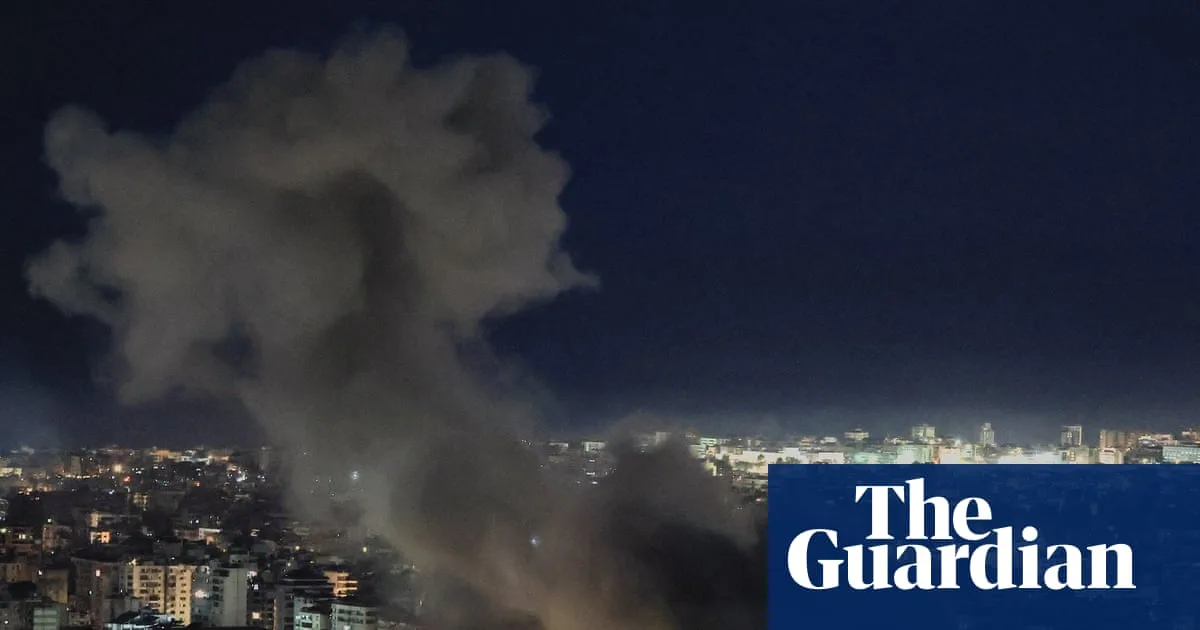
Israel Orders Mass Evacuation of Beirut Suburbs Amid Escalating Regional Conflict
Mass Evacuation Ordered in Beirut as Israel-Iran Conflict Intensifies

Mass Evacuation Ordered in Beirut as Regional Conflict Escalates

The Israeli military has issued an unprecedented evacuation order for the entire population of Beirut's southern suburbs, affecting more than 500,000 residents. This directive comes as Israel continues its bombardment of Lebanon and Iran, while Tehran launches retaliatory strikes across the Middle East.

Unprecedented Scale of Displacement

An Israel Defense Forces spokesperson urgently told all residents of Beirut's southern suburbs to "save your lives and evacuate your homes immediately" before Israel launched airstrikes on what were described as Hezbollah targets. The evacuation zone includes several hospitals and government ministries, raising serious humanitarian concerns.

Thursday's sweeping evacuation order represents an unprecedented scale of displacement. Even during the 13-month war between Israel and Hezbollah in 2024, no evacuation order of this magnitude was issued. The order has provoked panic throughout Beirut, with traffic at a standstill as thousands attempt to flee the affected areas.

Humanitarian Crisis Unfolding

The evacuation has created chaotic scenes throughout the Lebanese capital. Thousands of residents have resorted to walking, with women pushing strollers holding infants through bumper-to-bumper traffic. Families are making desperate appeals for rescue services to help extract elderly people who cannot leave their homes independently.

The Israeli military provided pre-approved routes north and east for evacuation—a tactic reminiscent of evacuation orders previously issued in Gaza. Israeli Finance Minister Bezalel Smotrich threatened on social media that "the southern suburbs of Beirut will become like Khan Younis", referencing a section of southern Gaza that has been almost entirely destroyed by Israeli bombs.

Regional Conflict Spreads

The conflict, now in its sixth day, has expanded dramatically. Iran has launched retaliatory strikes hitting targets as far afield as Cyprus, creating the world's largest travel disruption since the COVID-19 pandemic as countries shut down their airspaces. Oil prices have spiked amid the escalating tensions.

Gulf countries reported more incoming Iranian projectiles throughout Thursday, which Iran stated were targeted at US bases and personnel stationed in the region. A drone was shot down near the US al-Dhafra airbase in the United Arab Emirates, wounding six people when shrapnel fell. Qatar reported a missile attack on its capital, Doha, while Saudi Arabia announced it had destroyed a drone.

Casualty Figures Mount

Lebanon's Ministry of Health reported at least 102 people killed and 638 injured by Israeli airstrikes. The broader conflict has killed at least 1,230 people in Iran and about a dozen people in Israel. Six US soldiers have also been killed in the hostilities.

In Azerbaijan, a drone strike wounded four people near an airport in Nakhchivan, an area bordering Iran, while another drone fell close to a school. Azerbaijan's President Ilham Aliyev called this a "groundless act of terror and aggression" and stated the military was prepared to retaliate.

Political Dimensions Intensify

Meanwhile, former US President Donald Trump has inserted himself into the political dimensions of the conflict. Trump claimed he should be involved in choosing Iran's next supreme leader to replace Ayatollah Ali Khamenei, who was killed in a US-Israeli airstrike on the first day of the war.

Trump specifically stated that Mojtaba Khamenei, the 56-year-old son of the late supreme leader, would be an "unacceptable" choice. "We want to be involved in the process of choosing the person who is going to lead Iran into the future," Trump told Reuters, adding "We don't have to go back every five years and do this again and again... somebody that's going to be great for the people, great for the country."

Maritime Incident Adds to Tensions

Sri Lanka reported its navy had recovered at least 87 bodies after a US submarine sank an Iranian warship, the IRIS Dena, on Wednesday. Thirty-two sailors were rescued out of a total crew of almost 130. The country reported that another Iranian ship had arrived in its waters without providing further details.

Iran's Foreign Minister Abbas Araghchi reacted with fury to the sinking of the Dena, accusing the US of carrying out an "atrocity of sea." "Mark my words: The US will come to bitterly regret [the] precedent it has set," Araghchi stated on social media, while a senior Iranian cleric called for the exacting of "Trump's blood" on state television.

Military Operations Continue

The evacuation order for Beirut's southern suburbs was issued just one day after the Israeli military ordered all residents to flee the area south of the Litani River, which comprises about 10% of Lebanon. Israeli soldiers and Hezbollah fighters were engaged in combat in south Lebanon, according to UN peacekeepers in the area.

Despite the escalating nature of the conflict, the US provided an optimistic assessment of its campaign so far, with various officials offering differing goalposts and timelines for the war in Iran. The US and Israel continued their bombardment of Iran on Thursday, hitting key ballistic missile launchers, weapons caches, and security installations.

Human Rights Concerns Raised

Rights groups have condemned such sweeping evacuation orders in the past, arguing they amount to forced displacement—a potential war crime—and warning that non-able-bodied residents may not be able to comply. The World Health Organization reported that at least 13 hospitals and health facilities have been hit during attacks on Iran.

As the conflict affects 14 countries across the Middle East and beyond, fears continue to mount that the violence could spread further, creating one of the most significant regional crises in recent memory.