Monks Complete Epic Peace Odyssey at Lincoln Memorial
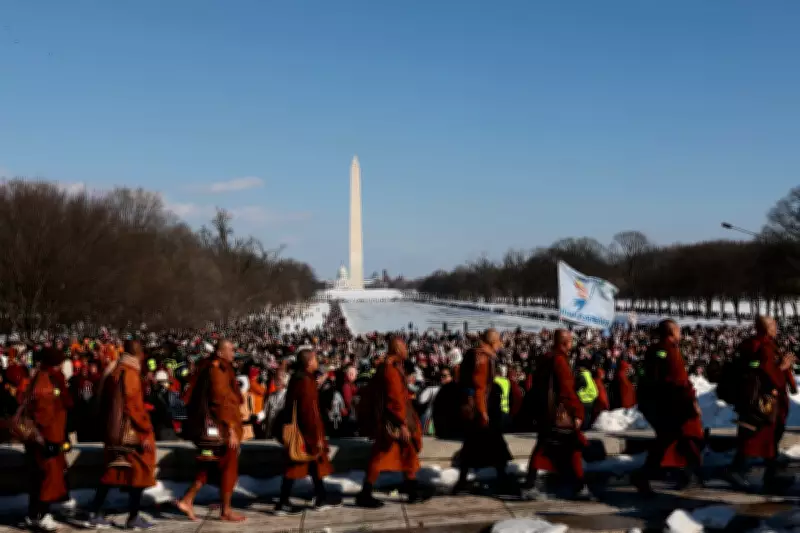
On a crisp Wednesday in Washington DC, a remarkable spiritual journey reached its poignant conclusion at the foot of the Lincoln Memorial. Over a hundred Buddhist monks, adorned in vibrant burnt-orange, saffron, and maroon robes, gathered to mark the end of an extraordinary 2,300-mile "Walk for Peace" that had captivated the nation.
A Journey of Endurance and Compassion
The odyssey began 108 days earlier in Texas, with nineteen monks and Aloka, a rescue dog from India, embarking on a mission to traverse nine states. Their goal was to raise awareness of peace, loving-kindness, and compassion across America and the wider world. Braving frigid temperatures and a paralysing winter storm, the monks often walked barefoot or in socks, a traditional Theravada Buddhist practice to feel the ground directly and remain present in the moment.
Bhante Saranapala, known as the "Urban Buddhist Monk", addressed the enthusiastic crowd, declaring, "These monks are awesome! Their determination should be greatly appreciated. Walking from Texas to Washington DC, 2,300 miles; it requires strong determination!" His words echoed the admiration felt by thousands who had cheered the monks along their route.

Historic Setting for a Message of Unity
The Lincoln Memorial, a site steeped in history from Marian Anderson's performance to Martin Luther King's iconic speech, provided a fitting backdrop. Inscribed with the aspiration to "bind up the nation's wounds", the monument witnessed a colourful and peaceful gathering, offering balm for America's current divisions. The event remained apolitical, though attendees included individuals waving a Palestinian flag and holding signs advocating peaceful resistance.
Tencho Gyatso, a niece of the Dalai Lama, read a tribute letter praising the monks' commitment. "Their dedication, including enduring physical hardship and challenging weather conditions over a journey of more than 2,000 miles, has drawn attention both within the United States and internationally," the letter stated. "May their walk help sow the seeds of greater peace, understanding and compassion in the United States and beyond."
Overcoming Perils and Inspiring Support
The journey was not without danger. In November, outside Houston, an escort vehicle was hit by a truck, injuring two monks. Venerable Maha Dam Phommasan, abbot of a temple in Snellville, Georgia, had his leg amputated but rejoined the group near Washington, addressing the crowd from his wheelchair at the memorial.
The peace walk garnered immense social media interest, with millions sharing messages of support. Martin Luther King III posted on X, calling it "a powerful reminder that peace is practiced step by step. In a divided time, this is what it looks like to stand up for the best of who we are."
Public Admiration and Hopeful Reflections
Crowds at the Lincoln Memorial held roses and signs with messages like "Warriors of peace welcome" and "Equal rights for all humans". They joined in chants led by Bhikkhu Pannakara, the spiritual leader of the walk. Attendees expressed deep admiration for the monks' commitment.
Jacquelyn Gray, 64, a construction logistics worker, said, "I've been following them since the day they left and I was impressed that somebody would be so committed to something. I admire their commitment to this cause." Katharine Naujoks, 57, a high school science teacher, added, "The world needs a bit of communalism and camaraderie and peace and goodwill. A lot of people are looking for that."
Reflecting on the monks' endurance through harsh weather, Naujoks noted, "It's quite amazing, the fact that they had to come in through the coldest time in Virginia, Maryland and DC. It just shows that it's an important thing." When asked if Washington politicians could learn from them, she replied hopefully, "That would be lovely."
The walk concluded with the monks preparing to end their journey in Annapolis, Maryland, leaving a lasting impression of resilience and hope in the heart of the nation's capital.