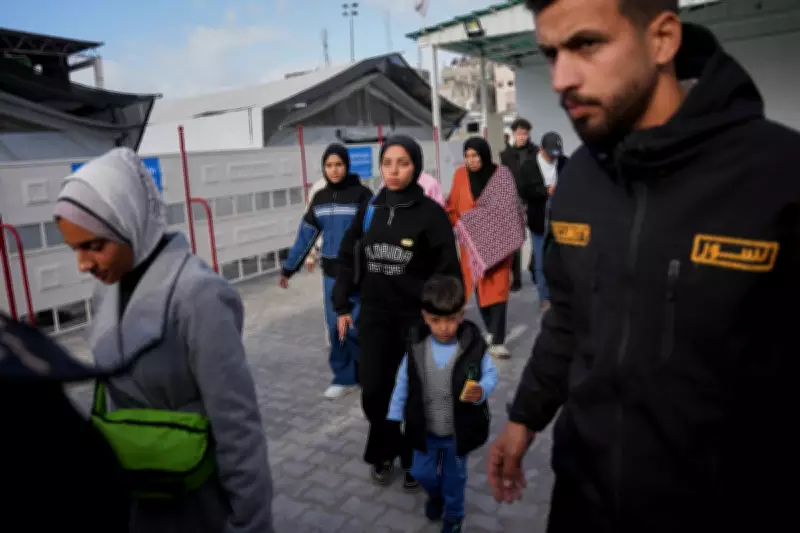
Rafah Border Crossing Reopens with Limited Traffic and Reports of Harsh Treatment
The Rafah border crossing between Gaza and Egypt has reopened this week, offering a "window of hope" after two years of devastating conflict, as a fragile ceasefire deal progresses. However, this hope has been quickly overshadowed by significant challenges, including disagreements over eligibility, extensive delays, and allegations of mistreatment by Israeli authorities. Far fewer individuals than anticipated have managed to cross in either direction, highlighting the ongoing complexities in the region.
Restrictions and Low Numbers at the Crossing
Under restrictions negotiated by Israeli, Egyptian, Palestinian, and international officials, the reopening was intended to allow only 50 people to return to Gaza daily and 50 medical patients—each accompanied by two companions—to leave for Egypt. Yet, over the first four days of operation, United Nations data reveals that just 36 Palestinians requiring medical care were permitted to exit, along with 62 companions. Palestinian officials estimate that nearly 20,000 people in Gaza are seeking to leave for medical treatment unavailable in the war-ravaged territory, underscoring the dire need for expanded access.
Amid confusion surrounding the reopening, the Rafah crossing was reportedly closed on Friday and Saturday, further complicating efforts. The crossing serves as a critical lifeline for Gaza, providing the sole link to the outside world not controlled by Israel, which seized it in May 2024, though traffic had been heavily restricted even prior to that.

Allegations of Harsh Treatment and Delays
Several women who successfully returned to Gaza after the reopening shared accounts with The Associated Press of harsh treatment by Israeli authorities and an Israeli-backed Palestinian armed group known as Abu Shabab. While the border crossing is operated by a European Union mission and Palestinian officials, Israel maintains a screening facility at a distance. Rana al-Louh, who fled to Egypt two years ago with her wounded sister, described being questioned for over six hours, during which she was allegedly blindfolded and handcuffed.
Al-Louh stated that interrogators repeatedly asked why she wanted to return to Gaza, with one claiming that Gaza belongs to Israel and warning of renewed conflict. She responded, "I told him I didn't care, I wanted to return." When asked about such reports, Israel's military denied any incidents of inappropriate conduct, mistreatment, or confiscation of property, while the Shin Bet intelligence agency and COGAT, the Israeli military body handling Palestinian civilian affairs, did not respond to allegations.
The lengthy questioning delayed al-Louh's return until nearly 2 a.m. on Thursday. Later that day, U.N. human rights officials highlighted a "consistent pattern of ill-treatment, abuse and humiliation by Israeli military forces," with Ajith Sunghay, the agency's human rights chief for the occupied Palestinian territories, emphasizing that safe and dignified returns are the "bare minimum" after years of devastation.
Operational Challenges and Future Prospects
Officials involved in negotiating the Rafah reopening described the initial days as a pilot phase, with potential for increased crossings if successful. However, challenges emerged quickly. On the first day, Israeli officials approved 71 patients and companions to leave Gaza and 46 Palestinians to enter, but World Health Organization organizers in Gaza could only arrange transportation for 12 people, leaving others behind. Israeli officials then insisted that no Palestinians could enter Gaza until all departures were complete, resulting in only 12 entries and forcing others to wait overnight on the Egyptian side.
Crossings improved slightly on the second day, with 40 people allowed to leave and 40 to enter, but delays mounted due to travelers exceeding luggage limits and carrying prohibited items like water. Each traveler is permitted one mobile phone and a small amount of money if declared 24 hours in advance. The process was further drawn out as Israeli authorities admitted one Palestinian into Egypt for each one allowed into Gaza.

Problems persisted on Wednesday and Thursday, with declining numbers of crossings. A bus carrying returnees on Wednesday did not reach its drop-off location in Gaza until 1:40 a.m. on Thursday. Despite these hardships, some Palestinians expressed gratitude for the opportunity to reunite with loved ones. Siham Omran, who had not seen her children and husband for 20 months, reflected, "This is a journey of suffering. Being away from home is difficult. Thank God we have returned to our country, our homes, and our homeland."
The reopening of the Rafah crossing represents a tentative step toward normalcy, but ongoing restrictions and allegations of mistreatment continue to hinder progress, leaving many in Gaza awaiting a more robust and humane resolution.