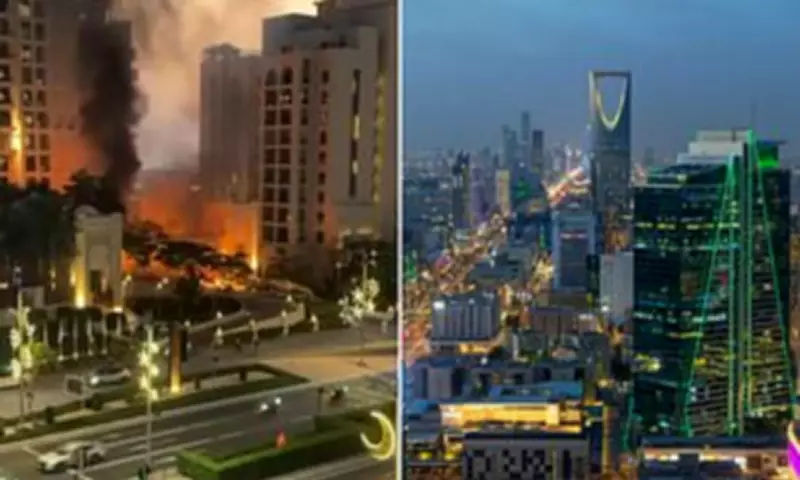
Riyadh Transforms into Unlikely Safe Haven Amid Regional Turmoil
Saudi Arabia's capital city of Riyadh has unexpectedly emerged as the critical escape route for the global super-rich fleeing devastating Iranian retaliatory strikes across the Middle East. The billionaire tax havens of Dubai and Abu Dhabi transformed from luxurious paradises into active war zones within hours of US-Israeli pre-emptive strikes on Iran early Saturday morning, triggering a massive regional security crisis.
Regional Airspace Lockdown Creates Desperate Exodus
Iranian drones and missiles struck multiple targets across Israel, Qatar, Bahrain, Kuwait, and Oman in coordinated retaliatory attacks, resulting in at least three civilian fatalities in Dubai alone. This widespread aggression has forced an unprecedented lockdown of Middle Eastern airspace, cancelling nearly 6,000 flights worldwide and delaying approximately 30,000 more. Amid this chaos, King Khalid International Airport in Riyadh stands as one of the few remaining operational aviation hubs in the entire region.
Private Jet Prices Skyrocket as Wealthy Flee
Desperate executives and their families are now flocking to the Saudi capital in droves, where private jets and commercial airliners await to transport them from the escalating conflict. According to Semafor reports, fleets of SUVs have been booked to ferry wealthy VIPs along the grueling 10-hour desert roads connecting Dubai to Riyadh. Private jet chartering prices and luxury vehicle rental costs have skyrocketed due to overwhelming demand.

Ameerh Naran, chief executive of private jet brokerage Vimana Private, revealed to Semafor that a single flight from Riyadh to Europe now costs up to $350,000. 'Saudi Arabia is the only real option for people who want to get out of the region right now,' Naran emphasized, highlighting the critical nature of Riyadh's operational status.
Historical Perceptions Shift Overnight
This development marks a dramatic shift in Riyadh's international perception. Historically associated with strict religious governance and post-9/11 security concerns, the Saudi capital has transformed into an unlikely safe passage within just 24 hours. Previously, wealthy evacuees looked toward Oman for escape routes, but that option vanished when Iran bombed an oil tanker in the Strait of Hormuz and targeted Oman's Duqm port.
Senior executives from global financial institutions and high-net-worth individuals have been observed in increasing numbers at Riyadh's airport, desperately seeking evacuation. The city's recent relaxation of visa requirements—allowing many nationalities to obtain visas upon arrival rather than through lengthy advance processes—has further positioned Riyadh as an accessible evacuation point.
Security Concerns and Contradictory Perceptions
Despite Saudi Arabia intercepting missile strikes aimed at Riyadh's airport on Saturday, as reported by Iran International, the airspace remains operational. Security experts note that Saudi Arabia's relative sparing from Iran's full retaliatory force remains puzzling, given the kingdom hosts several military bases. Crown Prince Mohammed bin Salman's public distancing from the initial strikes on Iran—declaring he wouldn't allow Saudi airspace or territory to be used for attacks against Iran—may have influenced this dynamic.
Ian McCaul, a director at UK-based security firm Alma Risk, told Semafor: 'We've been approached by a mixture of clients including families, individuals, and corporations that want to get out of the region either because they fear for their safety, or for business reasons they just need to be able to travel.'
Contrasting Experiences Amid the Chaos
The conflict's human impact reveals stark contrasts. While the Palm Jumeirah hotel in Dubai was engulfed in flames after being struck—injuring four people—some residents maintain contradictory perceptions of safety. Socialite influencer Hofit Golan, 40, insisted Dubai 'still feels like a very safe place' on Sunday, mere hours after Iranian missiles struck the nearby Palm Jumeirah hotel, forcing her to hide in a bath for protection.

The US-Israeli strikes that triggered this crisis targeted Tehran and multiple locations across Iran, killing Supreme Leader Ayatollah Ali Khamenei, who had ruled since 1989. American and Israeli officials described these bombings as pre-emptive strikes aimed at halting Tehran's nuclear ambitions, but the retaliatory consequences have created a humanitarian and logistical nightmare for the region's wealthy elite.
As violence escalates and airspace remains largely inaccessible across the Middle East, Riyadh's unexpected role as evacuation hub underscores the dramatic geopolitical shifts occurring in real time, with the super-rich paying unprecedented premiums for their escape from the crossfire.