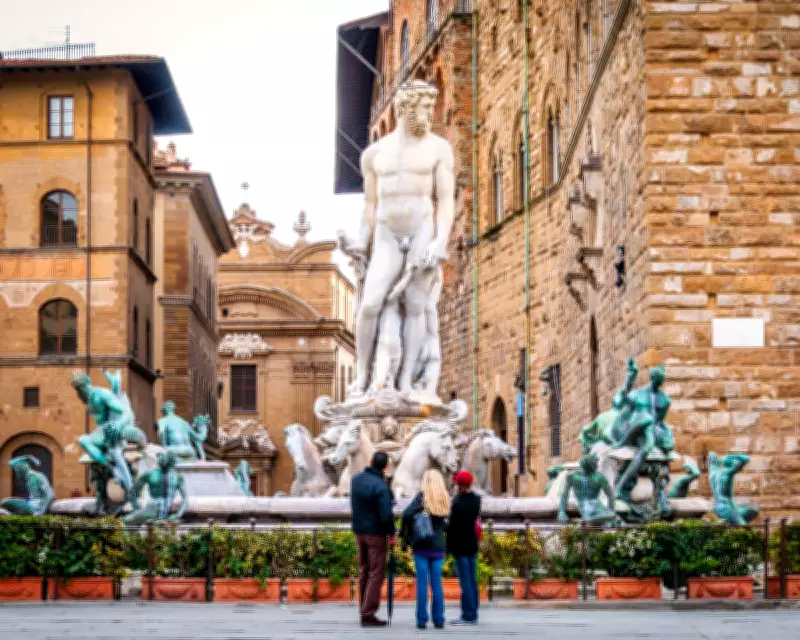
Tourist Charged for Damaging Historic Neptune Fountain in Florence Prank
A tourist has been formally charged by police after allegedly climbing a colossal marble statue in Florence to touch its genitals as part of a pre-wedding dare, causing significant damage to the historic monument.
Details of the Incident and Damage Assessment
The 28-year-old woman, whose nationality has not been disclosed, was spotted by officers as she ascended the Neptune fountain in Piazza della Signoria. According to a statement from Florence's city council, she told police her friends had dared her to touch the genital area of the statue. Experts from the council inspected the monument following the incident and found the prank had resulted in minor but significant damage to both the legs of the horses she walked on and the frieze she held onto to avoid slipping.
City officials have estimated the cost of the repairs at €5,000 (approximately £4,340). The tourist has been charged with defacing an artistic and architectural asset, a serious offence under Italian heritage protection laws.

Historical Significance of the Monument
The fountain of Neptune, a centrepiece of the Piazza della Signoria, was commissioned in 1559 by Cosimo I de' Medici to celebrate the marriage of his son, Francesco I de' Medici, to Grand Duchess Joanna of Austria. Created by the renowned sculptor Bartolomeo Ammannati, the basin encloses horses that pull a shell-shaped chariot at the base of a statue depicting Neptune, the Roman god of the sea. This masterpiece is a key part of Florence's rich artistic heritage, attracting millions of visitors annually.
A Pattern of Reckless Behaviour by Tourists
This is not the first time a tourist has attempted to mount the Neptune statue. CCTV cameras were installed in 2005 after a previous visitor climbed the monument, breaking one of its hands and damaging the chariot. In 2023, a German tourist caused substantial damage while trying to climb the fountain to take a selfie. That same summer, a young couple attempted to scale a copy of Michelangelo's David in Piazzale Michelangelo.
Despite stricter controls around Florence's landmarks, such incidents occur with alarming frequency. According to Giorgio Caselli, who manages the city council's fine arts office, it has become increasingly trendy for visitors to climb monuments as a "challenge", often driven by social media incentives.
Broader Issues of Respect and Overtourism
Caselli expressed concern over the lack of respect shown by some tourists. "The physical contact that is sought with the monument is far from the objective, emotional and intellectual awareness that we expect and favour towards our monumental heritage," he stated. "We must not allow ourselves any conscientious concessions to the ignorance and superficiality that characterise such actions. Our goal must be to awaken and cure the civic sense of those who frequent the city, which is not only to show respect toward others, but also towards monuments."
Florence is one of Europe's most-visited and overcrowded cities, drawing roughly 16 million tourists each year. Caselli noted that Florentines are protective of their heritage and often view visitors with suspicion, suggesting that some tourists treat the city "more of a game" because they do not live there.
Recent Similar Incidents in Florence
In 2024, a teenager hid overnight in the Cathedral of Santa Maria del Fiore before climbing up to its cupola for a selfie. Wearing casual attire, the teenager filmed himself walking up an inside stairwell of the World Heritage site, stepping onto a small platform outside, and posting the picture on Instagram. This incident underscores a growing trend of risky behaviour at historic sites.
Authorities continue to grapple with balancing tourism with preservation, as these actions not only endanger the monuments but also reflect broader issues of overtourism and cultural disrespect in one of Italy's most iconic cities.