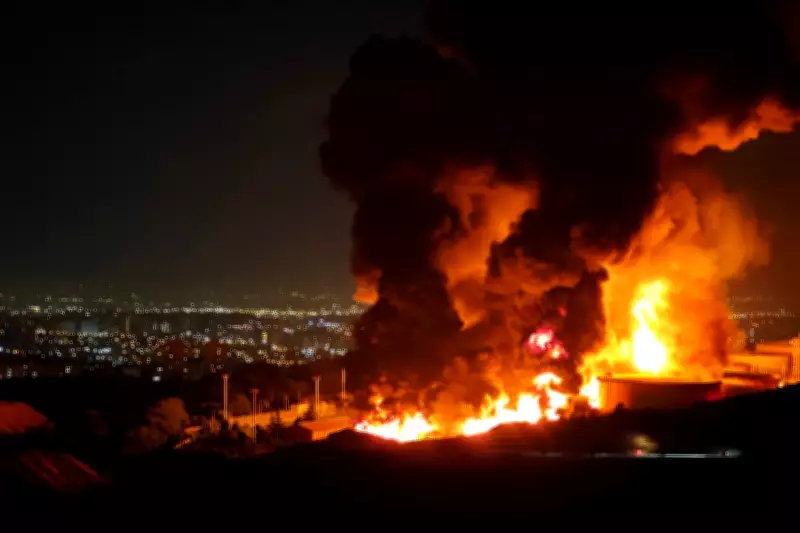
Trump's Iran Strike Marks Historic Turning Point, Scholar Compares to 9/11 and Berlin Wall
It is always challenging, perhaps even misguided, to attempt to evaluate the importance of unfolding events in real time. History typically offers the comfortable distance needed to place occurrences into proper context, free from the pressures of hasty judgments that may not endure. However, there have been three distinct moments in my lifetime when I instantly recognised that what I was witnessing held epic significance as it happened.
The first was the evening of 9 November 1989, when crowds gathered upon hearing news that border crossings were opening in Berlin, leading to the fall of the wall that very night. The second, undoubtedly, was on 11 September 2001, when it became obvious to all watching the coordinated hijacking of four passenger planes that the world would change forever.
A New Pivotal Moment in Global Affairs
Since then, numerous events have been important, horrific, or both. The Hamas attacks of 7 October, for instance, will be viewed as a key moment in reshaping the Middle East. Yet, what we have witnessed this weekend is, in my opinion, something with ramifications and implications that make these the most critical two days in a quarter of a century.

The assassination not only of Iran's supreme leader, Ali Khamenei, but also of a significant portion of the country's senior leadership, has delivered a devastating blow to the state. The murder of a serving head of state by a foreign power sets an extraordinary precedent in the modern era. The fact that the decision by the United States and Israel to attack Iran was one of choice, rather than necessity, further dismantles a world order that, while imperfect, has at least provided the semblance of an architecture of international law for decades.
Trump's Unilateral Action and Its Consequences
In 2003, during the deeply flawed intervention in Iraq, the administration of President George W. Bush attempted to make a case at the United Nations, sought approval from the Senate, and worked to create a network of alliances with partners. President Trump has bothered with none of that. Instead, he grew impatient waiting for a diplomatic solution.
"We warned them never to resume their malicious pursuit of nuclear weapons," he declared as he announced the start of "major combat operations" in the early hours of Saturday morning. "We sought repeatedly to make a deal. We tried. They wanted to do it. They didn't want to do it again. They wanted to do it. They didn't want to do it. They didn't know what was happening. They just wanted to practice evil." So that was that. He was out of patience. "We can't take it any more," he announced.
The following hours brought the decimation of Iran's political, clerical, and military leadership, essentially decapitating its chain of command. Those left alive have regrouped and announced an interim leadership council to try to steer the country until a new supreme leader can be chosen. They have one priority, and one priority alone: regime survival.
Regional Chaos and Diplomatic Fallout
The calculation thus far is that the best way to achieve survival would be to unleash chaos not only on targets across Israel and US military bases but also on all the countries of the Gulf region, presumably in the hope of getting them to use their leverage with Trump and Israel's prime minister, Benjamin Netanyahu. This approach has gone down badly with those who had been trying to mediate between Iran and the US.
Anwar Gargash, the highly experienced and well-connected Emirati diplomat, reminded Tehran that "your war is not with your neighbours", but also that "through this escalation, you confirm the narrative of those who see Iran as the region's primary source of danger, and its missile programme as a perpetual source of instability".

One reason why Iran's neighbours have been struck with missiles and drones is that the leadership's information gathering, communication channels, and operational effectiveness have all but collapsed in the fog of war, which is hardly surprising. That is why Abbas Araghchi, Iran's foreign minister, has been busy making apologetic and reassuring calls to Oman and others, explaining that Iran's "military units are now, in fact, independent and somewhat isolated, and they are acting based on general instructions given to them in advance".
A Turning Point in Global History
That is why feelers have also gone out to the US as well, with Trump claiming on Sunday that "they [Iran] want to talk, and I have agreed to talk, so I will be talking to them". What they will say, or offer, remains unclear. But one thing is clear: this is a moment in which the great wheel of history is turning.
Two weeks ago, the US secretary of state Marco Rubio declared that "the world is changing very fast right in front of us. The old world is gone". You might not like to hear that, nor the reasons why it has happened, nor what might occur next. But it is hard to disagree. The pace of change is breakneck, and the implications are profound, marking this as a defining chapter in global affairs since the seismic events of 9/11 and the fall of the Berlin Wall.