UN General Assembly Votes Overwhelmingly to Establish Global AI Scientific Panel
The United Nations General Assembly has voted overwhelmingly to approve the creation of a 40-member global scientific panel dedicated to examining the impacts and risks of artificial intelligence. This decision comes despite strong objections from the United States, which voted against the resolution alongside Paraguay.
A Foundational Step Toward Global AI Understanding
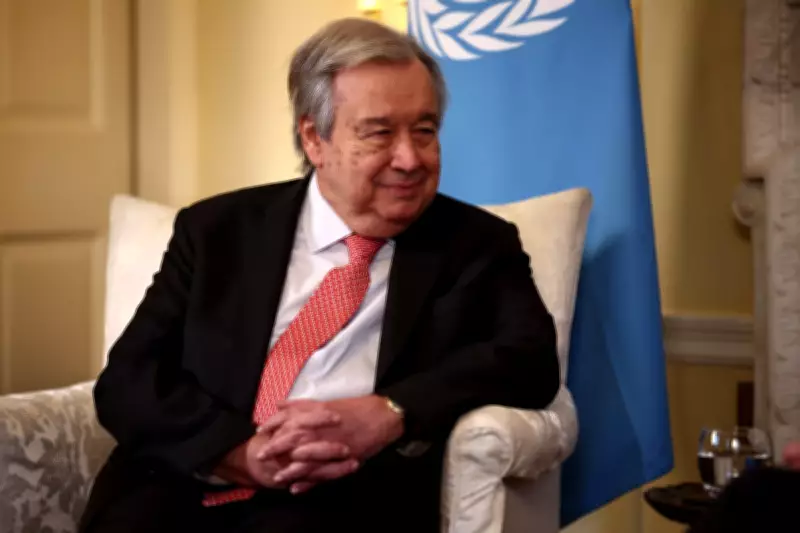
UN Secretary-General Antonio Guterres, who established the panel, described the adoption as "a foundational step toward global scientific understanding of AI." He emphasized that in a world where AI development is accelerating rapidly, this panel will provide "rigorous, independent scientific insight that enables all member states, regardless of their technological capacity, to engage on an equal footing."
Guterres has characterized this body as the first fully independent global scientific entity specifically designed to bridge knowledge gaps in artificial intelligence and assess its real-world economic and social consequences.

Voting Results and International Reactions
The vote in the 193-member assembly resulted in 117 nations supporting the resolution, with only the United States and Paraguay voting "no." Tunisia and Ukraine abstained from the vote. Notably, America's traditional allies in Europe and Asia voted in favor of the panel, as did Russia, China, and numerous developing countries.
US Mission counselor Lauren Lovelace voiced strong opposition, calling the panel "a significant overreach of the UN's mandate and competence" and asserting that "AI governance is not a matter for the UN to dictate."
US Concerns and Alternative Approach
Lovelace stated that as the world leader in artificial intelligence, the United States is committed to accelerating AI innovation and infrastructure development. She indicated that the Trump administration would support "like-minded nations working together to encourage the development of AI in line with our shared values."
The US representative expressed particular concern about potential international influence, stating: "We will not cede authority over AI to international bodies that may be influenced by authoritarian regimes seeking to impose their vision of controlled surveillance societies." Lovelace also criticized what she described as "the non-transparent way" the panel members were selected.
Panel Composition and Selection Process
Secretary-General Guterres explained that the 40 panel members were chosen from more than 2,600 candidates following an independent review conducted by three UN agencies: the International Telecommunications Union, the UN Office for Digital and Emerging Technologies, and UNESCO (the UN Educational, Scientific and Cultural Organization). Panel members will serve three-year terms.
The panel predominantly consists of AI experts but also includes members from other disciplines. Notable appointments include:
- Maria Ressa, a Filipino journalist and 2021 Nobel Peace Prize laureate
- Two American experts: Vipin Kumar (University of Minnesota professor focusing on AI, data mining, and high-performance computing) and Martha Palmer (retired University of Colorado professor and linguistics expert specializing in AI language processing)
- Two Chinese experts: Song Haitao (dean of Shanghai Jiao Tong University and the Shanghai Artificial Intelligence Research Institute) and Wang Jian (cloud-computing technology expert at the Chinese Academy of Engineering)
Abstentions and Specific Objections
Ukraine explained its abstention by objecting to the inclusion of Russian expert Andrei Neznamov, who specializes in AI regulation, ethics, and governance. This reflects ongoing geopolitical tensions influencing international scientific cooperation.
The establishment of this UN scientific panel represents a significant development in global efforts to understand and potentially regulate artificial intelligence technologies, setting the stage for future international discussions about AI governance, ethics, and risk management.