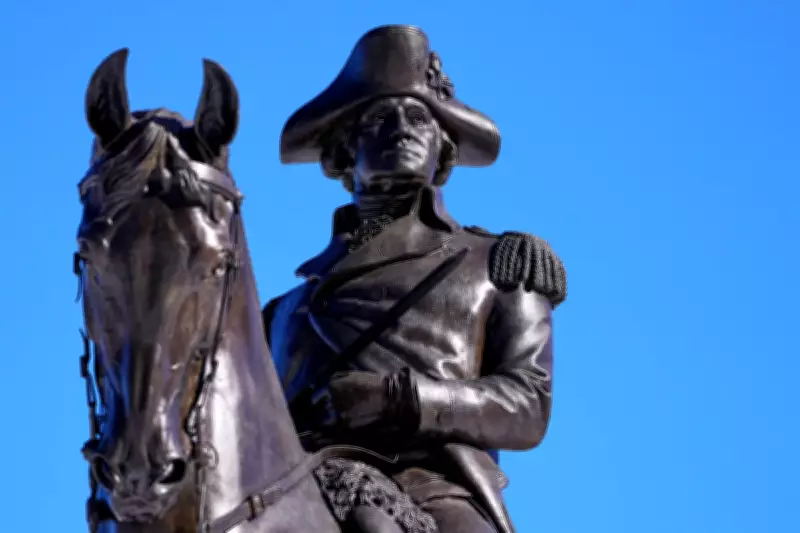
Contrary to popular myth, George Washington never had wooden teeth, but his leadership during the Siege of Boston remains an undeniable historical fact. More than a decade before he ascended to become the nation's first president, Washington was already steering a crucial campaign in the early days of the American Revolution. This siege, his inaugural command as head of the Continental Army, fundamentally laid the groundwork for his subsequent military and political triumphs, a legacy celebrated each Presidents Day.
The Strategic Importance of the Siege
Following the initial skirmishes at Lexington and Concord in April 1775, colonial militias had effectively trapped British forces within Boston. Recognizing the necessity for a coordinated military response, the Continental Congress appointed Washington to lead the newly established Continental Army. The Siege of Boston, which commenced 250 years ago, involved bottling up approximately 11,000 British troops and numerous loyalists for nearly a year. The primary objective was to expel the British from their occupation of the city.
A Decisive Military Maneuver
One of Washington's most critical decisions was dispatching Henry Knox, a young bookseller, to Fort Ticonderoga in New York to retrieve dozens of cannons. These artillery pieces were transported hundreds of miles through the harsh winter, eventually being deployed to bombard British positions. This strategic move, coupled with dwindling British supplies, compelled the British to evacuate Boston by sea on March 17, 1776.

Historians emphasize that the British withdrawal, commemorated in Boston as Evacuation Day, had profound implications. It purged the city of loyalists at a pivotal moment, deprived the British of a vital port, and significantly boosted patriot morale. "The success of the Siege of Boston gave new life and momentum to the Revolution," stated Chris Beagan, site manager at Longfellow House in Cambridge, which served as Washington's headquarters. "Had it failed, royal control of New England would have continued, and the Continental Army likely would have dissolved."
Forging Washington's Leadership
The siege represented a formidable test for Washington, who had been out of military service for nearly two decades since his role in the French and Indian War. His victory ensured his continued tenure as commander-in-chief throughout the revolution. Doug Bradburn, president of George Washington's Mount Vernon, noted that Washington began constructing a geographically diverse army, incorporating militiamen from Massachusetts to Virginia, and eventually including significant numbers of Black and Native American soldiers. This force became the most integrated military until President Harry S. Truman desegregated the armed forces in 1948.
Despite being a slave owner who initially resisted enlisting formerly enslaved and free Black soldiers, Washington's urgent need for manpower during the siege led him to reconsider. Bradburn explained that Washington realized "there are free Blacks who want to enlist and he needs them to keep the British from breaking out." The triumph in Boston also catapulted Washington to national prominence, making him the embodiment of the revolutionary cause before the Declaration of Independence was even drafted.
Preparation for the Presidency
Pulitzer Prize-winning military historian Rick Atkinson highlighted that Washington's eight-year command of the military provided essential preparation for his presidency. "Perhaps most important, it gave him a sense that Americans could and should be a single people, rather than denizens of thirteen different entities," Atkinson remarked.
Dispelling Enduring Myths
Washington's rise to fame spawned numerous myths that persist today. The tale of the cherry tree, where a young Washington allegedly confessed to chopping it down, was fabricated by an early biographer after his death. Similarly, the legend of his wooden dentures is false; historical records confirm his false teeth were crafted from ivory, gold, and even human teeth, not wood.

Washington's Multifaceted Legacy
Beyond his political and military roles, Washington was an innovative farmer and a proponent of Western expansion, acquiring up to 50,000 acres across Mid-Atlantic states. After the war, he established a whiskey distillery at Mount Vernon that grew into one of the nation's largest. His relationship with slavery was complex; while he advocated for its abolition and stipulated in his will that his own slaves be freed after his wife's death, he could not legally emancipate all slaves at Mount Vernon, as he did not own them all.
Presidents Day Celebrations
For admirers of George Washington, Presidents Day serves as a premier occasion to honor his legacy. Originally marking Washington's February 22 birthday, the holiday now often features retail promotions, but numerous events pay tribute to his contributions. These include a wreath-laying ceremony at his tomb in Mount Vernon, a Continental Army encampment, a parade in Alexandria, Virginia, and in Laredo, Texas, a monthlong festival with a carnival, pageants, an air show, and a jalapeno celebration.