St. Patrick's Day typically evokes vibrant imagery of revelry, Irish nationalism, Catholicism, and, most prominently, the colour green: green attire, shamrocks, beverages, and even dyed rivers. However, many are astonished to learn that this festive occasion was originally a solemn feast day where blue, not green, dominated the visual landscape. Indeed, a specific hue known as "St. Patrick's blue" holds historical significance, marking a profound shift in cultural and political symbolism over centuries.
The Origins of St. Patrick and Early Celebrations
Historians possess limited knowledge about St. Patrick, but it is believed he was born in the fifth century as Maewyn Succat in Wales, the son of a Roman-British official. Captured by Irish pirates and enslaved in Ireland, he eventually returned to Britain before coming back as a missionary to convert Irish pagans to Christianity, adopting the Latin name Patricius. By the 10th century, evidence emerged of St. Patrick being revered in Ireland.
In the early 17th century, Irish priest Luke Wadding persuaded the Catholic Church to designate March 17 as a feast day for St. Patrick. Initially, feast days were far from boisterous; Catholics attended Mass and enjoyed quiet home dinners, with Anglicans and Lutherans also acknowledging the day. Blue was the colour of choice for commemorations, as documented by the Dublin Evening Post in 1785, which described patriots marching "in a grand procession round the garden, dressed in true blue."

The Rise of Green in Irish Nationalism
Since the 12th century, Ireland had been a British colony, leading to growing unrest. In 1798, the United Irish, a rebel group seeking independence, launched an insurrection. Composed largely of middle-class Protestants and some Catholics, they adopted "the wearing of the green" to symbolise Irish nationalism and resistance against British imperialism. Although the rebellion failed and Ireland was incorporated into the United Kingdom in 1801, green became increasingly linked with nationalist sentiments.
Throughout the 19th century, Irish society became more sectarian, with nationalism intertwining with Catholicism. As Catholics outnumbered Protestants, green gained widespread acceptance, partly due to its association with the United Irish. Constance Markievicz, a key figure in the 1916 Easter Rebellion and the first minister of labour in the Irish Free State, emphasised blue as "the old colour of Ireland," using it for the Irish Citizen Army's flag to connect with tradition. In 1934, politician W.T. Cosgrave affirmed blue's traditional and national significance, yet green's prominence continued to grow.
The American Influence and Diaspora Impact
Irish immigration to America evolved significantly over time. Before the 1840s, most immigrants were Protestants, including Scots Irish descendants, who celebrated St. Patrick's Day to honour their heritage. The earliest recorded American celebration occurred in Boston in 1737, with annual parades in New York and Montserrat by the 1760s.
The Great Hunger of the 1840s spurred a massive influx of over 1 million impoverished Catholics to the U.S. Facing discrimination from American Protestants, these immigrants viewed St. Patrick's Day as a vital link to Irish culture and a symbol of pride. They advocated for Irish independence to align with republican ideals, with nationalist groups like the Fenians and Clan na Gael participating in parades, proudly wearing green to demonstrate solidarity with past movements like the United Irish.
Modern Symbolism and Lasting Legacies
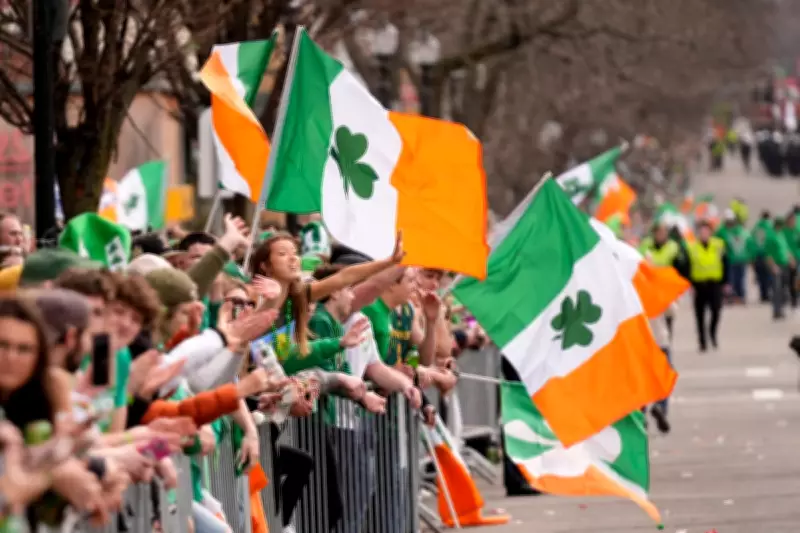
In Ireland, St. Patrick's Day remained a solemn observance well into the 20th century. The Irish government only recognised it as a public holiday in 1903, with Dublin's first parade held in 1931, and pubs remained closed on March 17 until 1961. Since 1922, when 26 of Ireland's 32 counties gained semi-independence, the tricolour flag has been official, with green representing Catholics, orange for Protestants, and white symbolising peace.

Today, green is globally associated with St. Patrick's Day and Ireland, largely due to the Catholic diaspora and its nationalist connections. However, blue retains symbolic importance: since 1945, the flag of Ireland's president features a gold harp against a dark blue background, preserving the legacy of St. Patrick's blue. This duality highlights the complex historical journey from solemn blue feasts to vibrant green celebrations, reflecting Ireland's evolving identity and cultural heritage.