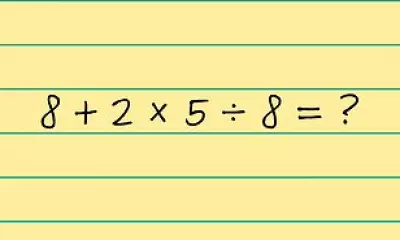
A straightforward mathematical brainteaser has unexpectedly ignited a fierce family feud, with relatives becoming embroiled in a heated dispute over the correct answer. The seemingly simple cow trading puzzle has not only divided a household but has also sparked a substantial online debate, drawing in thousands of commentators who are passionately defending their own calculations.
The puzzle that caused the rift
The contentious problem, which has amassed over a thousand comments on Reddit, presents a deceptively basic scenario: "I bought a cow for $800. I sold it for $1000. I bought it again for $1100. I sold it again for $1300. How much did I earn?" After this question was shared in a family group chat, members immediately set to work, with one admitting their brain was working overtime before concluding the answer was $300.
A household divided
However, consensus was far from reached. Another family member staunchly believed the seller would have earned $500, while yet another was equally adamant that the correct profit is $400. One frustrated participant explained: "My mother-in-law posted this question in our family group chat the other day, and we still can't convince her that the answer is $400. My husband and I have tried with Monopoly money, breaking it down on a calculator, using fake banking apps, and straight up googling the answer - I don't know how else to explain it at this point unless we're both missing something."

They elaborated on their reasoning for the $400 conclusion: "Splitting it into basic math as follows: 800 + 1000 = 200, 200 - 1100 = 900, 900 + 1300 = 400. I think where they're getting confused is trying to repay $100 somewhere, but no matter how I explain it, it's like trying to convince someone the sky is actually lime green."
The online debate intensifies
As the family argument spilled onto social media, other users weighed in with their own analyses and explanations. One commenter offered a clear breakdown: "Revenue: $2300 Expenses: $1900. Profit = $400. Maybe it’s the order that’s screwing them up."
Another user attempted to clarify how someone might arrive at the incorrect $300 answer: "So, I can see how my mother-in-law came up with $300. First sell is a $200 profit (1000 - 800). Buy back at a $100 loss (1000 - 1100). Sell it again for another $200 profit (1300 - 1100). $400 profit - $100 loss = $300 earned. It's wrong - the correct answer is clearly $400 - but I thought I'd clarify how someone could get to $300."
Common pitfalls and mental traps
A third observer drew parallels with other confusing puzzles: "This is exactly like those 'I owe you, you owe him, he owes her' brainteasers that trick people into double-counting the same 100 bucks. Your math is right - it lands on 400. At this point, I’d just say, ‘OK, cool, enjoy your imaginary missing $100’ and tap out."
Another insightful comment highlighted how changing the framing can make the solution obvious: "I think maybe people get tripped up by selling the cow for $1,000 then buying it again for $1,100, like those two things are somehow connected in their mind. But if you change it into two cows - cow A bought for $800 and sold for $1,000, and cow B, a separate cow, bought for $1,100 and sold for $1,300 - they would have no trouble working out the profit is $400 for both transactions."
This mathematical conundrum demonstrates how even simple arithmetic can become surprisingly contentious when presented in a slightly tricky sequence. The family's ongoing dispute serves as a reminder that sometimes the most straightforward questions can reveal unexpected divisions in reasoning and perspective, turning a harmless brainteaser into a source of genuine familial tension.