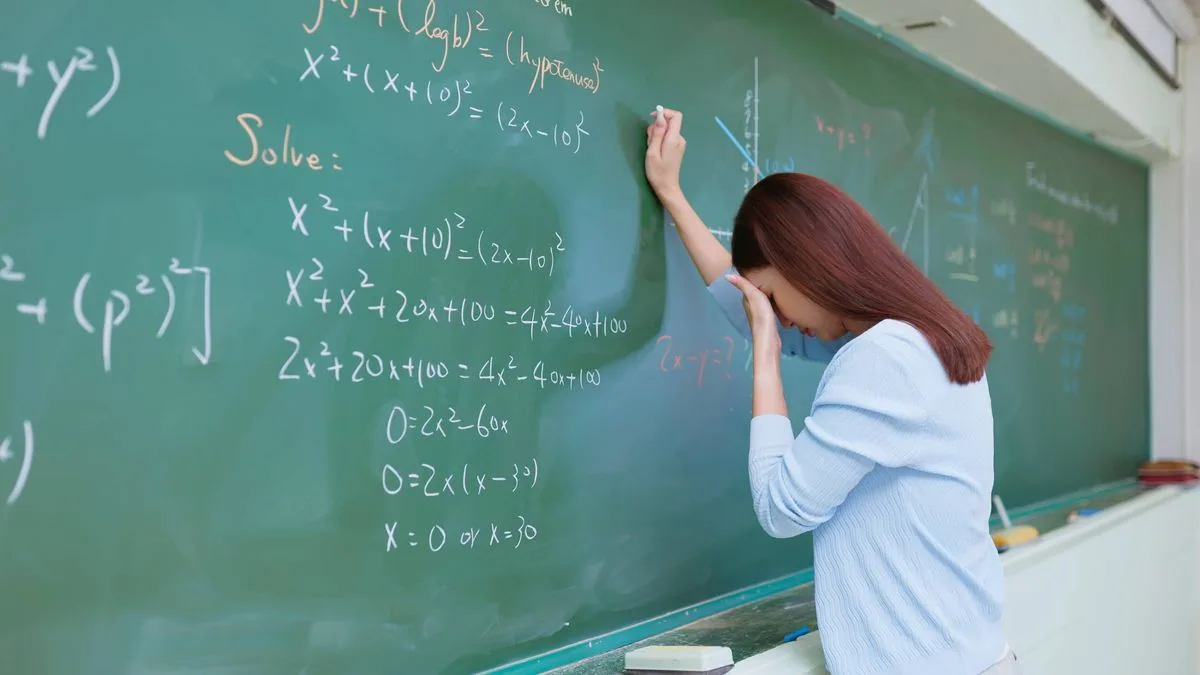
A tricky maths puzzle that left an American teenager in tears has been solved with basic algebra, showing that the question is simpler than it appears. The problem, shared on TikTok by The Math Tutor, involved finding two numbers based on a worded riddle.
The question stated: 'One number is 5 more than another number. Three times the greater plus twice the lesser is 30. Determine the numbers.' The teen, already crying, admitted the problem was 'messing' with her, but the solution requires only straightforward algebraic steps.
To solve, let the greater number be X and the lesser be Y. From the first sentence, X = Y + 5. The second sentence translates to 3X + 2Y = 30. Substituting X gives 3(Y + 5) + 2Y = 30, which simplifies to 5Y + 15 = 30. Subtracting 15 yields 5Y = 15, so Y = 3. Then X = 5 + 3 = 8.

Maths puzzles like this can enhance cognitive function and problem-solving skills, and may even help stave off dementia by strengthening brain cell connections. While some find such problems frustrating, breaking them down into equations often reveals a simple answer.