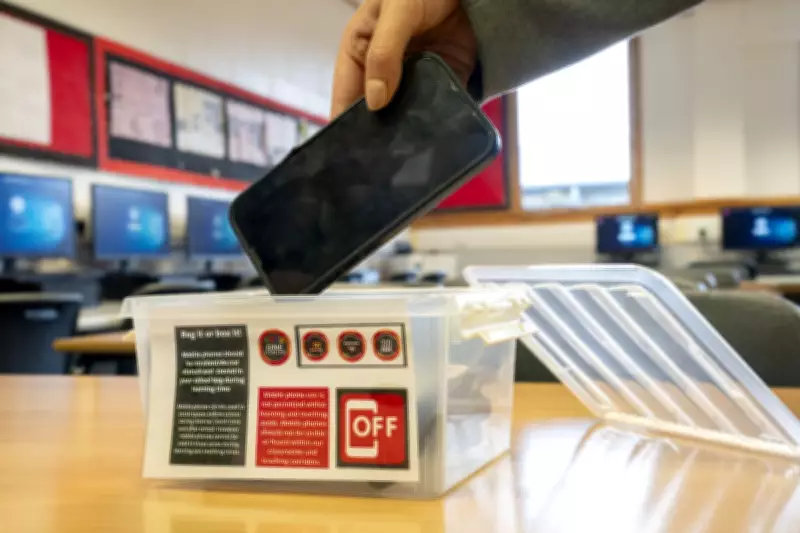
Government to Introduce Amendment for Statutory School Phone Bans
The Government will seek to make mobile phone bans in schools statutory by introducing an amendment to the Children’s Wellbeing and Schools Bill in the House of Lords. Peers are set to vote on this Conservative amendment on Monday evening, with MPs expected to follow suit on Wednesday.
Legal Force for Existing Guidance
A Department for Education spokesperson confirmed that the amendment will transform current non-statutory guidance on mobile phone bans into statutory law. "We have been consistently clear that mobile phones have no place in schools, and the majority already prohibit them," the spokesperson stated. "This amendment makes existing guidance statutory, giving legal force to what schools are already doing in practice."
The move builds on recent enforcement measures, with Ofsted now considering schools' mobile phone policies during inspections as of this month. The DfE emphasised that the broader Bill represents significant child safeguarding legislation, including measures to address profiteering in children's social care and implement a unique identifier system to protect vulnerable children.

Parliamentary Support and Opposition
Skills minister Baroness Smith of Malvern told the Lords that the Government has "listened to concerns about how we support headteachers in delivering on this policy and we have listened to Parliament." On Monday evening, peers voted 276 to 169, with a majority of 107, to ban pupils from having smartphones during the school day.
However, Shadow education minister Baroness Barran proposed amendments that would create potential exceptions for sixth formers, medical devices, and some boarding school settings. These proposals face further scrutiny in the Commons, where they have previously been rejected.
Mixed Reactions from Education Unions
Headteachers' union NAHT expressed support for making the ban statutory. General secretary Paul Whiteman said: "Statutory guidance will give school leaders the clarity they need to implement a ban, and will remove any ambiguity or differences between how schools approach smartphone policies." He noted that schools would need time to communicate with parents and pupils about implementing complete bans where not already in place.
Teaching union NASUWT has also previously announced its support for a statutory school phone ban. However, Pepe Di'Iasio, general secretary of the Association of School and College Leaders, argued that a statutory ban "doesn't really change that much" since most schools already have bans in place.
Di'Iasio called for government funding for secure phone storage solutions like lockers or pouches, and tougher regulatory action against social media harms that occur outside school hours. "We would also like to see much tougher regulatory action taken to tackle the harm caused by social media and the excessive use of smartphones – which generally happens outside of school time and is clearly having a profound and damaging effect on many young people," he added.
Political Tensions and Criticism
A Government source criticised opposition parties for attempting to "kill off some of the most far-reaching child protection legislation," calling it "an utterly abhorrent, and a dismal failure of some of the most vulnerable children in our country." The source referenced past child abuse cases and accused unelected peers of blocking manifesto commitments like free breakfast clubs and limits on branded school uniforms.
Lady Barran countered that putting "flawed guidance on a statutory footing achieves nothing." She argued that even phones kept in bags or pockets remain distracting, and the temptation to use them is "almost irresistible" for both children and adults. "There is so much evidence that the presence of a smartphone in one's bag or pocket is a distraction, that the temptation to turn it on when going to the lavatory, when out of sight, when in the playground, is almost irresistible. Indeed, it happens to adults too," she told the Lords.
The Education Secretary has previously written to headteachers in England emphasising that schools should be phone-free throughout the school day, but until now, guidance on mobile phones has remained non-statutory.