Ten Commandments in US Schools: Court Rulings Fuel Religious Display Mandates
Court rulings are strengthening mandates to display the Ten Commandments in public schools across the United States, as supporters aggressively work to expand the role of religion in classrooms. This includes efforts to make Bible stories required reading for students, igniting a fierce national debate over the separation of church and state.
The Drive to Post Religious Texts
The most significant push to place the Ten Commandments in every classroom originated last year in Texas, where a challenge to the law was recently dismissed by a U.S. appeals court. Although the issue remains unresolved, this ruling represents a victory for conservatives who argue that the displays do not proselytize to students or infringe upon the rights of parents, including those from diverse faith backgrounds.
The law has generated a mixture of enthusiasm and alarm, energizing school board meetings and leading to the issuance of guidance for teachers on how to respond to student inquiries. Some educators have chosen to resign rather than hang the Ten Commandments in their classrooms, highlighting the deep divisions this policy has created.

States Leading the Charge
Republicans in the Southern United States have been at the forefront of this movement. Louisiana became the first state to enact a requirement in 2024, with Arkansas and Texas following suit. Most recently, Alabama joined the list this month when Republican Governor Kay Ivey signed a law mandating the display of the Ten Commandments in public school classrooms for grades 5 through 12 where U.S. history is taught, as well as in common areas such as cafeterias and libraries.
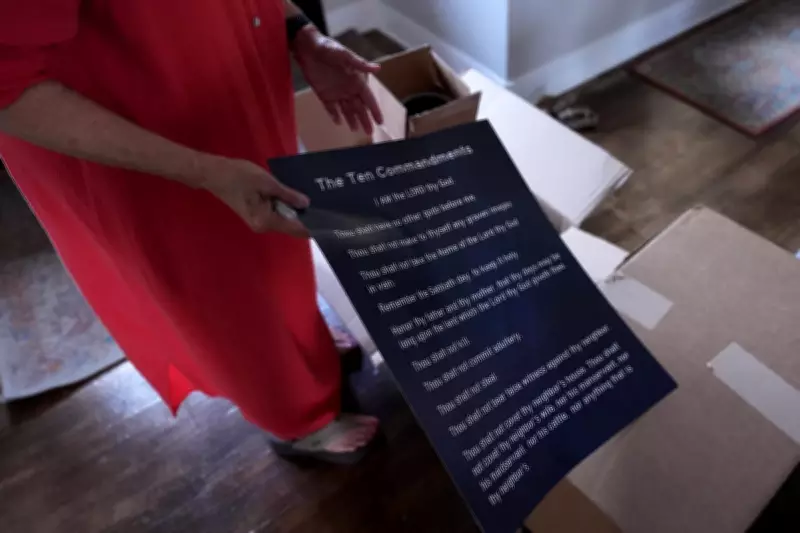
In Texas, a law signed by Republican Governor Greg Abbott requires the Ten Commandments to be posted in every public school classroom, effective since September. Since the law only mandates display if the posters are donated, conservative groups and individuals have been delivering boxes of posters to campuses statewide as the school year commenced.
An analysis by the Associated Press of state legislation tracked by Plural software reveals at least 30 measures introduced in current sessions that would require the display of the Ten Commandments in schools. All these bills were proposed by Republican lawmakers, nearly all in GOP-controlled states, with only a few advancing through legislative committees. Additionally, some states are considering bills to permit displays or require teaching that incorporates the document.
Legal Victories for Supporters
For months, a lower-court ruling prevented approximately a dozen Texas school districts from hanging the Ten Commandments posters. However, the 5th U.S. Circuit Court of Appeals in New Orleans overturned this decision with a 9-8 ruling, stating that the requirement does not violate the rights of students or parents. The court emphasized that no child is compelled to recite, believe, or affirm the divine origin of the Commandments.
The American Civil Liberties Union and other groups, which challenged the Texas law on behalf of parents, expressed extreme disappointment with the appeals court's decision. They argued that it undermines the First Amendment's protection of the separation of church and state and the freedom of families to decide how, when, and if to provide religious instruction to their children.
In February, the same appeals court allowed Louisiana to enforce its own Ten Commandments law. Louisiana's Republican Attorney General Liz Murrill celebrated the Texas ruling, noting that it adopted their entire legal defense, signaling a coordinated effort among states.
Broader Conflict Over Religion in Education
The mandate for the Ten Commandments in Texas is part of a larger battle over religion in public schools. In 2024, Texas approved an optional Bible-infused curriculum for elementary schools, and a proposal scheduled for a vote in June aims to add Bible stories to required reading lists.

In neighboring Oklahoma, the former top education official required public schools to integrate the Bible into lesson plans for students in grades 5 through 12, leading to a lawsuit from parents and teachers. Many schools have simply ignored this mandate. Last year, the Oklahoma Supreme Court blocked an attempt to establish the nation's first publicly funded religious charter school, a case now pending before the U.S. Supreme Court.
Future Legal Challenges
The ACLU and other groups that contested the Texas law have indicated they plan to appeal the 5th Circuit's ruling to the U.S. Supreme Court, setting the stage for further legal confrontations that could shape the future of religious displays in American public education.