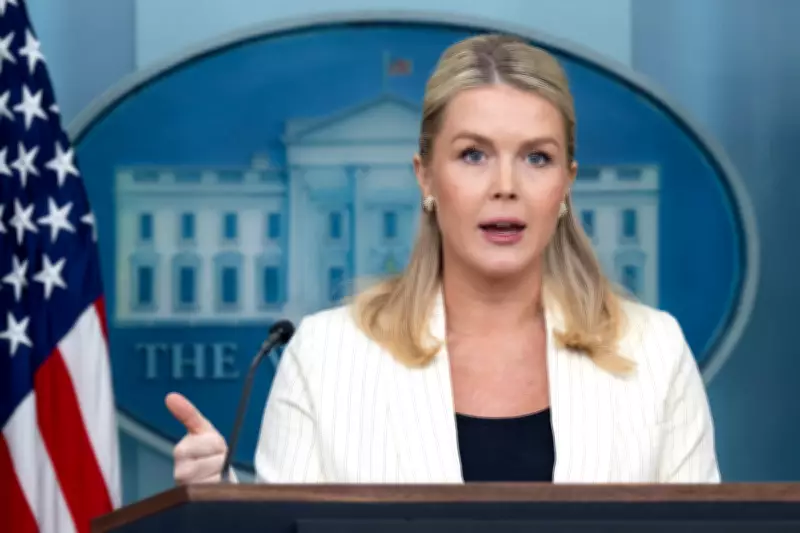
White House spokeswoman Karoline Leavitt has made a striking claim that President Donald Trump believes NATO and its member countries failed a critical test of their commitment and resolve. In a statement that underscores growing transatlantic tensions, Leavitt articulated the administration's perspective that European nations are long on rhetoric but short on substantive action when it matters most.
Leavitt's Assertion on NATO's Inaction
According to Leavitt, President Trump views the alliance's response to recent global challenges as inadequate, highlighting a perceived disconnect between diplomatic promises and tangible military or strategic contributions. She emphasized that this assessment is not merely speculative but rooted in specific operational contexts where the United States felt compelled to act unilaterally.
Operation Epic Fury as a Case Study
Leavitt pointed to Operation Epic Fury as a prime example of this dynamic. This covert mission, conducted by the United States with assistance from Israel, targeted and degraded Iran's military capabilities without the participation or support of European NATO allies. The operation, which involved sophisticated intelligence and precision strikes, was executed independently, reflecting what Leavitt described as a necessary pivot due to allied inaction.

From the White House's viewpoint, this operation demonstrated that while allies may engage in extensive discussions and condemnations, they often hesitate to commit resources or forces in high-stakes scenarios. Leavitt noted that the U.S. decision to proceed alone was a calculated move, acknowledging the geopolitical risks but prioritizing immediate security objectives over multilateral coordination.
Implications for Future U.S. Foreign Policy
Leavitt concluded her remarks by signaling that the United States will continue to pursue its national interests independently when deemed necessary, reinforcing President Trump's awareness of and frustration with allied passivity. This stance suggests a potential shift towards more unilateral actions in U.S. foreign policy, particularly in regions like the Middle East where Iran remains a focal point of concern.
The broader context of this statement includes ongoing tensions between the U.S. and Iran, with recent incidents such as attacks on commercial ships escalating hostilities. Leavitt's comments align with previous White House accusations against Tehran, including characterizations of Iranian actions as piratical, further complicating diplomatic efforts and alliance dynamics.
This development raises questions about the future of NATO cohesion and the role of European partners in global security initiatives, as the U.S. appears increasingly willing to bypass traditional alliances in favor of solo or limited-partner operations.