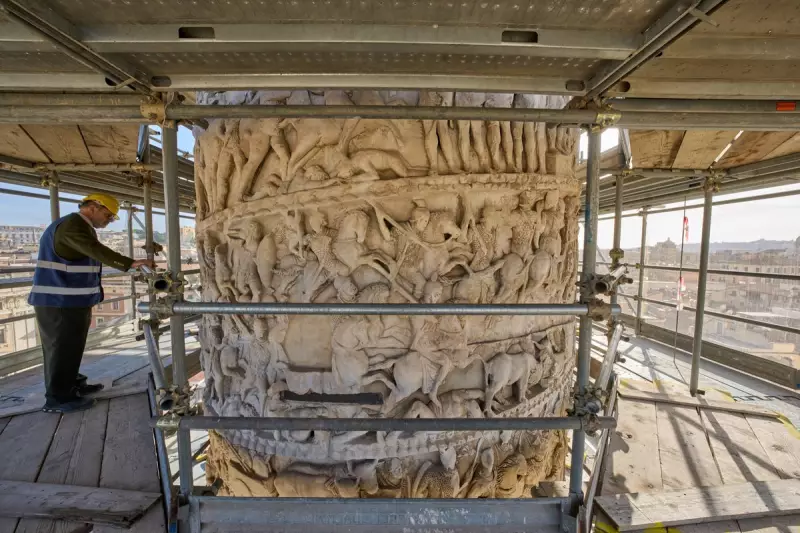
In a landmark project blending ancient history with cutting-edge technology, restorers in Rome have begun the first major cleaning of an iconic Roman monument in over four decades. This time, they have swapped traditional brushes for high-precision lasers.
A High-Tech Clean for a Millennia-Old Monument
Perched on scaffolding high above the Piazza Colonna, a team of specialists is using short-pulse laser beams to meticulously remove decades of accumulated grime, pollution, and biological growth from the Column of Marcus Aurelius. The 47-metre (154-foot) tall marble pillar, constructed between A.D. 180 and 193, stands directly outside the Italian Prime Minister's office.
This marks a significant technological leap from the monument's last restoration in the 1980s, when conservators relied on painstaking manual brushing. Marta Baumgartner, the director of restoration works, explained the advantage of the new method: "The laser gives us an excellent result. It works faster and above all allows a great respect for the material—for the marble and for the surface layers."

Unveiling a Spiral of Ancient Warfare
The column is famed for its intricate spiral relief that vividly recounts the military campaigns of Emperor Marcus Aurelius. As the laser work progresses, startlingly clear scenes of ancient warfare are being revealed. The narrative strip shows:
- Roman soldiers dragging captive women and children by their hair.
- Decapitated enemies lying on battlefields.
- Horses rearing in combat and terrified prisoners with bound necks.
Valentin Nitu, a restorer on the project, described the artistic intent: "It was a way of making the person who looked at it read the story. It really drags the viewer in, seeing it phase by phase, scene by scene with the truly wonderful details." The artists employed a clever perspective technique, making the figures gradually larger towards the top so they would appear correctly proportioned to viewers on the ground.
Challenges and Funding for a Delicate Task
Erecting a major construction site around a fragile, two-thousand-year-old monument presented significant logistical challenges. A custom, wide-square scaffolding system was built to give the team of 18 restorers ample space to work and step back to assess their progress.
In addition to the pioneering lasers, the team uses chemical wraps, sponges, and resin to combat damage from Roman smog and the effects of water freezing in cracks. The monument has suffered erosion, with some engraved faces lost to time.
The €2 million (approximately £1.7 million) restoration is financed by the European post-pandemic recovery fund. The project, which began in April, is scheduled for completion in June and will include a new night-time illumination system to showcase the column after dark.