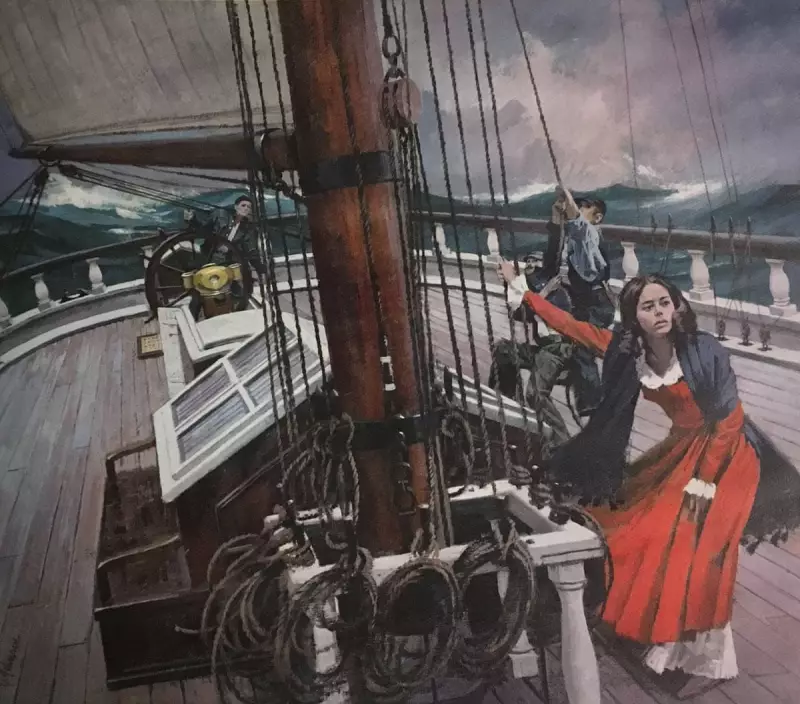
The Unforgettable Voyage of Mary Ann Patten
In the annals of maritime history, few tales are as gripping as that of Mary Ann Patten, a 19-year-old pregnant woman who defied all odds to captain the fast clipper Neptune's Car through treacherous seas. Her story, long overshadowed by time, is now being brought to light in a compelling new book by historian Tilar J Mazzeo, titled To the Edge of the World: A Perilous Storm, A Mutinous Crew and the Woman Who Defied Them All.
A Crisis at Cape Horn
In September 1856, off the coast of Cape Horn, the notoriously hazardous tip of the Tierra del Fuego archipelago, Patten found herself in a dire situation. Her husband, Captain Joshua Patten, had collapsed from tuberculosis, leaving the ship without a leader. With a mutinous crew and a disloyal first mate, William Keeler, locked in leg irons, Patten faced a stark choice: surrender command or take the helm herself. Despite her youth and pregnancy, she chose the latter, drawing on her education at one of the first US schools for working-class children and celestial navigation skills learned from her husband.
Navigating Perilous Waters
Patten's journey was fraught with danger. As Neptune's Car entered the Le Maire strait, described by Mazzeo as "a graveyard of shipwrecks", a terrible gale trapped the ship for days. When Keeler attempted to seize command from his shackles, Patten delivered an impassioned speech to the crew, convincing them to support her. Her determination moved the older sailors to tears, and the crew reportedly applauded her courage. To survive the storm, she made the radical decision to sail to the outer edge of the cyclone, allowing the storm to spit the ship out into safer waters.

Icebergs and Survival
Emerging from the storm, Patten found herself surrounded by icebergs and ice fields off the coast of Antarctica. Unable to stop for fear of freezing, she relied on celestial navigation—using an almanac, watch, and sextant—to pinpoint her location and steer the ship. This skill, which Mazzeo learned to better understand Patten's ordeal, was crucial for their survival. After 10 grueling weeks, Patten arrived in San Francisco Bay with her crew and cargo intact, becoming the first woman to command a merchant clipper ship.
Rediscovering a Heroine
Tilar J Mazzeo, inspired by a reference in an old book left on a boat, embarked on a journey to retrace Patten's route. She sailed 500 miles from Chile to the South Shetland Islands, experiencing the "electric blue" icebergs and unfamiliar Antarctic landscape that Patten would have seen. Mazzeo describes Patten as "quietly heroic", noting that few sea captains of the era could have matched her maritime feat. The story highlights what a woman in the 1850s, given education and opportunity, was capable of achieving, and challenges us to remember such overlooked figures in history.
Legacy and Lessons
Patten's triumph is not just a tale of survival but a testament to resilience and leadership. Her ability to overcome storms, mutiny, and navigational challenges while pregnant underscores her extraordinary character. Mazzeo's book, published on 29 January, aims to restore Patten to her rightful place in seafaring lore, reminding us of the unsung heroes who shaped our past. This narrative serves as an inspiration, showing how courage and skill can defy even the most daunting circumstances.